


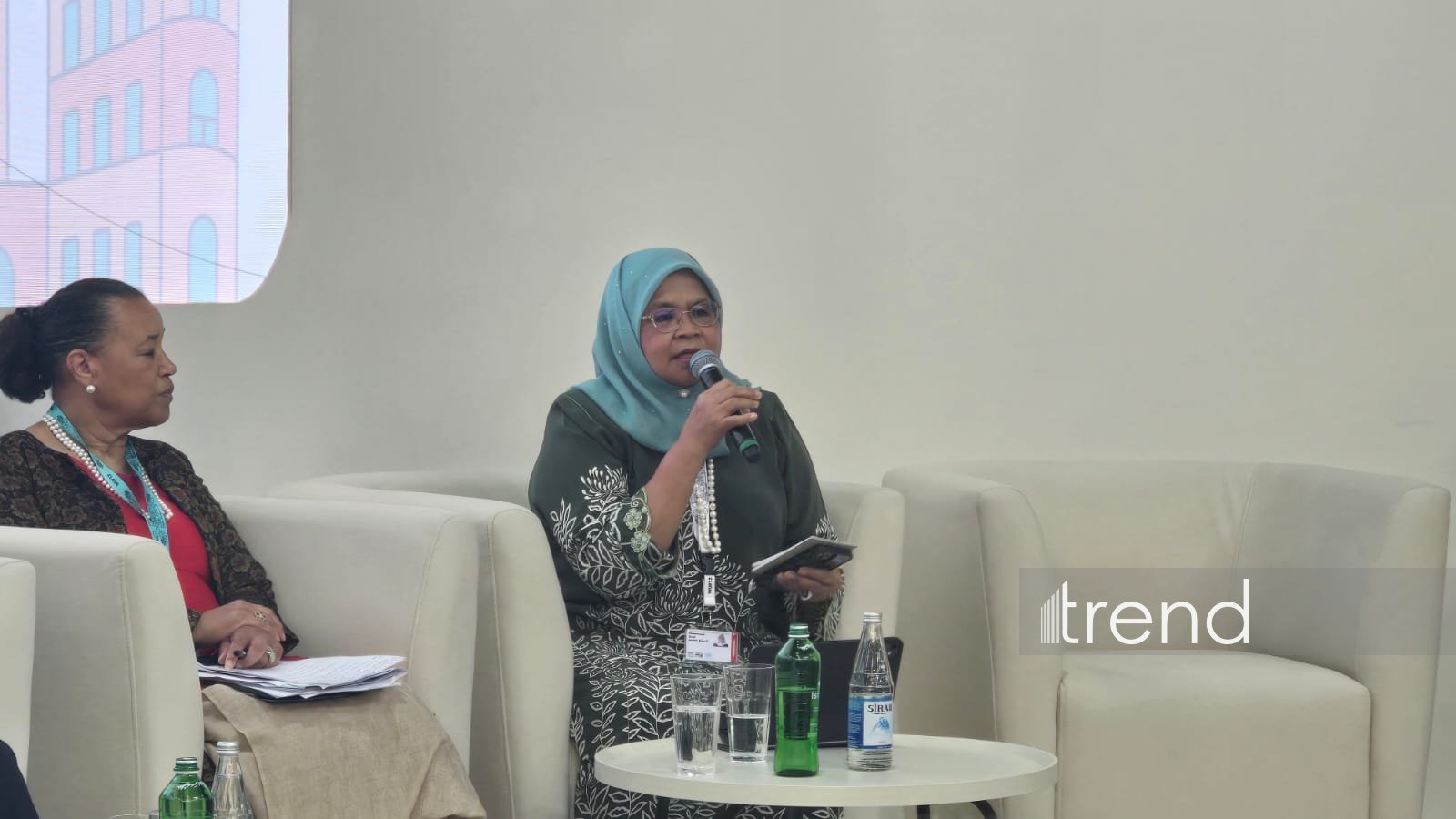

BAKU, Azerbaijan, May 21. Global housing strategies require direct support through specialized, ring-fenced budgets and concrete executive operations to secure actual societal impact, said Maimunah Mohd Sharif, former Mayor of Kuala Lumpur and former Executive Director of the United Nations Human Settlements Programme (UN-Habitat), Trend reports.
She made the remarks during a high-level session titled "Advancing Housing Policy Through Multilateralism: From Global Commitments to Local Impact," held within the framework of the 13th session of the World Urban Forum (WUF13) in Baku.
According to her, deploying global multilateral commitments and international urban agendas at the local level—encompassing both dense metropolitan zones and rural settlements—depends fundamentally on reinforcing vertical and horizontal policy integration layers. Vertical integration requires matching macro-level international policies systematically down to municipal executive units, while horizontal integration demands the structural inclusion of local communities, private enterprise, and civic organizations in strategic decision-making pipelines.
Sharif noted that Malaysia serves as an active model for this integration workflow, where UN Sustainable Development Goal 11 (SDG11) and the New Urban Agenda undergo initial absorption into the nation's five-year master development plans before entering state-level planning frameworks and local municipal operational directives.
"Merely ratifying abstract strategies and policy declarations remains completely insufficient. Their actual execution demands the allocation of concrete fiscal budgets. For instance, within the Kuala Lumpur City Hall municipal budget, 300 million Malaysian Ringgits underwent direct allocation for affordable housing pipelines, alongside an additional 200 million Ringgits dedicated entirely to underpinning micro-entrepreneurs and local traders. To yield tangible, field-level outcomes, policy documents must systematically transform into practical, funded operations. Otherwise, these comprehensive frameworks will function as nothing more than ink on paper," the former executive director emphasized.
According to her, driving the successful implementation of housing policies at national and municipal tiers requires engineering an enabling regulatory environment and structuring financial incentives that maximize capital deployment from private institutional investors and international financial institutions (IFIs).
She directed focus toward the critical application of the expanded "4P" partnership framework linking the public sector, private industry, and local populations.
"We must move past the conventional, restricted scope of standard Public-Private Partnerships (PPPs). Modern urban governance requires an evolved architecture: a Public-Private-People Partnership model. Embedding localized grassroots communities directly into these development loops operates as a non-negotiable prerequisite for sustainable operational success," Sharif explained.
The former UN-Habitat head added that cultivating specialized affordable housing institutions, securing high-tier executive leadership, building deep professional human capital pools, and maintaining absolute transparency in public management serve as the foundational pillars of resilient urban evolution.
Sharif called upon delegates to utilize future World Urban Forums as data-driven clearinghouses to showcase highly scalable, successful municipal practices.
"We must halt unnecessary institutional workflows aimed at re-inventing entirely new models for identical systemic urban bottlenecks every single cycle. Our collective focus must center on sharing empirical success stories, cross-analyzing data performance, and precision-adapting proven global workflows to match the distinct spatial and demographic features of our respective home cities," she concluded.
Today marks the fifth day of WUF13 in Baku.
The first day included a ministerial meeting dedicated to the New Urban Agenda, a ministerial roundtable, assemblies for women and civil society, business sessions, and discussions on urban prosperity. An official ceremony marking the raising of the UN and Azerbaijani flags also took place.
The second day stood out for the inaugural Leaders' Summit, featuring high-level discussions on the global housing crisis, urbanization policy, and urban resilience. Concurrently, the opening of the Mexico City pavilion took place, serving as a significant platform for expanding cooperation with the Latin American region and preparing for WUF14.
The third day of WUF13 featured a comprehensive program of events covering the global housing crisis, the formation of safe and inclusive cities, climate resilience, artificial intelligence and urban governance, green urbanization, social equity, and sustainable transport.
One of the highlights of the third day was the signing of a sister-city memorandum between the Azerbaijani city of Shusha and the Turkish city of Trabzon.
The fourth day of WUF13 featured a broad program of events dedicated to urbanization, climate change, inclusive urban development, housing policy, and sustainable governance.
One of the important events of the UN Special Programme for the Economies of Central Asia (SPECA) Cities Forum, held on the fourth day, was the announcement of Almaty’s official accession to the “Declaration of Intent on the Establishment of the SPECA Smart Climate-Resilient Cities Forum.”
Also, for the first time in WUF history and at Azerbaijan’s initiative, the “WUF13 NGO Forum: Global Partnership and Decision-Making” was held.
WUF13, which has attracted more than 40,000 registered participants from 182 countries, will continue until May 22. Held under the theme “Housing the world: Safe and resilient cities and communities,” the forum brings together governments, international organizations, experts, and representatives of civil society to strengthen global cooperation in the field of sustainable urban development.



