


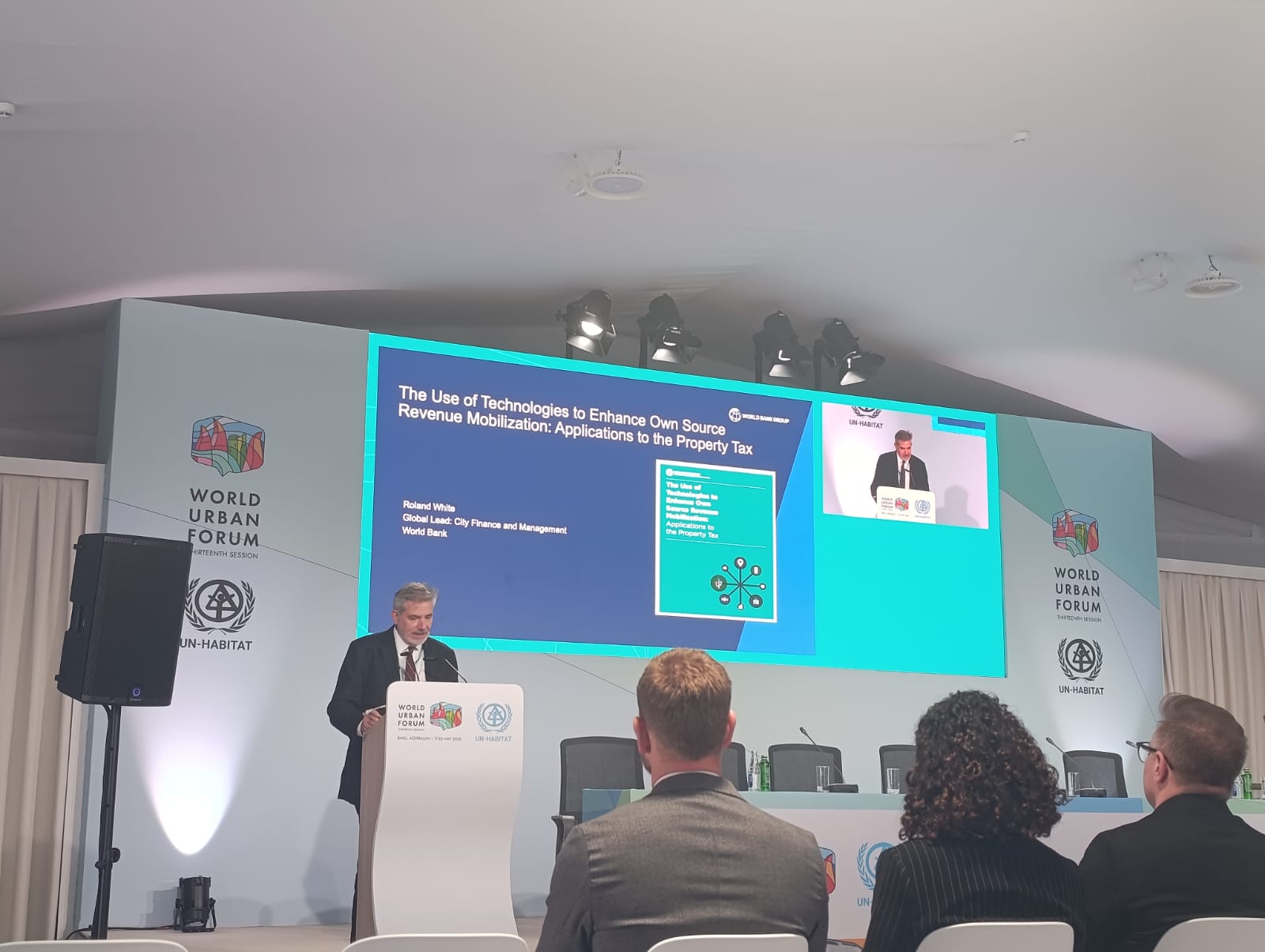
BAKU, Azerbaijan, May 21. Transitioning to more advanced technologies is possible, but their mere existence does not mean they should be implemented immediately. Roland White made the remarks during an event titled “Beyond External Financing: Can Cities Increase Their Own Revenues While Also Addressing Housing Challenges?” Trend reports.
According to him, the process must begin with defining the objective and overall strategy before making any technological choices. “Only after that can you make the right technology decisions. One important choice, for example, concerns property taxation. Suppose you have an area-based system. Such systems generally work reasonably well, but ultimately they are less effective and less fair than ad valorem systems, which are based on value rather than broad categories and ranges,” he said.
White noted that a key question is whether cities plan to transition from area-based taxation to value-based systems.
“To move to an ad valorem system, you need market data. You can have the best technology in the world, but without high-quality market data feeding the system, you still cannot accurately assess property,” he said.
He stressed that in some cases it may make more sense to retain existing systems or improve them only incrementally.
“At some point, transitioning to more advanced technologies may be justified. But the mere existence of a smarter technological solution does not mean it should be adopted immediately,” he added.
Today marks the fifth day of WUF13 in Baku.
The first day included a ministerial meeting dedicated to the New Urban Agenda, a ministerial roundtable, assemblies for women and civil society, business sessions, and discussions on urban prosperity. An official ceremony marking the raising of the UN and Azerbaijani flags also took place.
The second day stood out for the inaugural Leaders' Summit, featuring high-level discussions on the global housing crisis, urbanization policy, and urban resilience. Concurrently, the opening of the Mexico City pavilion took place, serving as a significant platform for expanding cooperation with the Latin American region and preparing for WUF14.
The third day of WUF13 featured a comprehensive program of events covering the global housing crisis, the formation of safe and inclusive cities, climate resilience, artificial intelligence and urban governance, green urbanization, social equity, and sustainable transport.
One of the highlights of the third day was the signing of a sister-city memorandum between the Azerbaijani city of Shusha and the Turkish city of Trabzon.
The fourth day of WUF13 featured a broad program of events dedicated to urbanization, climate change, inclusive urban development, housing policy, and sustainable governance.
One of the important events of the UN Special Programme for the Economies of Central Asia (SPECA) Cities Forum, held on the fourth day, was the announcement of Almaty’s official accession to the “Declaration of Intent on the Establishment of the SPECA Smart Climate-Resilient Cities Forum.”
Also, for the first time in WUF history and at Azerbaijan’s initiative, the “WUF13 NGO Forum: Global Partnership and Decision-Making” was held.
WUF13, which has attracted more than 40,000 registered participants from 182 countries, will continue until May 22. Held under the theme “Housing the world: Safe and resilient cities and communities,” the forum brings together governments, international organizations, experts, and representatives of civil society to strengthen global cooperation in the field of sustainable urban development.



