


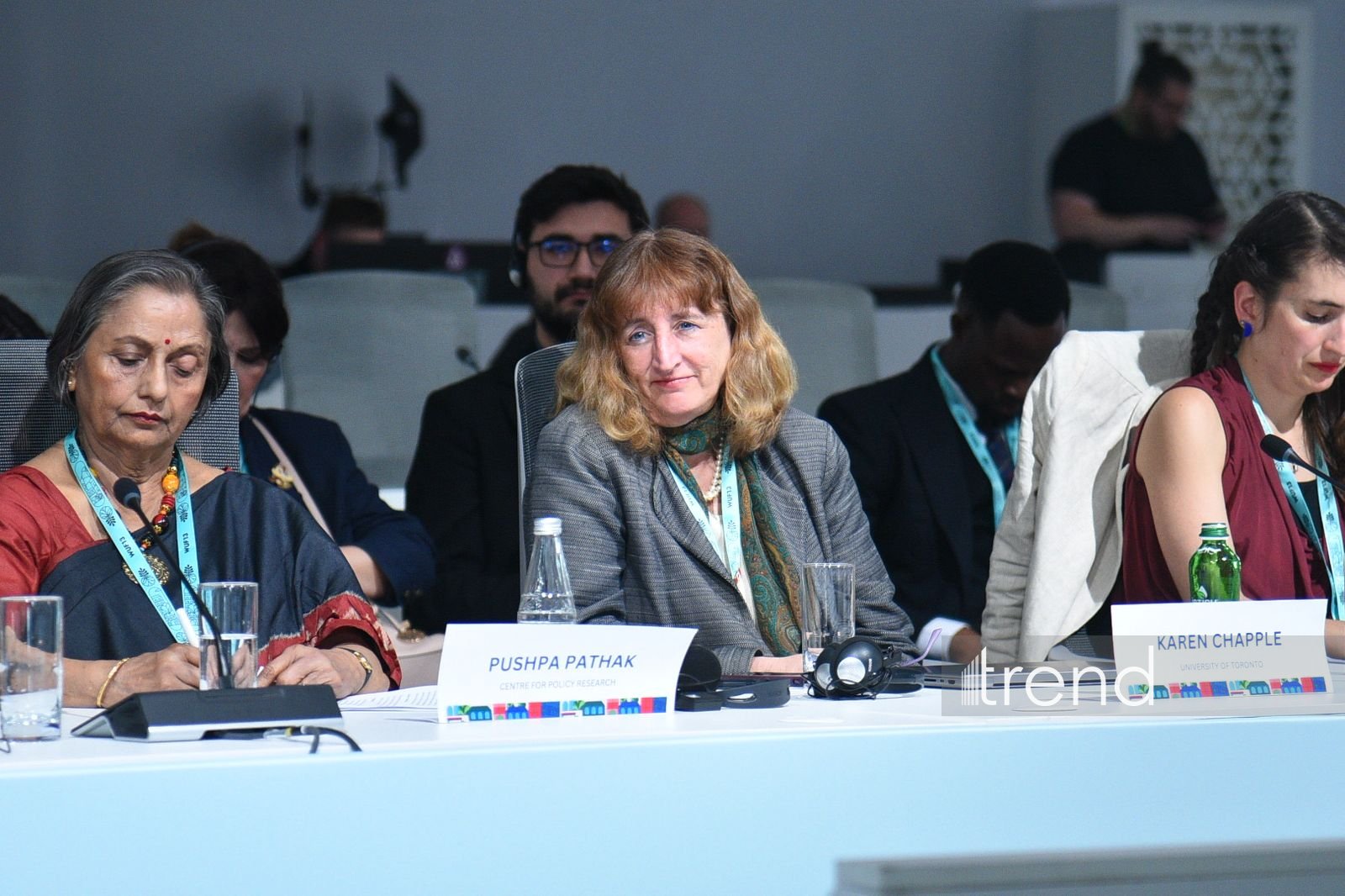

BAKU, Azerbaijan, May 21. Universities and research centers should accelerate the transfer of scientific findings to society and define research agendas based on people’s real needs. Karen Chapple made the remarks during an international roundtable on “Education and Professional Training” held within the framework of the 13th session of the UN World Urban Forum (WUF13) in Baku, Trend reports.
She said that turning academic research into practical outcomes often takes a long time. “From preparing grant applications to field research, writing academic papers, and publishing in peer-reviewed journals, it can take up to five years. After that, only a small portion reaches the public. Meanwhile, people absorb and use information much more quickly,” she emphasized.
Chapple stressed the need to strengthen links between universities and local communities.
“We have not fully used the opportunity to shape research questions based on societal needs. In most cases, research is conducted first, and only afterward its relevance to people is assessed. This approach needs to change,” she said.
She noted that her “School of Cities” center operates based on this principle.
According to her, the “Downtown Recovery” project, which tracks the revitalization of city centers, analyzed urban development dynamics across North America and Europe using mobile phone data.
The project attracted wide international media attention, helping identify what issues people are most interested in.
“People were particularly interested in which economic models are more resilient and how public transport systems recover after crises. We then directed our subsequent research toward answering these questions,” she said.
Chapple added that in the modern era, academic publishing alone is not enough to reach broad audiences.
“We use maps, data visualization, videos, policy briefs, and short analytical reports. Our research is shared on platforms such as Reddit, TikTok, LinkedIn, and Instagram, and our database receives over one million views annually,” she said.
She also emphasized the importance of training programs that teach the practical use of new tools and digital platforms.
“These trainings should not be limited to university students, but should also include peer-learning programs that promote knowledge exchange between cities and institutions. Universities can play a key role in advancing institutional cooperation,” she added.
Today marks the fifth day of WUF13 in Baku.
The first day included a ministerial meeting dedicated to the New Urban Agenda, a ministerial roundtable, assemblies for women and civil society, business sessions, and discussions on urban prosperity. An official ceremony marking the raising of the UN and Azerbaijani flags also took place.
The second day stood out for the inaugural Leaders' Summit, featuring high-level discussions on the global housing crisis, urbanization policy, and urban resilience. Concurrently, the opening of the Mexico City pavilion took place, serving as a significant platform for expanding cooperation with the Latin American region and preparing for WUF14.
The third day of WUF13 featured a comprehensive program of events covering the global housing crisis, the formation of safe and inclusive cities, climate resilience, artificial intelligence and urban governance, green urbanization, social equity, and sustainable transport.
One of the highlights of the third day was the signing of a sister-city memorandum between the Azerbaijani city of Shusha and the Turkish city of Trabzon.
The fourth day of WUF13 featured a broad program of events dedicated to urbanization, climate change, inclusive urban development, housing policy, and sustainable governance.
One of the important events of the UN Special Programme for the Economies of Central Asia (SPECA) Cities Forum, held on the fourth day, was the announcement of Almaty’s official accession to the “Declaration of Intent on the Establishment of the SPECA Smart Climate-Resilient Cities Forum.”
Also, for the first time in WUF history and at Azerbaijan’s initiative, the “WUF13 NGO Forum: Global Partnership and Decision-Making” was held.
WUF13, which has attracted more than 40,000 registered participants from 182 countries, will continue until May 22. Held under the theme “Housing the world: Safe and resilient cities and communities,” the forum brings together governments, international organizations, experts, and representatives of civil society to strengthen global cooperation in the field of sustainable urban development.



