


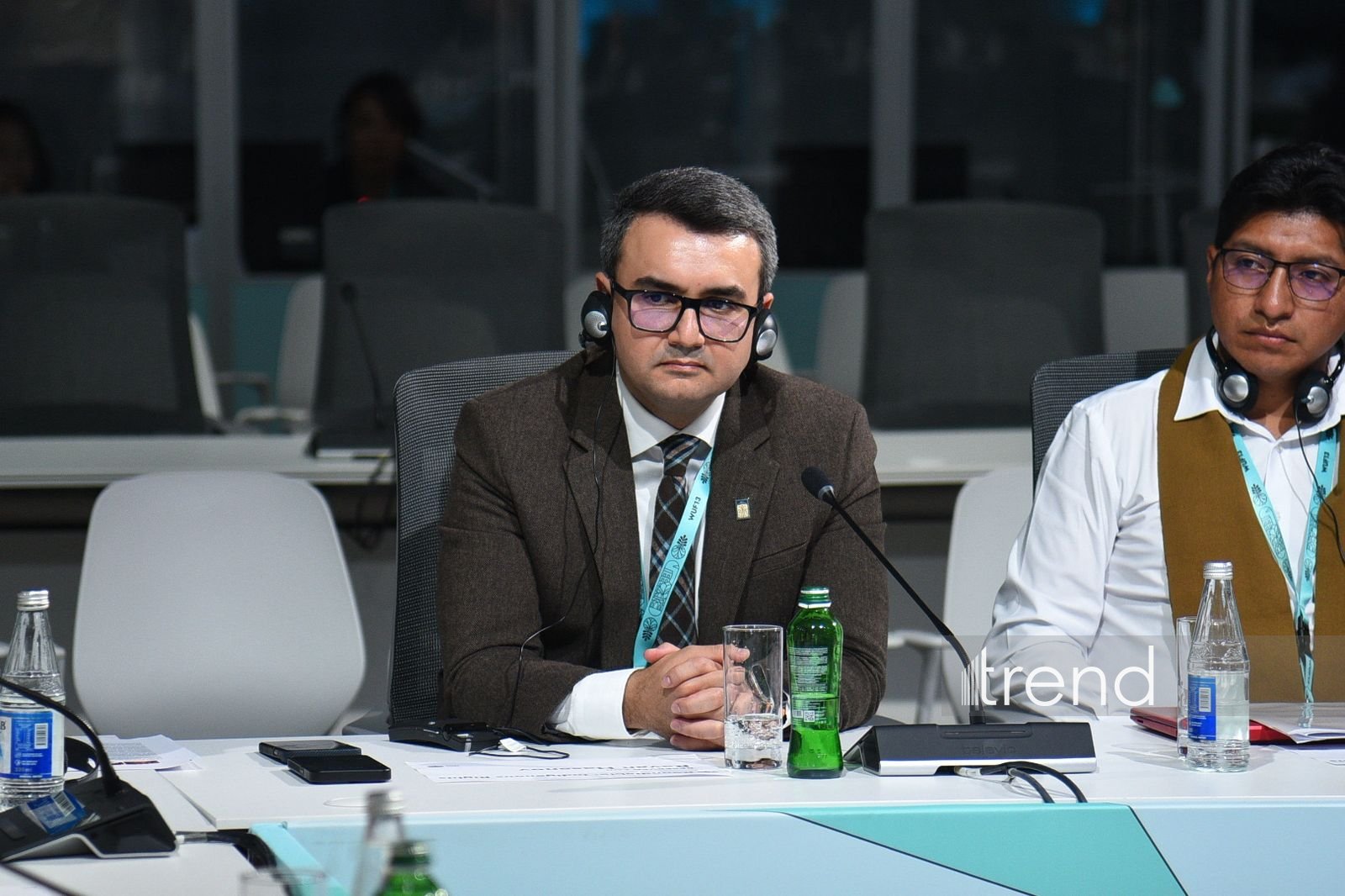
BAKU, Azerbaijan, May 22. Cities of the future must be places with more respect for all cultures, Executive Director of the Baku International Multiculturalism Center, Ravan Hasanov, said at the roundtable event on "Indigenous Peoples' Rights" held in Baku as part of WUF13, Trend reports.
According to him, the knowledge and experiences of indigenous peoples are not a legacy of the past, but an important resource for solving the problems of today and the future.
He noted that such discussion platforms are important not only for exchanging ideas, but also for solving real problems and developing cooperation.
"I believe that these round tables will help us make decisions to solve real problems. The goal is not only to listen to each other, but also to develop our cooperation and support each other," he pointed out.
Hasanov emphasized that the cities of the future should be more modern, more efficient, and more respectful of all cultures.
According to him, the approaches of indigenous peoples are an important example in terms of sustainable development.
"Indigenous peoples' attitude towards land is not based on ownership, but on the principle of protecting and sharing it. This way of thinking is of great importance, especially in an era of increasing climate change and environmental problems. They respect natural resources and make decisions taking into account the interests of the community. This is the development model we need in the world today," he explained.
The executive director highlighted that although the term "indigenous peoples" is not used in Azerbaijan, the country has a rich ethnic, religious, and cultural diversity that has been formed over centuries.
"Representatives of more than 30 nations live together in Azerbaijan with different languages, cultures, and beliefs. Multiculturalism, mutual understanding, and peaceful coexistence are our reality. This is not only our way of life, but also state policy," he said.
According to Hasanov, there are important similarities between the policy of multiculturalism and the integration of local communities into society.
"Both approaches are based on the principles of recognition, participation, and mutual learning from different knowledge. We attach great importance to this policy," he stressed.
He added that Azerbaijan is trying to bring together the principles of modernity, innovation, and diversity in the reconstruction process in the liberated Karabakh region.
"Cities for us are not just stones, buildings, or infrastructure. We protect cultural heritage, places of religious worship, historical monuments, and the heritage of all peoples living in Azerbaijan. This approach shows that the state attaches equal value to all heritage and serves to strengthen social solidarity in society," he noted.
As Hasanov also said, the experience of local peoples reminds that development is not only a movement forward, but also a commitment to roots, history, and culture.
"Over the past few days, we have learned a lot from each other, we have become acquainted with different points of view. I believe that Baku will continue to be an important platform where people come together and lay the foundation for new cooperation," he added.
Today marks the final day of the 13th session of the World Urban Forum (WUF13).
The first day included a ministerial meeting dedicated to the New Urban Agenda, a ministerial roundtable, assemblies for women and civil society, business sessions, and discussions on urban prosperity. An official ceremony marking the raising of the UN and Azerbaijani flags also took place.
The second day stood out for the inaugural Leaders' Summit, featuring high-level discussions on the global housing crisis, urbanization policy, and urban resilience. Concurrently, the opening of the Mexico City pavilion took place, serving as a significant platform for expanding cooperation with the Latin American region and preparing for WUF14.
The third day of WUF13 featured a comprehensive program of events covering the global housing crisis, the formation of safe and inclusive cities, climate resilience, artificial intelligence and urban governance, green urbanization, social equity, and sustainable transport.
One of the highlights of the third day was the signing of a sister-city memorandum between the Azerbaijani city of Shusha and the Turkish city of Trabzon.
The fourth day of WUF13 featured a broad program of events dedicated to urbanization, climate change, inclusive urban development, housing policy, and sustainable governance.
The fifth day of WUF13 continued discussions on the global housing crisis, the creation of safe and inclusive cities, climate resilience, the use of artificial intelligence in urban management, green urbanization, and social equality.
One of the important events of the UN Special Programme for the Economies of Central Asia (SPECA) Cities Forum, held on the fourth day, was the announcement of Almaty’s official accession to the “Declaration of Intent on the Establishment of the SPECA Smart Climate-Resilient Cities Forum.”
Also, for the first time in WUF history and at Azerbaijan’s initiative, the “WUF13 NGO Forum: Global Partnership and Decision-Making” was held.
WUF13, which has attracted more than 40,000 registered participants from 182 countries, will continue until May 22. Held under the theme “Housing the world: Safe and resilient cities and communities,” the forum brings together governments, international organizations, experts, and representatives of civil society to strengthen global cooperation in the field of sustainable urban development.



