


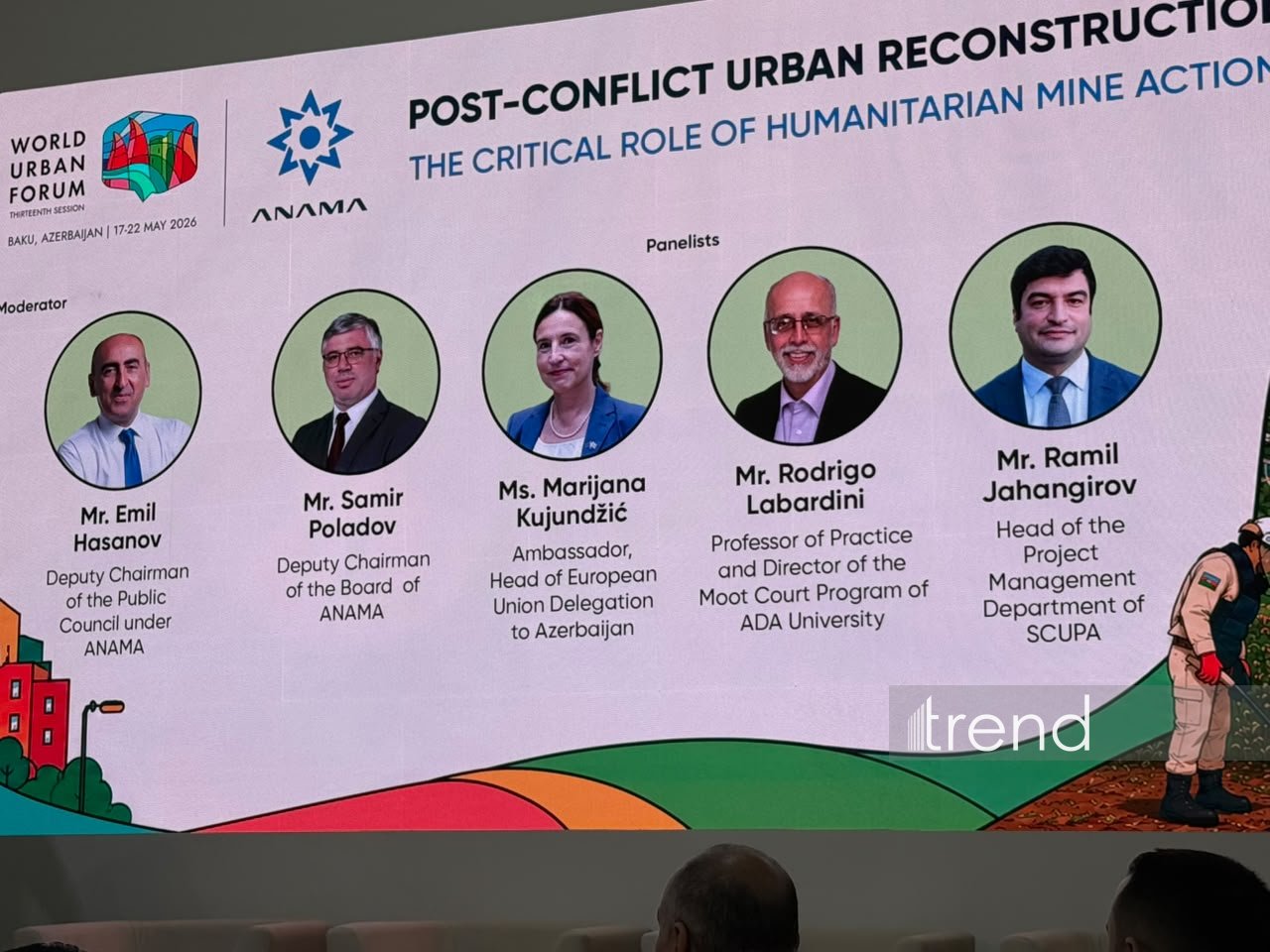

BAKU, Azerbaijan, May 22. The Azerbaijan National Agency for Mine Action (ANAMA) has held a side event on the topic “Post-Conflict Urban Reconstruction: The Critical Role of Humanitarian Mine Action” as part of the 13th Session of the World Urban Forum (WUF13), one of the most prestigious events of the United Nations, hosted by the country, Trend reports.
The event, organized at the Azerbaijani pavilion, brought together representatives of state agencies and international organizations to bring the mine problem facing our country to the attention of the international community, highlight the impact of the mine threat on the recovery and reconstruction process, as well as discuss global cooperation and recovery practices in the field of mine action.
Delivering his opening speech at the event, ANAMA Board Chairman Vugar Suleymanov stated that mine clearance isn't only a humanitarian activity that saves lives, but also the main basis for recovery and reconstruction. This activity creates the necessary conditions for the reconstruction of housing, infrastructure restoration, agricultural revival, development of transport networks, and revival of economic activity. Within the framework of the "Great Return" Program, mine clearance activities are fully integrated into urban planning, reconstruction, and development processes.
He emphasized that the mine threat slows down the recovery process not only in Azerbaijan, but also in a number of countries around the world, limits development opportunities, and puts the safety of the population at risk. That is why today's platform is of particular importance. Eliminating the mine problem is not limited to national efforts, but requires continuous international support, partnership, innovative approaches, and sharing of best practices.
The panel discussions, moderated by Deputy Chairman of the Public Council under ANAMA, Emil Hasanov, included Deputy Chairman of the Board of Directors of ANAMA, Samir Poladov, Head of the European Union Delegation to Azerbaijan, Ambassador Marijana Kujundzic, Professor of ADA University, former Ambassador Extraordinary and Plenipotentiary of Mexico to Azerbaijan, Rodrigo Labardini, and Head of the Project Management Department of the State Committee for Urban Planning and Architecture of Azerbaijan, Ramil Jahangirov.
Panel discussions were held on the topics of mine action as a basis for urban reconstruction and the Azerbaijani experience, international cooperation to support post-conflict recovery and reconstruction, and urban development and reconstruction in mine-cleared areas.
The side event highlighted the strategic importance of humanitarian mine action in rebuilding safe and inclusive cities in the post-conflict period.
Today marks the final day of the 13th session of the World Urban Forum (WUF13).
The first day included a ministerial meeting dedicated to the New Urban Agenda, a ministerial roundtable, assemblies for women and civil society, business sessions, and discussions on urban prosperity. An official ceremony marking the raising of the UN and Azerbaijani flags also took place.
The second day stood out for the inaugural Leaders' Summit, featuring high-level discussions on the global housing crisis, urbanization policy, and urban resilience. Concurrently, the opening of the Mexico City pavilion took place, serving as a significant platform for expanding cooperation with the Latin American region and preparing for WUF14.
The third day of WUF13 featured a comprehensive program of events covering the global housing crisis, the formation of safe and inclusive cities, climate resilience, artificial intelligence and urban governance, green urbanization, social equity, and sustainable transport.
One of the highlights of the third day was the signing of a sister-city memorandum between the Azerbaijani city of Shusha and the Turkish city of Trabzon.
The fourth day of WUF13 featured a broad program of events dedicated to urbanization, climate change, inclusive urban development, housing policy, and sustainable governance.
The fifth day of WUF13 continued discussions on the global housing crisis, the creation of safe and inclusive cities, climate resilience, the use of artificial intelligence in urban management, green urbanization, and social equality.
One of the important events of the UN Special Program for the Economies of Central Asia (SPECA) Cities Forum, held on the fourth day, was the announcement of Almaty’s official accession to the “Declaration of Intent on the Establishment of the SPECA Smart Climate-Resilient Cities Forum.”
Also, for the first time in WUF history and at Azerbaijan’s initiative, the “WUF13 NGO Forum: Global Partnership and Decision-Making” was held.
WUF13, which has attracted more than 40,000 registered participants from 182 countries, will continue until May 22. Held under the theme “Housing the world: Safe and resilient cities and communities,” the forum brings together governments, international organizations, experts, and representatives of civil society to strengthen global cooperation in the field of sustainable urban development.



