


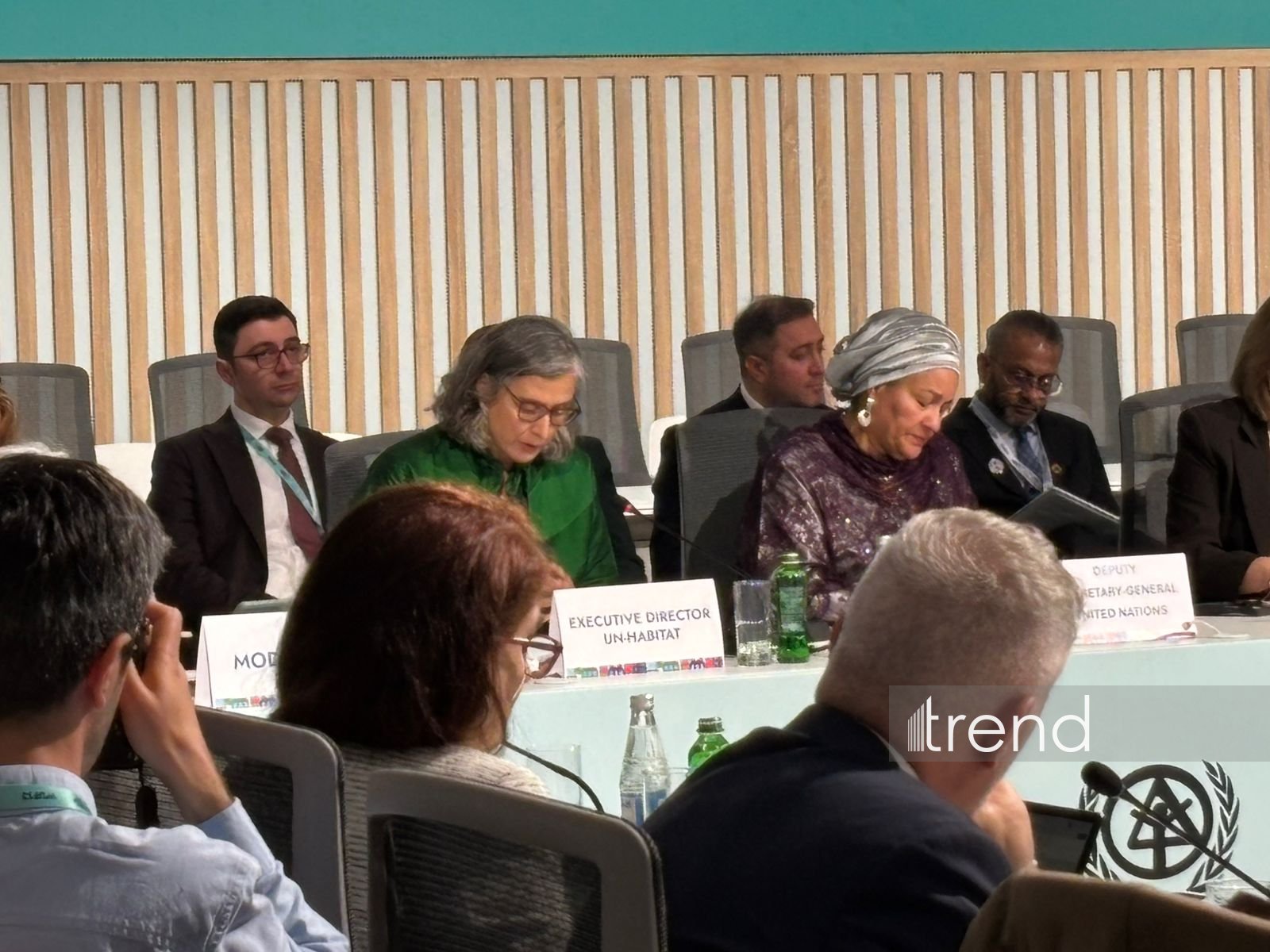
BAKU, Azerbaijan, May 22. Women face systemic barriers to accessing adequate housing, Executive Director of the United Nations Human Settlements Program (UN-Habitat), Anacláudia Rossbach said, Trend reports.
She made the statement at the “Women’s Roundtable” session held as part of the 13th World Urban Forum (WUF13) in Baku.
According to her, billions of people worldwide live in inadequate housing conditions, with women being the most affected by the crisis and facing additional barriers to housing access, including discriminatory inheritance and property laws, as well as limited access to land and credit.
She noted that the consequences of a lack of adequate housing exacerbate risks for women, including vulnerability to violence, especially in crisis situations.
Rossbach also emphasized that gender-neutral policies may, in practice, fail to address real inequalities and do not always reach the most vulnerable groups of women.
Furthermore, Anacláudia Rossbach stated that women’s participation in decision-making is a key condition for ensuring adequate housing, and multi-level governance mechanisms that ensure the participation of women and girls are also important.
She added that there remains a significant gap between international commitments and their implementation at the national level, as well as a lack of gender-disaggregated data in the field of housing policy.
At the end of the discussions, as Rossbach noted, the proposals will be included in the final document of WUF13 - the Baku Call to Action.
Meanwhile, today Baku is hosting the final day of WUF13.
On the first day of the forum, a ministerial meeting on the New Urban Agenda, a ministerial roundtable, women’s and civil society assemblies, business sessions, and discussions on urban well-being took place. The forum also featured a flag-raising ceremony for the UN and Azerbaijan.
The second day of the forum was marked by the first-ever Leaders’ Summit. On this day, high-level discussions were held on the global housing crisis, urbanization policy, and urban sustainability. Also, as part of WUF13, the Mexico City pavilion was inaugurated, presented as a key platform for expanding cooperation with the Latin American region and preparing for WUF14.
The third day of WUF13 was also marked by an extensive program of events. Discussions on this day covered topics such as the global housing crisis, the creation of safe and inclusive cities, climate resilience, artificial intelligence and urban governance, “green” urbanization, social equality, and sustainable transportation.
One of the highlights of the third day was the signing of a sister-city agreement between the Azerbaijani city of Shusha and the Turkish city of Trabzon.
The fourth day of WUF13 featured an extensive program of events dedicated to the themes of urbanization, climate change, inclusive urban development, housing policy, and sustainable management.
On the fifth day of the forum, discussions continued on the global housing crisis, the creation of safe and inclusive cities, climate resilience, the use of artificial intelligence in urban management, “green” urbanization, and social equality.
One of the key events of the Cities Forum of the United Nations Special Program for the Economies of Central Asia (SPECA), held on the fourth day, was the announcement of Almaty’s official accession to the “Declaration of Intent on the Establishment of the SPECA Forum on Smart Cities Resilient to Climate Change.”
Also, for the first time in WUF history, the “WUF13 NGO Forum: Global Partnership and Decision-Making” was held at the initiative of Azerbaijan.
The WUF13 Forum, dedicated to the theme “Housing the world: Safe and resilient cities and communities", brought together governments, international organizations, experts, and civil society representatives to strengthen global cooperation in the field of sustainable urban development. More than 40,000 people from 182 countries registered to participate in the forum.



