


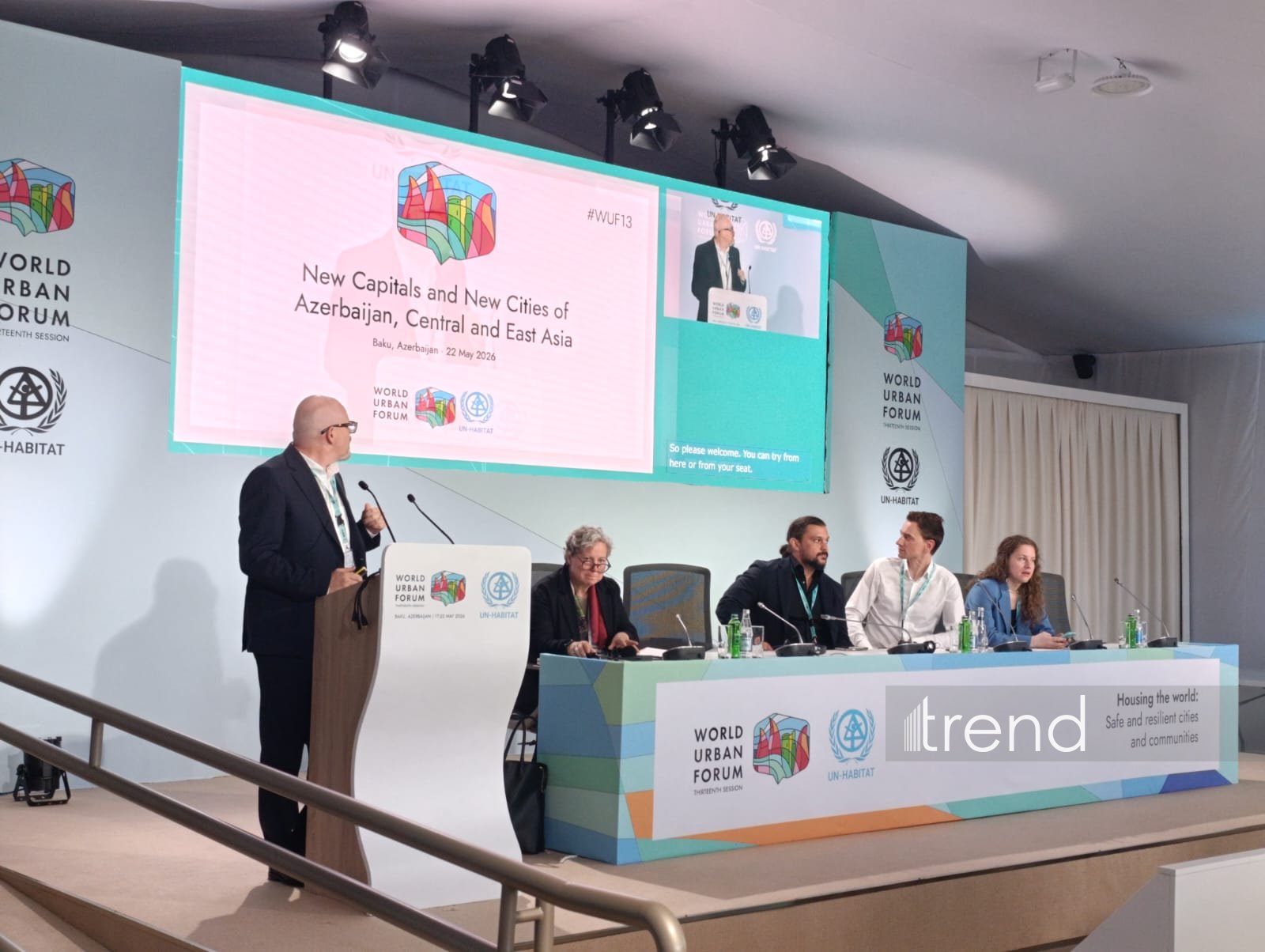
BAKU, Azerbaijan, May 22. As part of the 13th session of the World Urban Forum (WUF13), a panel discussion has been held on the topic "New Capitals and New Cities of Central Asia. Water-Sensitive Urban Planning and Housing for Climate Resilience," Trend reports.
During the session, participants discussed how developing capitals and newly planned cities, such as Astana (Kazakhstan), New Tashkent (Uzbekistan), the city of Alatau (Kazakhstan), Arkdag and Ashgabat (Turkmenistan), the Altai residential complex in Bishkek (Kyrgyzstan), and New Karakorum (Mongolia), are incorporating the principles of water-efficient urban planning into master plans, housing strategies, infrastructure systems, and management systems.
Particular attention has been paid to innovative planning approaches, nature-based solutions, sustainable housing typologies, and decentralized water supply systems.
Experts also presented policy tools that place water security and climate-resilient solutions at the core of expanding housing supply, while promoting inclusive and sustainable urban development.
The session aims to develop practical policy recommendations relevant to cities worldwide facing similar water and climate constraints, as well as to promote international knowledge exchange and South-South cooperation.
Today marks the final day of the 13th session of the World Urban Forum (WUF13).
The first day included a ministerial meeting dedicated to the New Urban Agenda, a ministerial roundtable, assemblies for women and civil society, business sessions, and discussions on urban prosperity. An official ceremony marking the raising of the UN and Azerbaijani flags also took place.
The second day stood out for the inaugural Leaders' Summit, featuring high-level discussions on the global housing crisis, urbanization policy, and urban resilience. Concurrently, the opening of the Mexico City pavilion took place, serving as a significant platform for expanding cooperation with the Latin American region and preparing for WUF14.
The third day of WUF13 featured a comprehensive program of events covering the global housing crisis, the formation of safe and inclusive cities, climate resilience, artificial intelligence and urban governance, green urbanization, social equity, and sustainable transport.
One of the highlights of the third day was the signing of a sister-city memorandum between the Azerbaijani city of Shusha and the Turkish city of Trabzon.
The fourth day of WUF13 featured a broad program of events dedicated to urbanization, climate change, inclusive urban development, housing policy, and sustainable governance.
The fifth day of WUF13 continued discussions on the global housing crisis, the creation of safe and inclusive cities, climate resilience, the use of artificial intelligence in urban management, green urbanization, and social equality.
One of the important events of the UN Special Program for the Economies of Central Asia (SPECA) Cities Forum, held on the fourth day, was the announcement of Almaty’s official accession to the “Declaration of Intent on the Establishment of the SPECA Smart Climate-Resilient Cities Forum.”
Also, for the first time in WUF history and at Azerbaijan’s initiative, the “WUF13 NGO Forum: Global Partnership and Decision-Making” was held.
WUF13, which has attracted more than 40,000 registered participants from 182 countries, will continue until May 22. Held under the theme “Housing the world: Safe and resilient cities and communities,” the forum brings together governments, international organizations, experts, and representatives of civil society to strengthen global cooperation in the field of sustainable urban development.



