



BAKU, Azerbaijan, April 7. European policy on migration has long turned into a grand theater of hypocrisy, where the scenery changes at dizzying speed, and the principles once proclaimed sacred manage to rot before they even make it onto the stage.
Only yesterday, Brussels, wearing the face of a high-minded preacher, lectured the entire world about human rights, human dignity, humanism, and the inadmissibility of any discrimination. Today, that same Brussels, with businesslike haste, accelerates deportation procedures, expands the grounds for detaining people in closed centers, and constructs a system in which a person without the proper status ceases to be a subject of law and becomes an object of administrative disposal.
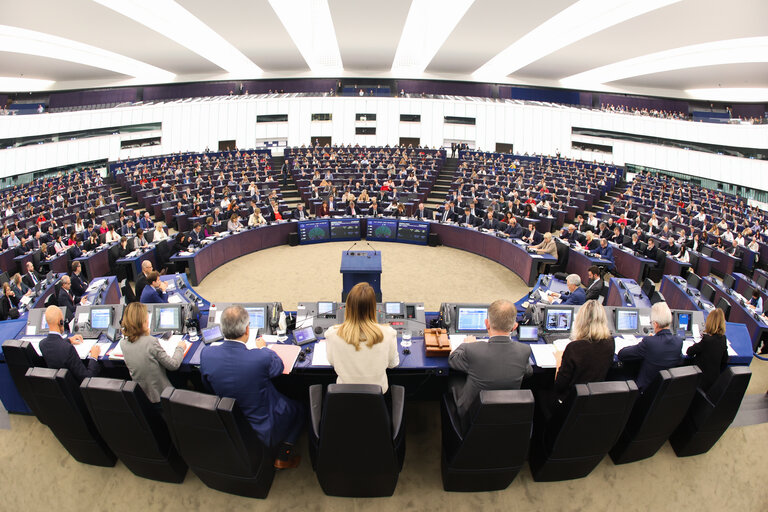
The European Parliament has supported advancing a new regulation on the return of irregular migrants: 389 deputies voted “for,” 206 “against,” and 32 abstained. This represents a clear course toward tightening deportation procedures across the entire European Union.
The essence of what is happening is perfectly clear. Europe is not solving a problem that it itself has carefully cultivated and nourished for years - it is trying to hide it behind the barbed wire of bureaucratic formulations. The new approach suggests faster decisions on expulsions, broader use of detention mechanisms, increased pressure on those required to leave EU territory, and the creation of a system in which a deportation decision made in one country is more easily and quickly enforced in another. So-called external return centers are also being discussed - essentially shifting the dirtiest part of migration policy beyond its own borders so that European voters do not see the consequences of the policies their own governments have pursued for decades.
What makes all this particularly repulsive is the moral tone with which Europe loves to lecture others. The moment some country disliked by Brussels takes a tough step on security, borders, or controlling irregular migration, the familiar record immediately starts playing: humanism, proportionality, international obligations, human rights. But when the same problem affects Europe itself, it suddenly turns out that accelerated procedures are perfectly acceptable, prolonged detention is possible, and outsourcing the process to third countries no longer seems so monstrous. There is one law in Europe, it seems, but fundamentally different modes of its application: moralizing for others, exceptions, tricks, and self-justification for itself.
The migration crisis, by the way, did not fall on Europe out of a clear blue sky. For decades, the continent itself participated in the destruction of entire regions - directly, indirectly, through allied military campaigns, through reckless foreign policy, through support of dubious regimes, through economic schemes that drained peripheral regions and pushed people out of their own countries. And then those same people began moving toward European borders, and Europe pretended it had nothing to do with the origins of that flow. Such a position is convenient, but revoltingly false.
It is enough to recall 2015, when the number of first-time asylum applications in the EU exceeded 1.25 million. At that time, European elites still tried to maintain the appearance of humanitarian virtue. By March 2016, the EU–Turkey agreement followed: those arriving irregularly on the Greek islands began to be sent back, and the EU effectively outsourced a significant part of the problem beyond its borders. Humanism ended exactly where political panic began. Since then, this approach has only been refined: buffer zones, external partners, transit states, sanitary cordons. Europe did not solve the issue - it pushed it further away.
The numbers, by the way, do not confirm the hysteria that many European politicians are fueling today. According to Frontex, in 2025 the number of detected irregular crossings of the EU’s external borders fell by 26 percent - to around 178,000. This is the lowest level since 2021. In the first two months of 2026, the drop was already 52 percent compared to the same period last year. The flow is not growing like an avalanche, as they try to convince a frightened electorate. What is growing is something else entirely - the political profit from fear. Migration has long become a convenient marketplace of emotions for European parties, where anxiety, irritation, and cultural insecurity are traded.
Against this background, the handling of the Muslim issue looks especially dirty. Europe first told beautiful stories about multiculturalism, harmonious coexistence, and how all differences could easily be integrated into a unified civic space. Later it turned out that behind this polished facade there had been accumulating failures of integration, radicalization of certain groups, and the cowardice of elites who preferred either to remain silent or to respond with nervous suspicion toward everyone. As a result, an ordinary Muslim in many European countries has found themselves caught between two millstones: on one side, radicals exploiting religion; on the other, a state and society increasingly viewing them as a potential problem.
In 2024, the EU Agency for Fundamental Rights recorded that 47 percent of Muslims in 13 EU countries had faced racial discrimination over the past five years. In 2016, that figure was 39 percent. At the same time, only 6 percent of incidents, according to the same study, reach official institutions. These figures are devastatingly precise. Behind them is not abstract sociology, but a lived atmosphere. A person encounters humiliation at school, in the labor market, in daily life, in dealings with officials, police, employers. And then European politicians innocently ask: why is integration stalling? It stalls because integration cannot be built on hidden contempt.
One must also not forget the legal precedents that have formed an unpleasant pattern over the years. In 2009, Switzerland banned the construction of new minarets by referendum. In 2014, the European Court of Human Rights, in S.A.S. v. France, found that France’s ban on full-face coverings in public places did not violate the Convention. In 2017, the Court of Justice of the EU, in the Achbita case, allowed bans on visible religious symbols in the workplace under certain conditions. In France, the abaya was banned in public schools in 2023, and in 2024 the Council of State upheld the ban. Each individual case can be neatly packaged into a legal formula by European lawyers, but the overall picture remains clear: Muslim presence in Europe is consistently subjected to special control, suspicion, and pressure.
Europe, of course, likes to pretend that this is all about security, secularism, public order, and the protection of constitutional systems. Behind this rhetoric, something far more mundane increasingly emerges - fear of changes in the cultural landscape and irritation toward those whom Europe itself invited or tolerated for decades when it was profitable. When a migrant washes dishes, builds houses, delivers food, works night shifts, cleans streets, and fills gaps in the low-wage labor sector, they still somehow fit into Europe’s worldview. But when that same migrant demands respect, visibility, legal guarantees, and normal treatment, the heavy artillery of talk about an identity crisis is immediately deployed.
Human rights organizations within Europe itself are already warning about the risks of this new course. The Council of Europe’s Commissioner for Human Rights has pointed out that the proposed regulation poses serious threats to the rights of migrants and asylum seekers, especially regarding external return centers, individual guarantees, and the treatment of vulnerable groups. The UNHCR has also called for stronger procedural safeguards and warned of the risk of undermining the principle of non-refoulement. Alarm is being raised not only by ideological opponents of right-wing parties, but also by elements of the very legal architecture that Europe likes to invoke in international disputes.
History has already shown how Europe’s tendency to “remove the problem from sight” ends. In 2012, the European Court of Human Rights, in Hirsi Jamaa and Others v. Italy, ruled that returning migrants to Libya without proper individual procedures was unlawful. The Court clearly pointed to the inadmissibility of collective expulsions and the risks people faced. This precedent is well known to those now drafting new Brussels rules. The conclusion drawn from it, apparently, is peculiar: not to abandon the flawed logic, but to devise a more sophisticated legal shell for it.
This is where the main duplicity of the European approach lies. The issue is not that states do not have the right to protect their borders or return those who are unlawfully on their territory - they do. The issue is different: Europe itself turned migration into an economic resource, itself benefited from the demographic and labor potential of newcomers, itself built a moral pyramid around its “openness,” and now pretends it has encountered an alien, imposed, external misfortune. No, this is not someone else’s misfortune. It is a product of European policy, European economics, and Europe’s own self-satisfied deception.
Today, Europe is not “defending values.” It is defending the comfort of its own conscience, long accustomed to justifying itself with any words necessary. A continent that lectured others for decades now finds itself in a situation where principles have begun to interfere with political advantage. And then it becomes clear that European universalism is highly conditional: when convenient - humanism; when afraid - deportation; when labor is needed - openness; when it is time to pay the political price for its own miscalculations - restriction, toughness, detention, external centers, accelerated procedures.
What we are witnessing is not a triumph of order, but a deep crisis of European conscience. Not a display of strength, but a crude reaction of a system that long lived in self-deception. A political class unable to honestly admit: the problem is not only migrants, not only irregular status, not only radicals, not only weak borders. The problem lies in Europe itself - in its hypocrisy, selective morality, and its habit of switching from the language of law to the language of fear at the first electoral tremor.
Europe opened its doors itself. Europe needed newcomers itself. Europe created entire sectors dependent on migrant labor itself. Europe replaced serious integration with empty rhetoric itself. Europe accumulated parallel worlds while refusing either to seriously integrate people into civic space or to clearly and honestly define the rules of the game. Now that same Europe wants to appear as a fortress besieged from the outside. It is too late for such a pose - the siege was organized by Europe itself.
Therefore, the new return regulation is not just a technical migration document. It is an admission of European failure - moral, political, and civilizational. Brussels can wrap this shift in formulas of efficiency, sustainability, and trust in the system as much as it wants; the essence does not change.
A continent that once prided itself on legal exceptionalism is increasingly using law as a selective instrument.
A continent that spoke of human dignity is more readily dividing people into necessary and unnecessary.
A continent that taught the world humanism is increasingly governed by fear.
This is what must be called by its proper names today: not a migration crisis, but a crisis of hypocrisy. Not the defense of law, but its selective application. Not a struggle for security, but the political exploitation of fear. Not civilizational maturity, but a nervous retreat into harshness after decades of comfortable, self-satisfied illusion.
The views and opinions expressed in this article are those of the author and do not necessarily reflect the official policy or position of the editorial office.



