


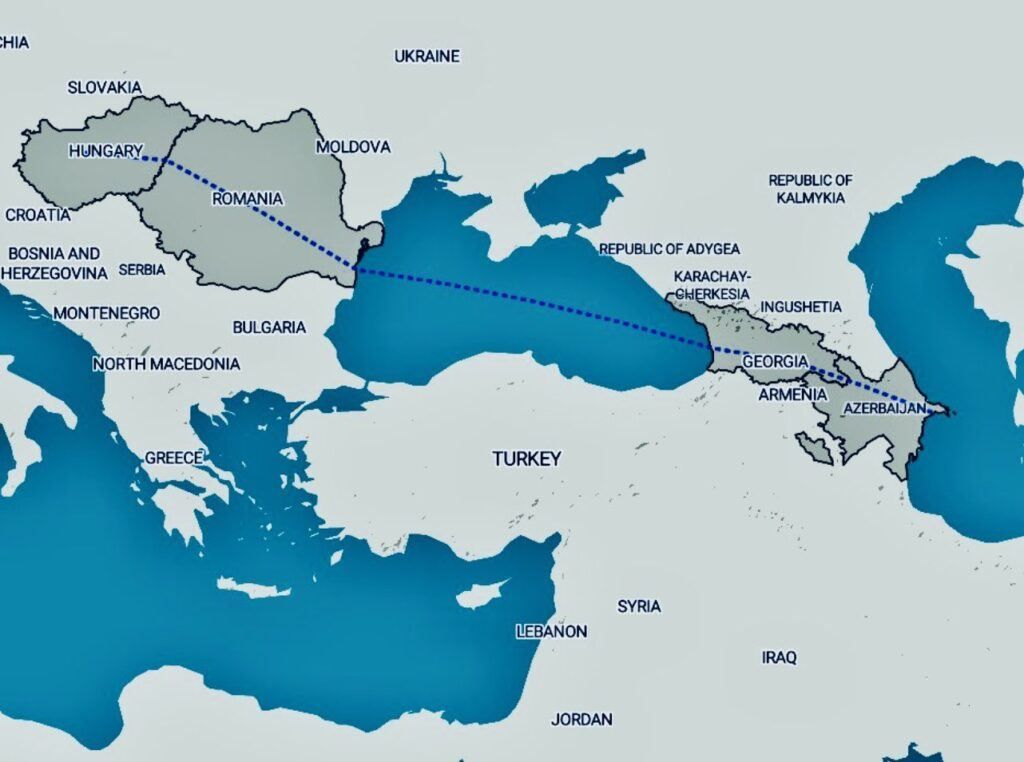

BAKU, Azerbaijan, June 9. The Black Sea cable will facilitate the export of “green” energy from Georgia and Azerbaijan to Europe and will also strengthen digital connectivity through its planned fiber-optic component, PMCG Vice President Zviad Kharebava said, Trend reports.
He made the announcement while delivering a keynote speech at the Burgas Connectivity Forum 2026, organized by the Konrad Adenauer Foundation (KAS) and the Bulgarian authorities.
Meanwhile, it is emphasized that during the forum, Kharebava delivered a keynote speech on the topic “Georgia as a Strategic Energy Transit Hub: Connecting the Caspian Sea with Europe.”
According to the information, in his speech, he noted Georgia’s growing role in connecting the South Caucasus and Central Asia with European markets through existing and emerging energy corridors.
Kharebava spoke about Georgia’s already established role as a transit country for Caspian oil and gas via major regional infrastructure routes, including the Baku-Tbilisi-Supsa, Baku-Tbilisi-Ceyhan, and South Caucasus gas pipelines.
He also touched on issues related to Georgia’s energy sector, the potential of renewable energy, and the strategic importance of future energy interconnection projects. The presentation devoted special attention to the Black Sea Energy Cable project, a planned high-voltage subsea power line that will connect Georgia with Romania and Hungary. “The project is expected to facilitate the export of ‘green’ energy from Georgia and Azerbaijan to Europe, as well as strengthen digital connectivity through the planned fiber-optic component,” PMCG reports.
According to reports, Kharebava also highlighted the broader potential of the Caspian “green” energy corridor, which could link renewable electricity production in Central Asia with the South Caucasus and, via Georgia, with European markets: “This positions Georgia as an important regional platform for energy security, market integration, and sustainable growth.”
Furthermore, it is emphasized that the Burgas Connectivity Forum 2026 has become an important platform for dialogue on strategic infrastructure, energy, transport, and cooperation priorities shaping the future of Southeast Europe and the Black Sea region.
According to meta-studies funded by the European Union, the Black Sea Power Cable project, which aims to transport “green” energy from Azerbaijan and Georgia to Europe, represents an important strategic step toward the integration of energy markets.
"An important strategic step toward integrating energy markets is the planned subsea power cable from Georgia to Romania, which was included in the second list of Projects of Common Interest and Projects of Mutual Interest (PCI/PMI list) in December 2025. It will help balance both power grids and integrate a greater volume of renewable energy sources on both sides. The project is expected to be implemented in the early 2030s. However, to maximize the use of this interconnection, internal grids must be strengthened, in particular through the construction of more powerful 400 kV transmission lines in Romania and Bulgaria (for example, in Dobruja and across the Danube). “To physically implement these intermarket connections, the necessary logistics infrastructure for deploying large-scale energy facilities is also being developed in the region,” the study states.
Analysts note that in Georgia, the modernization of the ports of Batumi and Poti, as well as the Anaklia deep-water port project, are strategically aimed at ensuring the reception of heavy equipment necessary for laying submarine cables and implementing renewable energy projects.
"A similar logistical infrastructure is taking shape along the European coast of the Black Sea, where Bulgaria and Romania are modernizing the ports of Constanța and Varna. By equipping these hubs with berths for heavy cargo and specialized storage facilities for offshore wind energy components, these countries are creating a synchronized industrial ecosystem necessary for the construction of physical corridors that will connect energy markets," the report notes.
On December 17, 2022, Azerbaijan, Georgia, Romania, and Hungary signed a strategic partnership agreement providing for the construction of a 1,000 MW subsea power cable along the Black Sea seabed, spanning 1,195 kilometers. The cable is intended to transmit “green” electricity generated in Azerbaijan and Georgia to Romania, with subsequent transport to Hungary and other European countries, which will expand Europe’s access to renewable energy sources in the Caucasus region.
In September 2024, the Romanian electricity transmission system operator Transelectrica, the Georgian operator Georgian State Electrosystem, the Azerbaijani energy company AzerEnerji, and the Hungarian energy company MVM established a joint venture to lay the undersea cable along the Black Sea seabed.



