


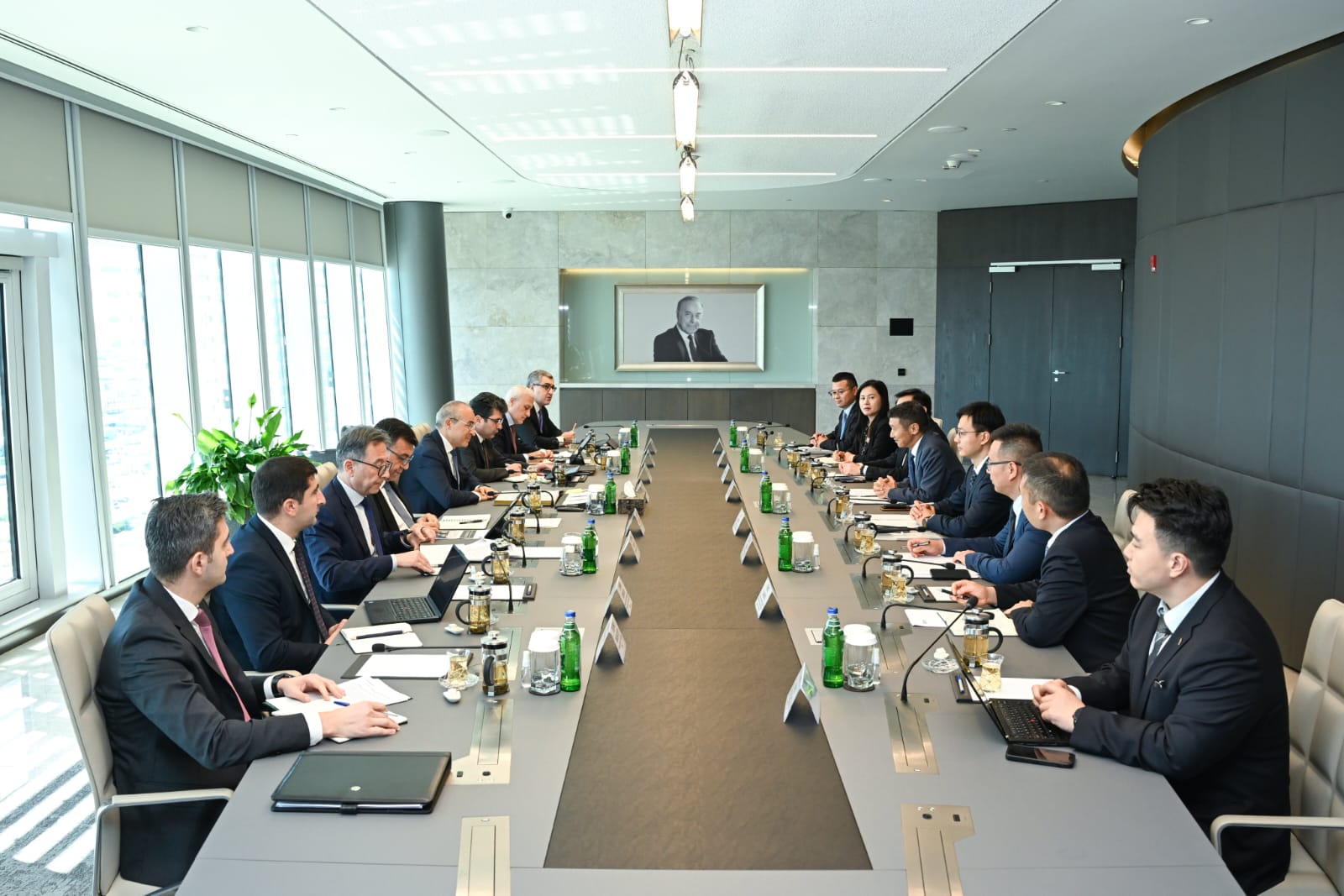

BAKU, Azerbaijan, July 23. Azerbaijan and the Chinese company PowerChina Resources have discussed priority areas of cooperation in the field of ''green energy.''
This was announced by Azerbaijan’s Minister of Economy Mikail Jabbarov in a post on his social media page on ''X.''
''During our meeting with Yang Tianfu, President of PowerChina Resources, we highlighted the priority areas of the Azerbaijan – China partnership in greenenergy and prospects for developing joint initiatives.
Discussions focused on the progress of solar and wind power projects, opportunities for public-private partnerships, and potential cooperation in energy, watermanagement, and mineral resources,'' the post reads.
Earlier, Azerbaijan’s Minister of Energy Parviz Shahbazov also held a meeting with Yang Tianfu, President of PowerChina Resources Ltd.
During the meeting, the sides expressed satisfaction with the successfully developing cooperation between Azerbaijan and the PowerChina group of companies in the field of renewable energy. The company’s active participation in ''green energy'' projects currently underway in Azerbaijan was noted.
In addition, it was noted that the subsidiary of PowerChina is huadong Engineering Co., Ltd. it was the general contractor of the 240 MW Khizi-Absheron wind farm project, and currently it is the general contractor of the 200 MW Masdar Absheron wind farm project.
During the meeting, an exchange of views took place with PowerChina Resources Ltd. regarding a 160-MW solar power plant project, as well as a wind energy project in Azerbaijan’s sector of the Caspian Sea. The work completed on the 160-MW solar power plant project was reviewed. It was emphasized that the projects being implemented by PowerChina Resources Ltd. are among the Ministry of Energy’s priority projects. The discussion touched on the prospects for the safe integration of renewable energy sources into the power grid, the development of power transmission infrastructure, and the use of battery energy storage systems (BESS). It was noted that the integration of new generating capacity into the grid will be carried out taking into account the results of the feasibility study on the development of the power system. In this context, ensuring the stability of the power system during project implementation was identified as one of the top priorities.
In conclusion, an agreement was reached to continue cooperation and intensify consultations at the technical level to ensure the successful implementation of the projects.
Azerbaijan is implementing large-scale projects to increase electricity production and diversify its energy system. In particular, the development of renewable energy sources is one of the main priorities of the country’s energy strategy. The country is currently carrying out major investment projects to build solar and wind power plants in partnership with BP, Masdar, ACWA Power, China Gezhouba Group Overseas Investment, SOCAR Green, and other partners. As a result of these projects, Azerbaijan’s energy mix will be supplemented by thousands of megawatts of new generating capacity in the coming years, which will reduce domestic demand for natural gas and increase gas exports.
According to Energy Minister Parviz Shahbazov, these projects are expected to increase the share of renewable energy sources in Azerbaijan’s energy mix to approximately 43% by 2035.
The minister noted that Azerbaijan is implementing strategic projects to establish a new energy and investment platform between Central Asia and neighboring regions. According to him, one of the key initiatives is the Central Asia–Azerbaijan Green Energy Corridor project. ''The creation of the Trans-Caspian Energy Corridor between Azerbaijan, Kazakhstan, and Uzbekistan, which will connect the power grids, is an integral part of our countries’ strategic vision. This project also offers broad opportunities for the development of the Middle Corridor across the Caspian Sea, which will serve as a green energy bridge between Europe, Asia, and China,'' emphasized Parviz Shahbazov.
The minister added that the Green Corridor Alliance joint venture, based in Baku, is already operational and is coordinating the feasibility study funded by the Asian Development Bank and the European Bank for Reconstruction and Development. At the same time, intensive work is continuing on the ''Caspian–Black Sea–Europe'' green energy corridor, as well as on the Azerbaijan–Türkiye–Europe and Azerbaijan–Georgia–Türkiye–Bulgaria energy interconnectors. Parviz Shahbazov stated that ''green energy corridors are shaping the geo-economic map of the future,'' and these initiatives will stimulate not only energy exports but also the development of digital communications, fiber-optic infrastructure, and regional economic cooperation.



