


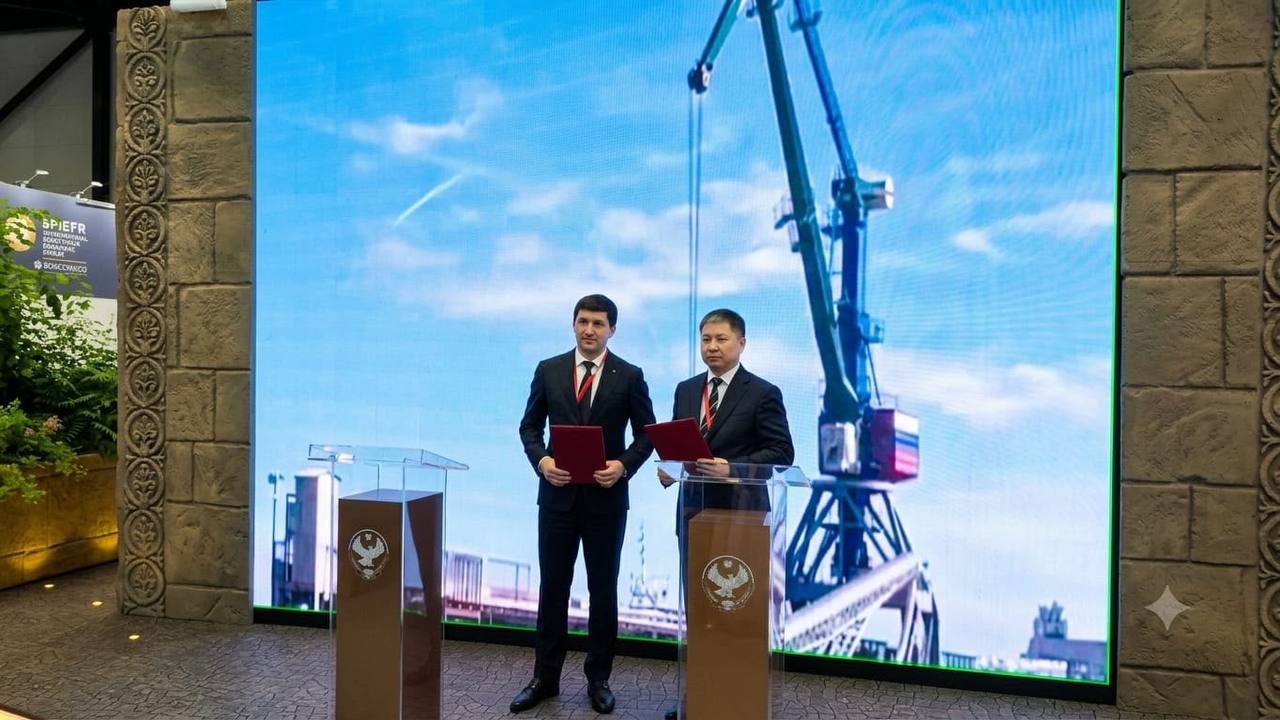

BAKU, Azerbaijan, June 9. Kazakhstan's Kuryk Port and Russia’s Makhachkala Commercial Sea Port signed a cooperation agreement aimed at launching and developing vehicle ferry services between the two ports, Trend reports via Kazakhstan Temir Zholy (KTZ).
The agreement was signed by Turlan Medina, Executive Director for Marketing and Logistics at Kuryk Port, and Jamal Aliyev, Director General of the Makhachkala Commercial Sea Port, within the framework of the 29th St. Petersburg International Economic Forum.
The primary objective of the partnership is to redirect cargo flows currently moving along the China–Central Asia–Turkmenbashi route toward a new logistics corridor passing through the ports of Kuryk in Kazakhstan and Makhachkala in Russia. The initiative is expected to create more efficient transportation solutions and open new development opportunities for both ports and logistics market participants.
The parties also expressed interest in expanding their cooperation and further developing the maritime transport route connecting Kuryk and Makhachkala. The corridor is expected to provide additional logistics options for cargo transportation between Europe and Asia while strengthening international transport connectivity across the Caspian region.
Located on the eastern coast of the Caspian Sea south of Aktau Port, Kuryk Port benefits from favorable weather conditions for cargo handling operations, including rail wagon loading and unloading. Its ferry complex is designed to handle grain, petroleum products, fertilizers, chemicals, and other types of cargo.
Makhachkala Port, meanwhile, is Russia’s only ice-free and deepest seaport on the Caspian Sea. It serves as a key transport hub linking southern Russia with Central Asia, the South Caucasus, Iran, and other Caspian countries. The port currently operates 12 berths, three dry cargo terminals, and a fleet of four support vessels dedicated to cargo handling and transportation.
The agreement reflects growing efforts by regional transport operators to enhance connectivity along trans-Caspian trade routes and improve freight mobility between Asia and Europe.



