


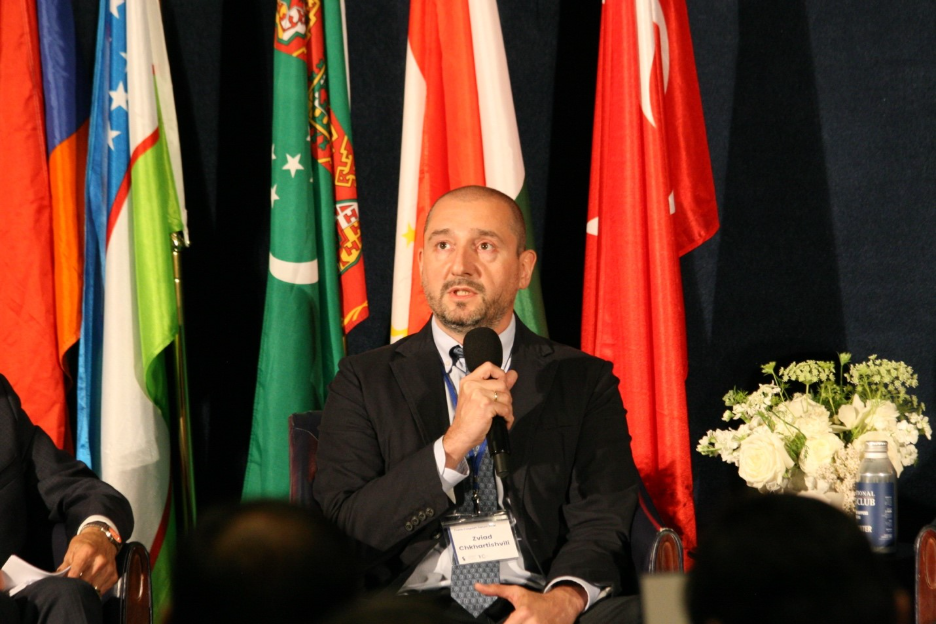

BAKU, Azerbaijan, June 12. Georgia aims to turn the Middle Corridor into a gateway of choice, said Zviad Chkhartishvili, Director of Poti Sea Port Administration of Georgia.
Speaking at the 10th anniversary Trans-Caspian Forum, held by the Caspian Policy Center in Washington, DC on June 10, Chkhartishvili gave important insight into Georgia’s critical role in the development of Middle Corridor infrastructure.
“To expand the Middle Corridor’s capacity, we have been deeply engaged with the government of Georgia and the countries of Central Asia on how to transform one of the best alternative routes to a gateway of choice, to become competitive with the Northern and Southern Corridor,”he said.
Chkhartishvili also shared insight into Georgia’s investment into infrastructure, adding that “in the Middle Corridor, most commodities are transported the old way by railway or road transportation, so now we provide an increased budget of containerization. In the next year to three years, we will have a modern port expansion project. Already the Poti port project is one of the biggest we have developed, with state-of-the-art infrastructure.”
Asked about the effects of global instability, Chkhartishvili also noted that, “For supply chains, the most important part is sustainability in this turbulent period when the Strait of Hormuz is closed. Fortunately, we already have the Middle Corridor. The next step now is transforming it into a competitive corridor.”
Earlier, during the Antalya Diplomacy Forum in Türkiye in April this year, Levan Zhorzholiani, Head of the Government Administration of Georgia said that his country needs cooperation with partners to advance the Middle Corridor.
“We are promoting the Trans-Caspian Transport Corridor (Middle Corridor), and we need cooperation with our friends in this direction,” he noted.
Georgia says it has made steady progress toward bolstering Middle Corridor connectivity.
“Countries of our region, whether we call it the Silk Road, CAREC 2, Middle Corridor or Trans Caspian route, have been trained in resilience for centuries and it is being realized that the current challenges need the resilient efforts to be made collectively. Georgia has made steady progress toward its strategic objectives—completing core infrastructure of East–West highway, bolstering Middle Corridor connectivity and has a strong agenda of further enhancement of the road, rail, energy, and digital connectivity and energy security and independence,” said the country’s Minister of Finance Lasha Khutsishvili in his statement for ADB Annual Meeting in Samarkand, Uzbekistan.



