


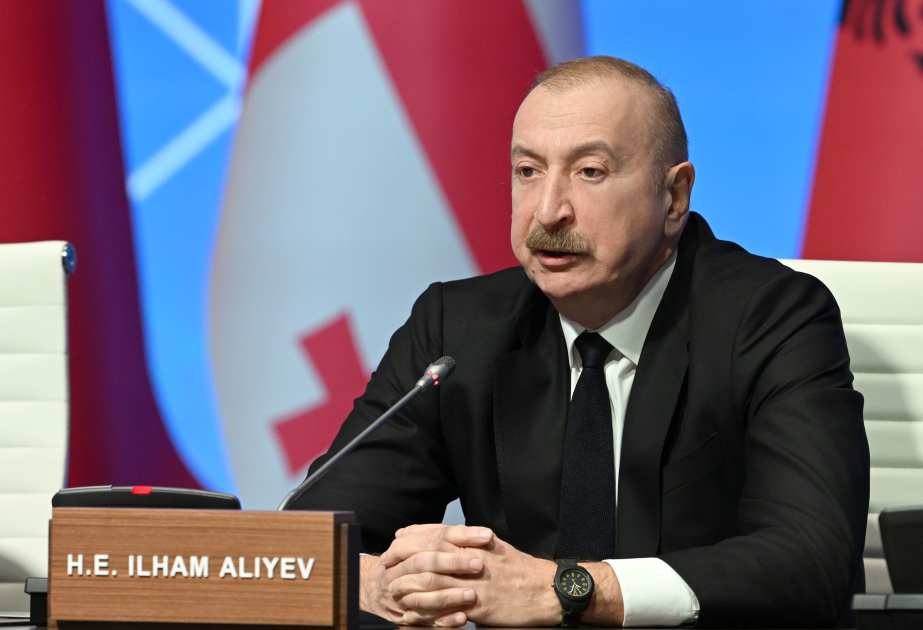
BAKU, Azerbaijan, March 3. We want to increase our presence in the European energy market, President of Azerbaijan Ilham Aliyev stated during his speech at the 12th Ministerial Meeting of the Southern Gas Corridor Advisory Council and the 4th Ministerial Meeting of the Green Energy Advisory Council, Trend reports.
Speech by President Ilham Aliyev
- Good morning, ladies and gentlemen.
First of all, I'd like to welcome all our guests. A special welcome to Mr. Commissioner — he has just arrived and probably needs to be in bed now, but instead he is with us. We highly appreciate that he is participating in this important event, although we know that he had very busy meetings back in Brussels. So really, your presence once again demonstrates the strong partnership between European institutions and Azerbaijan in the area of energy, and not only.
As always, we at the annual Advisory Council review what has been done since the last meeting and also plan our joint future steps in order to strengthen partnership cooperation in the field of energy security and sustainable energy supply.
It has already been more than a decade that this initiative has demonstrated sustainability, and now we understand, maybe more than when we launched this initiative 12 years ago, how important it is to gather together and address important issues of energy security.
Especially if we look back at these 12 years, we see different scenarios, different complications, challenges, and problems. But despite all those difficulties and very hard times in our region, energy security provided by Azerbaijan and its partners, to a number of countries, has really become something that we can feel on a daily basis. If we look at what has been done since we met last time in Baku last year, we again see progress. Every time we talk about progress.
Last time I was addressing the audience, saying that we supply gas to 12 countries. Now the number of countries where Azerbaijani gas has reached its consumers has reached 16. And by this number, Azerbaijan is number one in the world with respect to the number of countries it supplies with pipeline gas.
Last time I touched upon our plans to expand the geography of gas supplies. So, as you see, it has been done. Also, I think an important event was that our gas supplies have already reached other destinations beyond Europe. For the first time, we started to supply gas to Syria in order to help the Syrian people reduce the dramatic electric energy deficit.
By supplying 1.5 billion cubic meters of Azerbaijani gas to Syria, we helped the population be better protected and have more opportunities to do business and make enterprises functional, because everybody knows very well that without electricity you cannot achieve any development. So this was important for Syria, for the region, and for Azerbaijan because diversification of gas supplies for us, as for every country, is very important. We understand the challenges that countries which receive gas face with respect to diversification. But also for producers, diversification is an important factor.
And again, we see positive dynamics in cooperation between the producer, Azerbaijan, transit countries, and consumers. And this unity and shared interests and shared benefits, I think, are the main reasons for our successful journey for more than a decade.
With respect to our plans, yes, we want to increase our presence in the European energy market. We have already started to supply two more countries in Europe — Germany and Austria. Thus, today, 10 members of the EU receive gas from Azerbaijan. In the coming years, with respect to the new production of gas from Azerbaijani fields, we may increase the output. But for that, definitely — and we spoke about that last time — we need to think about the expansion of the existing gas transportation infrastructure, because today the Southern Gas Corridor is already fully packed. We are looking for other extensions and interconnections in order to be able to supply as much as the market needs and probably will need even more, taking into account the current situation in the world, and in order to be able to export as much as we can.
This year, we expect the beginning of production from the ACG deep gas field. We expected production to start last year, but it did not happen. But definitely, this year production will start. In two or three years, we expect the beginning of the full-phase development of the Absheron field, which will increase gas production from Absheron three times. We also expect the beginning of gas production from the second phase of the Umid field.
With respect to our major source of natural gas, Shah Deniz, in 2028, we expect the beginning of production from a new phase of Shah Deniz. All these gas production profiles will allow us, at the maximum level of production, to reach an additional 10 to 15 billion cubic meters of gas. As I said earlier, for that we will need new markets, expansion of the existing pipeline system, and of course, we need to look at how to diversify our gas distribution network.
Part of the discussions for several years at the Advisory Council has been the green agenda. And here also we can report good results. This January, we inaugurated the biggest wind power station in the region so far — 240 megawatts — financed and constructed by ACWA Power.
This is an additional source of green energy to what we already had. In 2023, Masdar built a 230-megawatt solar power station. Several projects are already in the implementation phase, and we expect the inauguration of new renewable power stations in the coming years. Here, we have a good combination of foreign investors and local companies. Local companies, definitely SOCAR, but not only SOCAR — private companies have also started to invest in renewables because we know that there is great potential and market demand.
There are already transmission lines, but there will be more transmission lines. We need to work on that. We need to work jointly on energy cables, including the energy cable stretching from Azerbaijan to Europe across the Black Sea and the energy cable from Central Asia to Azerbaijan. Both agreements have been signed. The feasibility study has almost been completed for one project and will be completed for the other.
If we look forward to when all these projects are materialized, we will see that they will be very sustainable and, I would say, existential for many countries' energy corridors. Our renewable plans are based on contracts that have already been signed.
I would like to underline that they are contracts, not MOUs — so they are contractual obligations. By 2032, we expect 6 to 8 gigawatts of electric power from renewable sources. This, of course, is a big asset. We need to export it and use this electricity for domestic purposes to substitute the natural gas that we are currently using to produce electricity and to provide conditions for a growing economy and growing industry, including our plans with respect to the communications sector, AI, and data centers — all of which are projects already in the pipeline, especially after the signing last month here in Baku between the Vice President of the United States and myself of the Charter on Strategic Partnership between the United States and Azerbaijan, which covers many areas, including AI, energy, connectivity, and many others.
So the realization of our plans, having the United States — the biggest power — as our strategic partner seems to be absolutely realistic. We have been investing and continue to invest in hydropower stations. These projects are being implemented in the territories liberated from Armenian occupation. So far, 307 megawatts of hydropower stations have already joined our system. Our plans are to almost double that, maybe in two or three years, which will give us additional potential and cheap energy.
So hydro, solar, wind, potentially thermal — we are now investigating this issue — gas, and all the combinations — that is how it should be. Coming back to what we discussed even at COP29, when we were hosting this climate conference, I said then — though I realized it was not in line with the trend at that time — that you cannot ignore fossil fuels. If you ignore fossil fuels, that means you live in your dreams.
We all want to have a safe and clean planet. We all do not want to see the complications of climate change. And by the way, here one can see how the Caspian Sea is shrinking year after year. But at the same time, we need to treat this issue from the point of view of pragmatism and realism, not from the point of view of ideology. The combination of fossil fuels and renewables, and especially appreciation of the efforts of countries like Azerbaijan — which has reserves that can be enough for the country and its neighbors for 100 years of fossil fuels, but nevertheless is investing billions in renewables — I think this is how it should be. I am sure all these issues will be discussed at today's event, and we will come up with good solutions.
I would also like to underline that Azerbaijan plays an important role as a reliable transit country for energy resources. We provide important oil transit for Kazakhstan and Turkmenistan, and year after year, the volume of oil transported through our system is growing. We are capable and have the infrastructure to receive more oil from the eastern shores of the Caspian.
With respect to our efforts on the European energy market, I think it is important for the audience to know that we recently acquired one of the biggest power stations in Türkiye — 870 megawatts. Last month, a contract was signed with Serbia to build a 500-megawatt power station there. Our contribution to energy security is not limited to our boundaries or to the Southern Gas Corridor.
Among important achievements for us is also the acquisition of two refineries in Italy with a total capacity of 10 million tons. If we add that to what we already have on the Turkish Aegean coast — a 12-million-ton refinery — in total we will have 22 million tons of refinery capacity in the Mediterranean and Aegean regions, which will definitely help provide sustainable supplies of oil products. Thousands of petrol stations are also part of the deal.
So I do not want to take much of your time. I know that you will be very busy, but I just wanted to underline the main milestones that are important to understand our plans, what has been done, and what we are planning to do. I am sure that, as always, the meeting will be productive, constructive, and result-oriented.
Thank you very much.



