


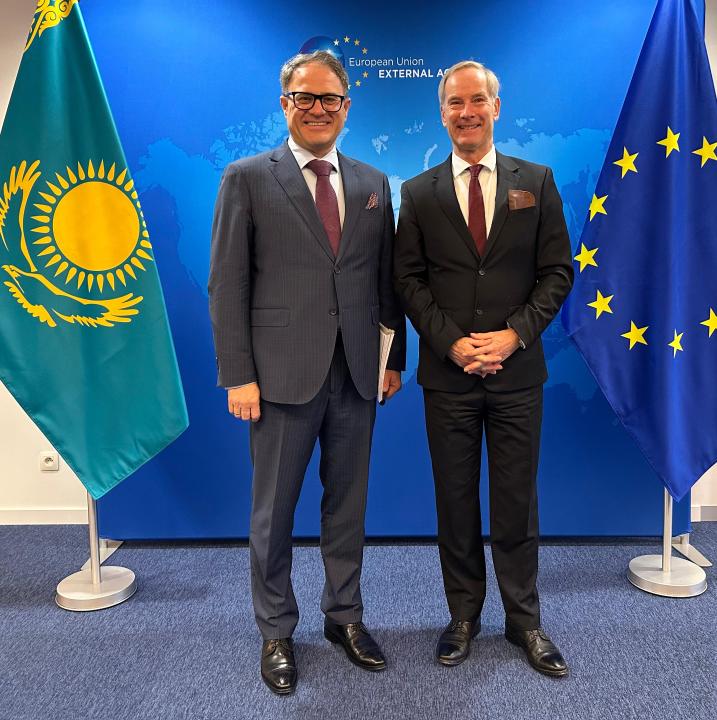

ASTANA, Kazakhstan, February 14. Kazakhstan and the EU intend to expand cooperation in rare earth metals, green energy, and the development of transport corridors, including the Trans-Caspian International Transport Route, Trend reports.
This was announced during the meeting of Deputy Foreign Minister of Kazakhstan Roman Vassilenko with representatives of various key structures of the EU, which discussed the prospects for deepening cooperation between Kazakhstan and the EU, as well as regional cooperation in Central Asia.
The meeting addressed priority areas of interaction, including transportation and infrastructure projects, sustainable development, energy partnership, and supply chain resilience. In the course of talks with Luc Devigne, Deputy Managing Director of the European External Action Service (EEAS), and Vivian Loonela, Head of the Office of the EU High Representative for Foreign Affairs and Security Policy, the sides discussed issues of bilateral interaction, including strengthening political dialogue and economic cooperation, as well as preparations for upcoming joint events.
In particular, preparations for important events of the first half of the year, such as the Central Asia-EU Foreign Ministers' Meeting in Ashgabat, the first Central Asia-EU Summit in Samarkand, as well as the Astana International Forum, were also discussed.
Deputy Minister of Foreign Affairs of Kazakhstan noted that the timeliness of the meetings in Brussels is due to both a very broad agenda of our interaction and the high dynamics of our relations with the EU, as well as the formation of foreign policy priorities of the new European Commission and the rapidly changing geopolitical situation
Furthermore, the issues of regional development and implementation of infrastructure projects were discussed with Peteris Ustubs, Director for International Partnerships of the European Commission, and Lucie ŠESTÁKOVÁ, Head of the Office of the European Commissioner for International Cooperation and Partnerships. The participants discussed the prospects of implementing joint projects aimed at developing transport routes, modernizing logistics, promoting sustainable energy solutions, and digitalization.
Energy cooperation and resilient supply chains were also important topics of discussion. The parties exchanged views on further steps in the development of green energy, including the expansion of renewable energy sources and cooperation in the field of low-carbon technologies.
During a meeting with the Chair of the European Parliament Delegation for Relations with Central Asia, Giuseppina Princi's plans for developing inter-parliamentary cooperation between Kazakhstan and the EU were outlined. The interlocutor positively assessed the reforms initiated by President of Kazakhstan Kassym-Jomart Tokayev, emphasizing their importance for the democratic development of the country and the increase in government transparency.
Following the meetings, the parties confirmed their commitment to further strengthening dialogue and developing practical cooperation in various areas. Kazakhstan and the EU expressed their readiness to continue working on joint initiatives, laying the foundation for a sustainable and long-term partnership.
To note, the European Union is Kazakhstan's largest trading and investment partner. The EU accounts for about a third of Kazakhstan's foreign trade and accumulated foreign investments. The trade turnover in 2024 amounted to $48.7 billion, with exports from Kazakhstan totaling $38.1 billion and imports at $10.6 billion (+36.7 percent). In the first, second, and third quarters of 2024, direct investment inflows from EU countries amounted to $6.4 billion.
More than 3,000 companies with European capital operate in Kazakhstan, including such multinational corporations as Shell, Schneider, Eni, Total, Air Liquide, Alstom, Siemens, and others.



