


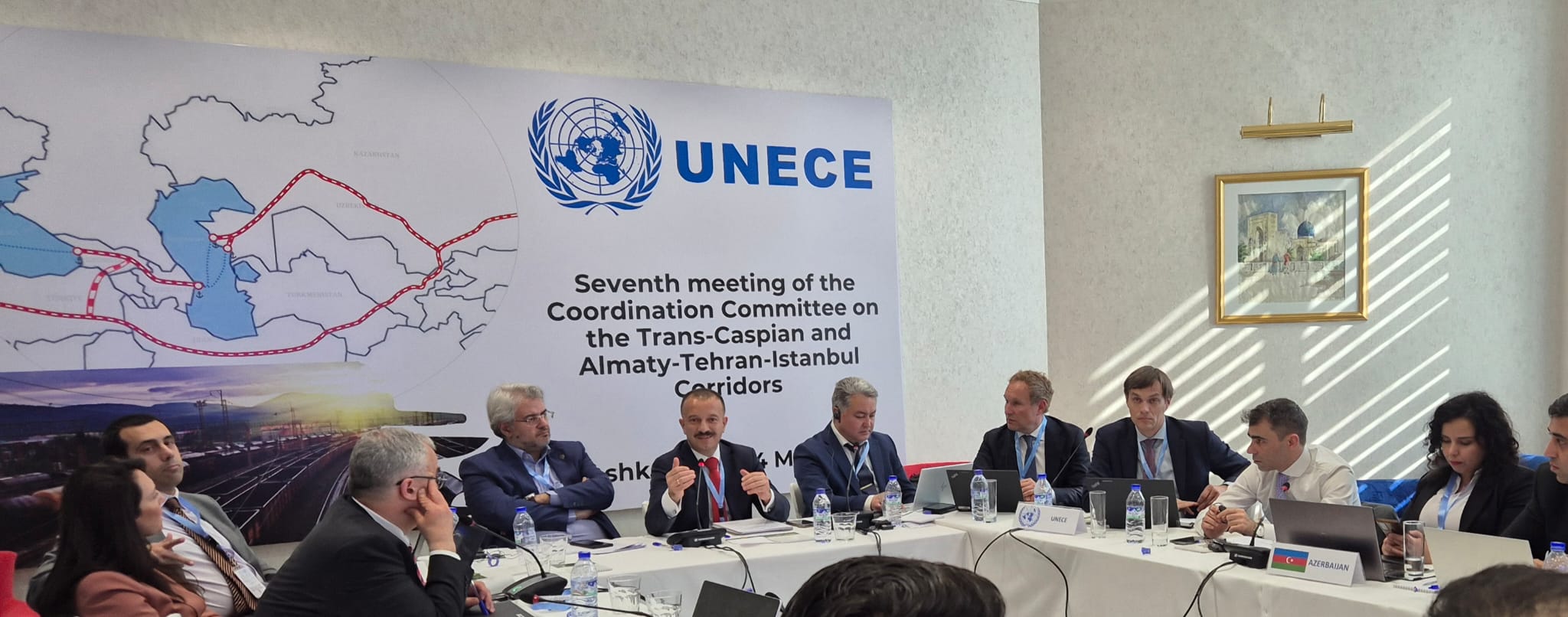

TASHKENT, Uzbekistan, May 14. The 7th Meeting of the ECO-UNECE Coordination Committee on the Trans-Caspian and Almaty–Tehran–Istanbul Corridors took place in Tashkent, Trend reports, citing the Economic Cooperation Organization (ECO).
The event brought together representatives from all eight committee member states. Alireza Mahmoudi, Director for Transport and Communications at the ECO Secretariat, was also in attendance.
The primary focus of the meeting was advancing the operationalization of regional transport corridors, with discussions centered on key topics such as infrastructure renewal, enhancing data exchange during multimodal transport operations, and harmonizing transport documentation to facilitate cross-border trade and improve logistics integration within the ECO region.
One of the main highlights of the meeting was a simulation exercise that analyzed data and information flows along various segments of the Trans-Caspian routes. The exercise provided valuable insights into current bottlenecks and identified opportunities to enhance real-time coordination and information sharing between transport operators and border agencies.
Participants also explored the various transport documents used across the corridors, discussing practical approaches to harmonizing, simplifying, and digitalizing documentation to boost efficiency and reduce administrative burdens.
In his opening remarks, Mahmoudi underscored the strategic significance of the transport corridors in fostering sustainable, resilient, and seamless regional connectivity. He emphasized that the sessions addressed both operational challenges on the ground and the strategic vision required to unlock the full potential of the corridors. Mahmoudi also highlighted the upcoming 3rd United Nations Conference on Landlocked Developing Countries, scheduled for August 2025, as a major milestone for the region.
In parallel with the main discussions, a technical workshop was held on the safety of transporting and handling containers and other cargo transport units (CTUs). The workshop aimed to equip stakeholders with best practices and policy guidance to improve transport safety and mitigate operational risks.
The ECO Secretariat reiterated its commitment to continued collaboration with the UNECE and member states to drive progress in infrastructure development, trade facilitation, and digital transport solutions across the region.
Meanwhile, the Trans-Caspian Transport Corridor has emerged as a central artery in Central Asia's rapid economic growth. From 2021 to 2024, container movement along the corridor has doubled in terms of capacity, underscoring its growing importance in regional trade.



