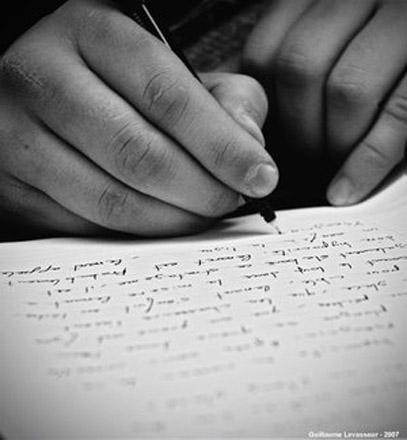
Letters in which German author Hans Fallada spoke openly of the illness and anxiety which plagued him have be found in Israel's National Library, the daily Ha'aretz reported Monday.
Fallada, who's real name was Rudolf Ditzen, wrote Little Man, What Now (1932), a novel set in Germany during the Great Depression. He also penned the international bestseller Alone in Berlin, DPA reported.
The 53 letters, correspondence between Fallada, whose real name was Rudolf Ditzen, and the Jewish Austrian writer Carl Ehrenstein from 1934 to 1938, were turned over to the library by Ehrenstein's estate years ago.
They were discovered by archivist Stefan Litt soon after he began working at the library a month ago. Among the papers he was given to sort through was a file labelled "Hans Fallada", found to contain the letters and other documents.
The letters are to be scanned and uploaded to a website as part of a project to make available online, along with 150,000 rare books and documents from the library archives.
The library will also hold a special workshop on Fallada and the letters on March 8.
In a letter dated August 3, 1935, and sent to Ehrenberg in Britain, Fallada wrote: "Will I ever reach you? I doubt it. The need for quiet - to neither see nor hear a thing - grows stronger every day. Sometimes I dream of a wall three metres high around my yard. With no humans."
"There are many similar files hiding here that we hope to make accessible to the public," said Haggai Ben-Shamai, the library's academic director.
"You open the file and touch the letters and the notes, and you are actually touching time. There is a lot of charm in it, but it is also frightening. It's like meeting a ghost," said Galili Shahar, an expert on German literature.
"The letters reveal the sad friendship between two authors in exile, one in London and one - Fallada - in internal exile in his home. Both were lonely and sought comfort in writing letters. "
Fallada was born in northern Germany in 1892. As an adult he was frequently admitted to psychiatric hospitals and jailed repeatedly for morphine and alcohol abuse. He supported himself through journalism and other writing.
Fallada was interrogated repeatedly over his refusal to join the Nazi Party. After he rejected a request by Nazi propaganda chief Josef Goebbels to write an anti-Semitic novel, he had a breakdown and was hospitalized in a facility for the criminally insane.
After World War II, a friend gave him a file, found among Gestapo documents, with information about a German couple who had rebelled against the Nazis.
Fallada turned their story into Alone in Berlin, completing it in 24 days. He died a few weeks before it was published in 1947. In 2009 the book was translated into English and became a best seller.
Hans Fallada letters found in Israeli archive
Letters in which German author Hans Fallada spoke openly of the illness and anxiety which plagued him have be found in Israel's National Library, the daily Ha'aretz reported Monday.