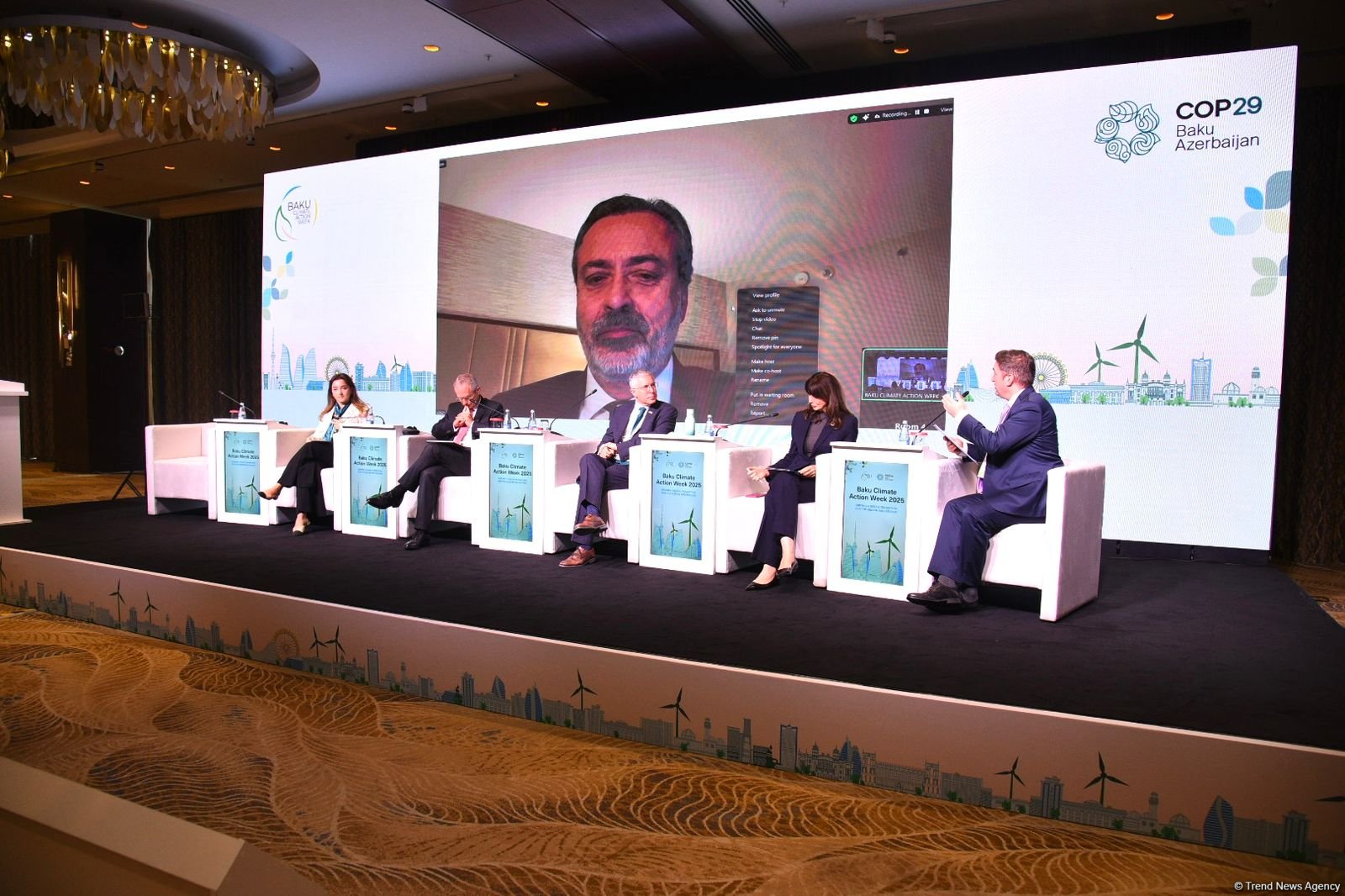



BAKU, Azerbaijan, September 29. Baku Climate Action Week has kicked off in Azerbaijan's capital, Trend reports.
The event was attended by COP29 President, Representative of the President of the Republic of Azerbaijan on Climate Issues Mukhtar Babayev, Prosecutor General of the Republic of Azerbaijan Kamran Aliyev, UK Ambassador to Azerbaijan Fergus Auld, and other officials.
Key topics on the agenda included: the outcomes of COP29 and the road to COP30; Azerbaijan’s climate leadership from COP29 to BCAW 2025; advancing the green transition through national climate plans (NDCs and NAPs); investment platforms and transition strategies; and supporting the green skills ecosystem, with a focus on small and medium-sized enterprises (SMEs).
Speaking at the event, Azerbaijan's Prosecutor General Kamran Aliyev said that law enforcement agencies should play a key role in combating climate change.
According to Kamran Aliyev, environmental protection and the fight against environmental crimes are becoming transnational issues that require joint efforts.
"Azerbaijan is consistently raising the issue of involving law enforcement agencies in the climate agenda at the international level. In particular, at COP29 in Baku, in partnership with the United Nations Office on Drugs and Crime and the UAE Ministry of Interior, a high-level session was organized, which resulted in the adoption of the Baku Declaration calling for action," the Prosecutor General said.
He noted that the joint efforts initiated in Baku are continuing today, and Azerbaijan will soon share its experience at an event within the framework of COP30 in Brazil.
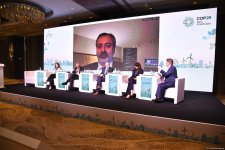
In his video address to the participants of the Baku Climate Action Week, Simon Stiell, Executive Secretary of the United Nations Framework Convention on Climate Change (UNFCCC), noted that the promises made at COP29 in Baku must be translated into real steps that people and communities will see.
According to him, it is important today to transform national climate plans into investable solutions on the ground and to develop projects that will attract both public and private investment. At the same time, he stressed, it is necessary to build predictable policy frameworks and coordinated business strategies.
“When national climate plans coincide with agreed business strategies, climate action is easier to scale up and harder to roll back. The private sector plays a key role here. Business is demonstrating its ambition not only by setting targets, but also by making real investments today,” Stiell noted.
He added that such steps create markets for green technologies and give governments the confidence to raise their own ambitions. According to the head of the UNFCCC, two factors are necessary for a large-scale influx of private investment: project packages that combine national priorities with business interests, and innovative partnerships that bring together public and private funding.
Simon Stiell emphasized that this applies not only to reducing emissions but also to adapting to climate change. “No company can thrive on a planet where systems are collapsing. Adaptation protects growth, stability, and prosperity,” he said.
According to him, governments must create transparent and predictable conditions that reduce risks for investors and encourage long-term solutions, while businesses must not only provide capital but also share data, technology, and experience to scale solutions.
“Baku Climate Action Week is all about that — moving from promises to projects and from ambition to action. We must show that the climate agenda is not a cost, but a path to strong economies, sustainable societies, and a safer world,” Stiell noted.
He stressed that the momentum created in Baku must be strengthened on the way to Belém. “Let's use this moment to build projects, partnerships, and policies that turn commitments into real results,” concluded the head of the UNFCCC.
The President of the 73rd session of the UN General Assembly, María Fernanda Espinosa, in turn, noted that it is necessary to move from negotiations to integrating climate action into the DNA of economies.
According to her, at COP29 in Baku, the global community agreed on a new collective goal to mobilize at least $300 billion annually, which was an important step towards achieving $1.3 trillion in climate finance. “Today, we must move from negotiations to integrating climate action into the very DNA of our economies, governance, and international system,” Espinosa said.
She emphasized that despite geopolitical tensions, growing inequality, and global crises, multilateral cooperation remains the only tool capable of delivering solutions on the scale and at the speed required by science and climate challenges.
Espinosa also noted that on the sidelines of the UN General Assembly, about 100 countries representing two-thirds of global emissions announced new nationally determined contributions, and investments in clean energy in 2024 exceeded $2 trillion, surpassing investments in fossil fuels for the first time.
Azerbaijan's Deputy Foreign Minister, Yalcın Rafiyev, emphasized in his speech that the COP conference in Baku was one of the most successful in history.
"Baku stood out for its scale—more than 76,000 people took part in the event—and its high level of engagement: it is the second COP conference in history in terms of the number of heads of state and government. It also became one of the most inclusive, bringing together representatives of government agencies, the private sector, the scientific community, civil society, and indigenous peoples," he noted. Rafiyev recalled the UN General Assembly High-Level Week in New York, where many leaders presented new climate plans.
“Listening to these political statements, we must be confident that the states expected to provide climate finance, primarily developed countries, will fulfill their commitments,” he said. “Listening to these political statements, we must be confident that the states expected to provide climate finance, primarily developed countries, will fulfill their commitments,” the diplomat stressed.
He noted the need to ensure the long-term legacy of the Baku COP. “This means not only implementing the decisions taken, but also preserving and developing the positive experience gained in Baku,” Rafiyev said.
The Deputy Minister added that Azerbaijan is assisting Australia and Türkiye in negotiations on the selection of the host country for COP31 and continues to mediate between other states to achieve positive results.
“We are also actively cooperating with our Brazilian partners to implement the Baku-Belen roadmap related to the goal of climate financing of $1.3 trillion. This task is crucial to ensuring adequate financing for the needs of developing countries,” the deputy minister concluded.
UN Secretary-General's Special Representative and Director-General Damilola Ogunbiyi stated that the event is taking place at a critical moment for the planet. Forums such as Baku Climate Action Week play a special role in maintaining the momentum of joint efforts to combat climate change.
This year, the Week is particularly significant, as it takes place just a few days after the UN General Assembly and a few weeks before COP30 in Belen. COP29 in Baku was an important step forward: countries agreed to mobilize at least $300 billion per year by 2035 and supported the Global Commitment to Energy Storage and Grids," she emphasized.
Ogunbiyi noted that by 2030, emissions must be reduced by 43 percent compared to 2019, but the world is on a dangerous trajectory of a 2.5–2.9°C temperature increase.
She highlighted three priorities ahead of COP30: climate finance, ambitious national contributions (NDCs), and technology development, taking into account national responsibility for the energy transition.
“The example of Azerbaijan shows how COP29 commitments can be translated into practical action,” the UN representative concluded.
The representative of the President of Azerbaijan on climate issues, COP29 President Mukhtar Babayev, said that the Baku-Belen Roadmap is currently being developed to ensure that funding from all sources increases to $1.3 trillion per year.
He noted that historic results were achieved at COP29:
"We have concluded lengthy negotiations on carbon markets, which will channel trillions of dollars of investment into climate projects in developing countries. The Azerbaijani banking sector has implemented $1.2 billion worth of green projects. The Asian Development Bank has allocated $3.5 billion to combat glacier melt. International financial institutions have committed to allocating $170 billion annually until 2030. Global active managers controlling more than $10 trillion have joined our initiatives," COP29 President said.
Babaev also highlighted the launch of the Fund for Loss and Damage, whose resources are already available for distribution this year.
"One of the key outcomes was the establishment of a new financial benchmark in Baku—a commitment by donor countries to allocate at least $300 billion annually to climate finance from 2035 onwards. This is the highest target ever set within the UN process. We continue to actively chair COP29, holding countries accountable for the commitments made in Baku. This month, at the UN General Assembly in New York, together with Secretary-General António Guterres, we reminded donors of their commitments. We are working on new partnerships and preparing for the World Cities Forum, which will be held in Baku in 2026," he added.
In 2024, the COP29 Presidency successfully held the first “Baku Climate Action Week” in partnership with London as a similar event to mobilize the whole society ahead of COP29 in November 2024.
Baku Climate Action Week will last until October 3.