


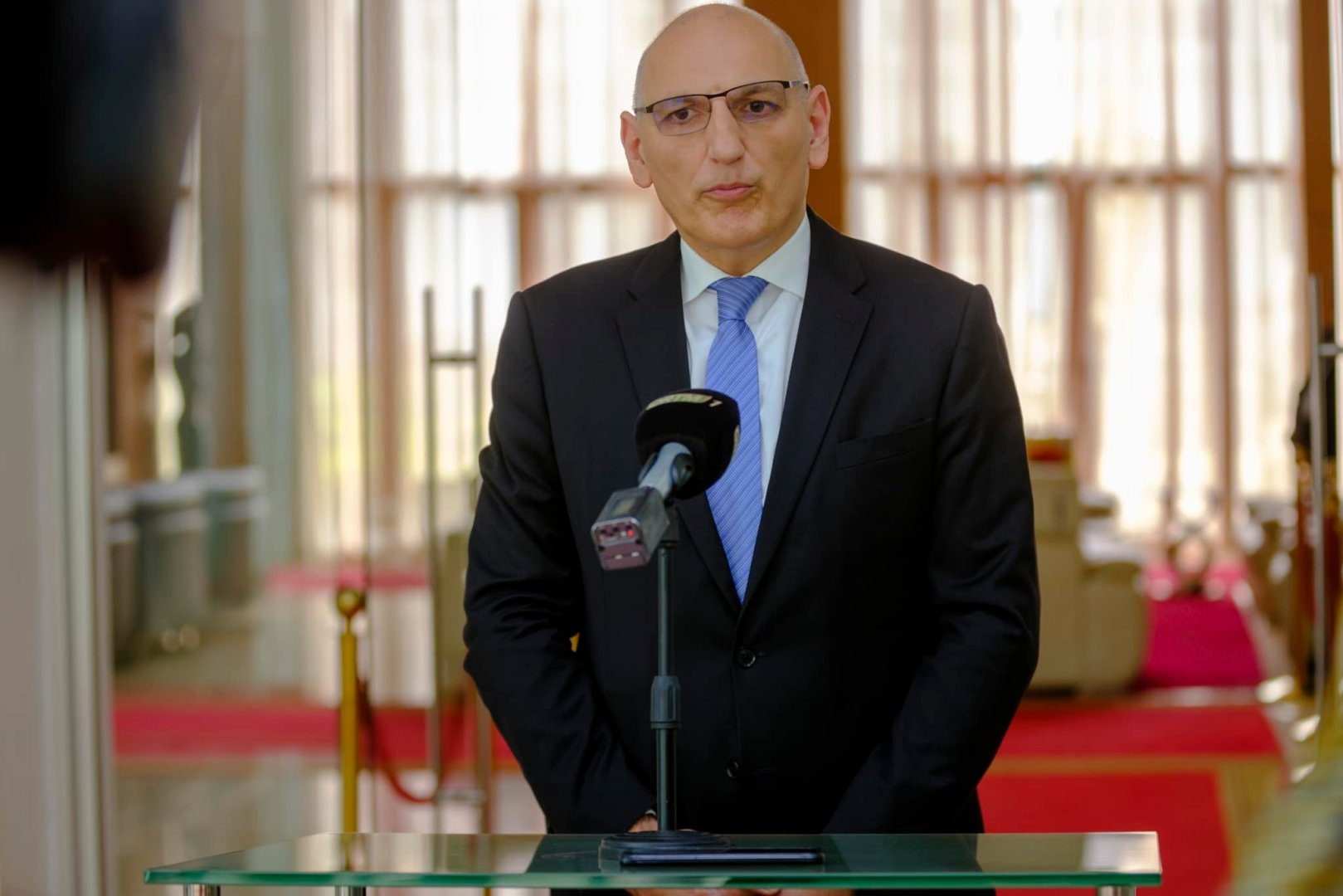

BAKU, Azerbaijan, May 2. The strategic importance of energy cooperation between Azerbaijan and Italy has become even more evident following the crisis around the Strait of Hormuz, Elchin Amirbayov, the President of Azerbaijan’s Special Assignments Representative, said in an interview with Italian media, Trend reports.
Amirbayov said that in a period of geopolitical instability, the key issue is not only access to energy resources, but also the reliability and security of supply routes.
“In this regard, Azerbaijan has long proven itself as a reliable partner for Italy. In 2025, Azerbaijan supplied 9.5 billion cubic meters of gas to Italy via the Trans Adriatic Pipeline (TAP), accounting for around 16 percent of Italy’s total gas imports. Since the start of TAP operations, more than 42 billion cubic meters of Azerbaijani gas have been delivered to Italy. This shows that TAP is not only a commercial success but also a strategic pillar of Italy’s energy security,” he said.
Amirbayov added that this partnership is not limited to bilateral relations.
“Azerbaijan today plays an important role in the overall energy security of Europe. In 2025, Azerbaijan exported 12.5 billion cubic meters of natural gas to European Union member states, which is 53.8 percent more compared to 2021. This demonstrates that the Southern Gas Corridor has already become one of Europe’s key diversification routes. This is especially significant at a time when the continent is seeking reliable alternatives and secure overland supply channels. Recent tensions around the Strait of Hormuz once again reminded everyone how vulnerable global energy markets are to geopolitical shocks. In this context, Azerbaijan’s role gains even greater importance. Therefore, yes, after the Hormuz crisis, energy ties between Azerbaijan and Italy have become more relevant not only for the two countries but for Europe as a whole,” he said.
According to Amirbayov, doubling pipeline capacity is, in principle, feasible.
“Most importantly, this is not a new idea. When European Commission President Ursula von der Leyen visited Baku in July 2022, the EU and Azerbaijan signed a Memorandum of Understanding on a strategic energy partnership. The goal is to expand the Southern Gas Corridor infrastructure and double Azerbaijani gas exports to the EU—from 10 billion to 20 billion cubic meters annually by 2027. This process has already begun, and we are moving toward that target. The first phase of TAP expansion was commissioned in January 2026, adding 1.2 billion cubic meters of annual capacity, of which 1 billion cubic meters is directed to Italy. This shows the corridor is not static but continues to evolve in response to Europe’s energy needs,” he said.
He added that there is clear potential for further expansion, but it requires investment.
“Azerbaijan has repeatedly stated its readiness to increase gas supplies to Europe. However, this requires further expansion of the Southern Gas Corridor infrastructure, including new investments to increase both production and pipeline capacity. In the current geopolitical uncertainty, expanding this capacity increasingly aligns with Europe’s strategic interests. Financing is crucial here. As the EU continues its efforts to diversify energy supply sources, relevant EU institutions can play an important role in creating the necessary investment conditions,” Amirbayov noted.
He emphasized that TAP is a strategic infrastructure project, contributing to a more diversified and secure energy supply for Europe through Azerbaijani gas delivered via the Southern Gas Corridor.
“This is especially important for Italy, which is not only a consumption market but also a key energy hub between Europe and the Mediterranean. The more resilient Italy’s energy policy is, the greater its ability to contribute to regional stability, including in Southeast Europe and the Mediterranean basin. TAP already connects Greece, Albania, and Italy, while the Southern Gas Corridor expands its reach across Europe through interconnectors. With Austria and Germany recently joining as buyers, Azerbaijani gas is now delivered to 10 EU countries. This can be seen as Azerbaijan’s contribution to regional stability,” he said.
He concluded that TAP also strengthens stability in a broader geopolitical sense.
“It reduces dependence on more vulnerable supply routes and creates long-term interdependence between producing, transit, and consuming countries. Therefore, its impact on Euro-Mediterranean stability goes beyond energy supply—it helps build a more resilient, interlinked, and secure regional environment,” Amirbayov said.



