


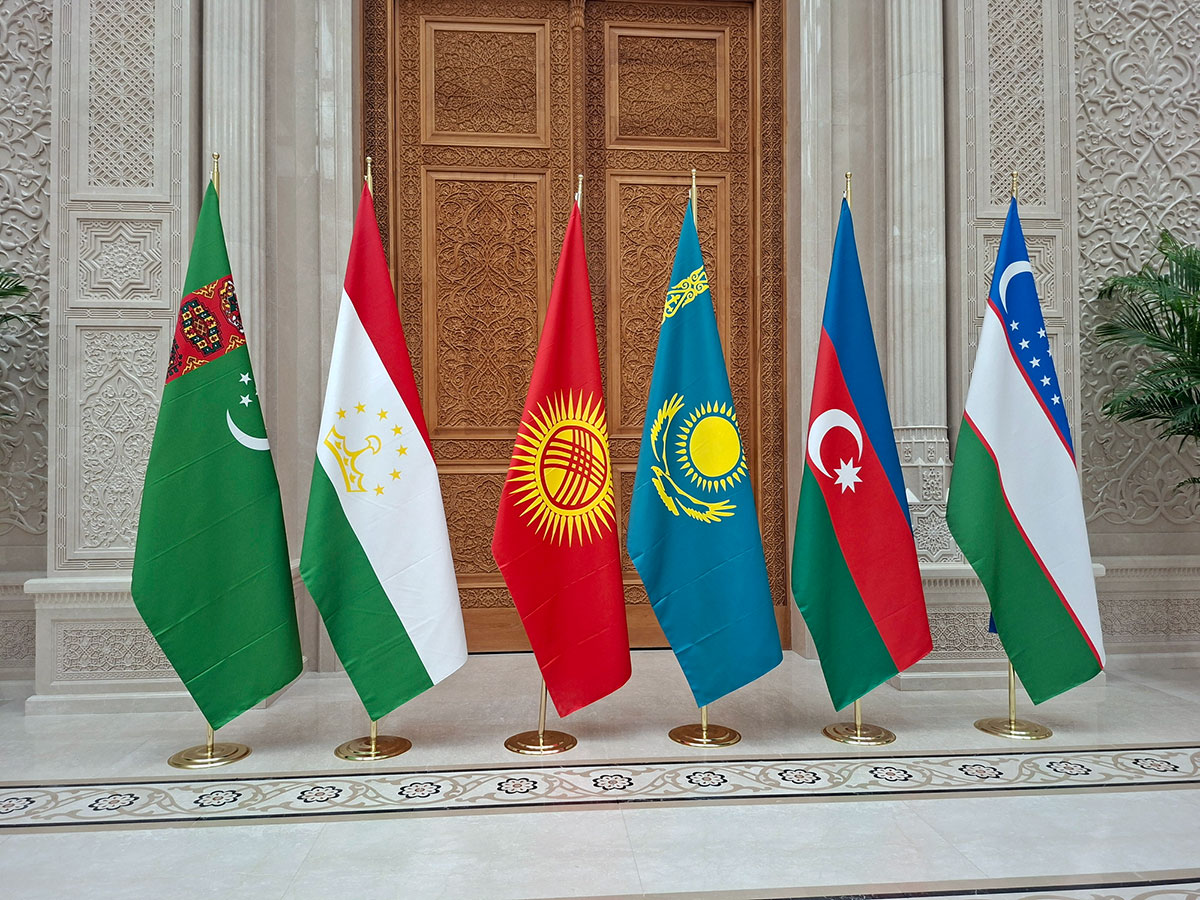

BAKU, Azerbaijan, July 29. Kyrgyzstan is set to host the informal Central Asia-Azerbaijan summit. The meeting will take place at a time when the C6 format is gradually moving beyond the usual mechanism of political consultations and is beginning to acquire strategic significance for all of Eurasia.
Today, the global economy is undergoing a major transformation. While just a few decades ago, states competed primarily as independent players, now entire macro-regions, united by transport, energy, trade, and investment links, are playing an increasingly important role. This is why regional associations and cooperation formats capable of offering sustainable logistics routes, integrated markets, and joint infrastructure projects are gaining increasing importance worldwide.
Against this backdrop, Central Asia is no longer perceived as a peripheral region. It is becoming one of the new centers of economic growth in Eurasia, attracting the attention of major global players. At the same time, the importance of the South Caucasus has grown significantly, becoming a key link in the transport routes between Asia and Europe.
It's in this new geoeconomic reality that cooperation between Azerbaijan and the Central Asian countries is taking on a completely new dimension. The C6 format is no longer simply a platform for political dialogue. It is becoming a tool for creating a unified space of interconnectedness, bringing together transport, energy, trade, investment, digitalization, and security.
It's important to note that cooperation between Azerbaijan and the Central Asian states is not new. They are linked by the historical routes of the Great Silk Road, close trade relations, a common Turkic civilizational foundation, and converging long-term strategic interests. The decision for Azerbaijan to work in a consultative format, adopted in 2025, merely institutionalized processes that had already been actively developing in recent years.
Natural partners
Many regional experts call the current C6 format historically logical. Azerbaijan and the Central Asian states were never random neighbors. For centuries, they formed a single trading space, connecting East and West. The Caspian Sea was the site of the most important routes of the Great Silk Road, and today, their place is being taken by modern transport, energy, and digital corridors. Therefore, current cooperation is restoring the region's natural interconnectedness rather than creating it anew.
This is not an opportunistic political project, but a return to the objective geographic and economic logic of the region's development.
It's precisely this complementarity that makes the C6 format so promising. For the Central Asian states, Azerbaijan is becoming the shortest route to the Caucasus, Türkiye, and European markets. The Middle Corridor, the Baku-Tbilisi-Kars railway, the largest seaport on the Caspian Sea, and the energy infrastructure connecting the Caspian region with Europe pass through its territory.
Meanwhile, the Central Asian countries provide Azerbaijan with access to the Eurasian domestic market and China. Thus, Azerbaijan becomes Central Asia's gateway to the West, and Central Asia becomes Azerbaijan's gateway to the East. This is precisely why both sides objectively enhance each other's strategic importance.
This complementarity is also reflected in economic indicators. Despite the significant potential for further growth, trade and economic cooperation between Azerbaijan and the Central Asian states is already demonstrating steady positive dynamics.
By the end of 2025, Azerbaijan's mutual trade with Central Asian countries reached $1.8 billion. Imports from the region account for the majority of this turnover. At the same time, Azerbaijani producers are gradually strengthening their position in Central Asian markets. For example, exports of non-oil and gas products of Azerbaijani origin to Kazakhstan and Uzbekistan increased by more than 5% compared to the previous year, demonstrating the gradual diversification of trade relations and the expanding presence of Azerbaijani products in the region.
This positive trend continues this year. According to the State Customs Committee of Azerbaijan, in the first six months of 2026, the country's trade turnover with the Central Asian states amounted to approximately $425 million, confirming the steady development of economic cooperation.
Middle Corridor – key project of new Eurasia
The most striking example of such a partnership is the development of the Middle Corridor. Today, the Trans-Caspian International Transport Route is no longer seen as an alternative logistics route, but as one of the most important future routes between Asia and Europe.
The construction of the China-Kyrgyzstan-Uzbekistan railway is of particular importance. Once completed, it will become the eastern link of the Middle Corridor, which then runs through the Caspian Sea, Azerbaijan, Georgia, and Türkiye. This is why President of Kyrgyzstan Sadyr Japarov called the Zangezur Corridor a logical extension of the China-Kyrgyzstan-Uzbekistan railway.
"Today, we are witnessing the creation of a new regional transport artery. The construction of the strategically important China-Kyrgyzstan-Uzbekistan railway will not only connect but will also reshape logistics, opening the shortest route for our countries to the largest markets in Asia and Europe. In this context, the Zangezur Corridor project is seen as a logical and strategic continuation of the China-Kyrgyzstan-Uzbekistan railway," Japarov said at the 7th Consultative Meeting of the Heads of State of Central Asia in the "Central Asia + Azerbaijan" format in November 2025.
The Zangezur Corridor is increasingly becoming an element of the new geoeconomic architecture of Eurasia. For Azerbaijan, the Zangezur Corridor is both an internal connectivity project and an element of its international transport strategy. As President Ilham Aliyev stated in an interview with local television channels on January 5, 2026, Azerbaijan expects cargo from China and Central Asian countries to travel along the Zangezur Corridor as well.
"We naturally view it primarily as a link with the Nakhchivan Autonomous Republic, but also as an international transport corridor. Currently, there is only one railway route from Azerbaijan westward. There will be two. Two are always better than one, especially when you have no access to the world ocean and have to go through neighboring countries. It is always better to have an alternative for volumes, to be competitive, to prevent monopolization of the transit route by anyone, and, of course, to ensure more competitive tariffs," the head of state said.
The Zangezur Corridor isn't intended to duplicate existing routes, but rather to create an alternative - a key logistics category for landlocked countries. This alternative means competitive tariffs, reduced operational risks, less dependence on a single route, and improved predictability of deliveries - parameters critical for modern supply chains.
Together, these projects can create a unified transport system from the Pacific Ocean to Europe. As a result, Azerbaijan will cement its status as one of the most important logistics hubs in Eurasia, while Central Asian states will gain reliable access to global markets.
However, transport is only one element of the new cooperation model.
Azerbaijan and the Central Asian states are already actively cooperating within the CAREC program, developing trade, transport infrastructure, digitalization of customs procedures, and investment cooperation.
Energy is also emerging as a promising area. Azerbaijan is actively developing the Caspian "green" energy corridor, while Kyrgyzstan is developing hydropower, solar, and wind power projects. Potential for combining these potentials within the framework of regional energy cooperation is already being discussed.
Traditional energy is also developing: Bishkek is negotiating with Baku to increase supplies of Azerbaijani oil and petroleum products. Essentially, the discussion is about forming a comprehensive economic partnership encompassing transport, energy, investment, digital technology, industry, and trade.
OTS and C6 - complementary formats
The development of cooperation is receiving additional impetus within the Organization of Turkic States (OTS). Namely the OTS forms the common political basis for interaction, while the C6 format focuses on the practical implementation of joint projects between Azerbaijan and the Central Asian states.
These mechanisms don't compete with each other, but, on the contrary, reinforce each other, creating a multi-layered system of regional integration.
Kyrgyzstan - one of Azerbaijan's main partners
Kyrgyzstan holds a special place in the new cooperation architecture.
Namely Bishkek was one of the first to support Azerbaijan's participation in the Central Asian consultative format, consistently advocating for stronger ties between Central Asia and the South Caucasus.
Today, bilateral relations are developing in virtually all key areas - from transport and investment to energy, digitalization, and space technology.
The Azerbaijan-Kyrgyzstan Development Fund, whose capital is planned to be increased to $100 million, continues its work. Trade infrastructure is being developed, and new investment projects, supplies of Azerbaijani oil, and cooperation in renewable energy are being discussed.
The key feature of the C6 format is that it responds to objective changes in the global economy.
Today, it is not individual states that benefit, but regions that are able to combine their advantages into a unified system of transport, energy, investment, and production ties.
Central Asia and Azerbaijan are gradually becoming precisely such a system.
Therefore, the significance of the C6 is not determined by the number of summits and adopted documents. Its main value is that it creates a new geo-economic reality in which Central Asia and Azerbaijan no longer act as separate partners, but as a single strategic space connecting East and West.



