


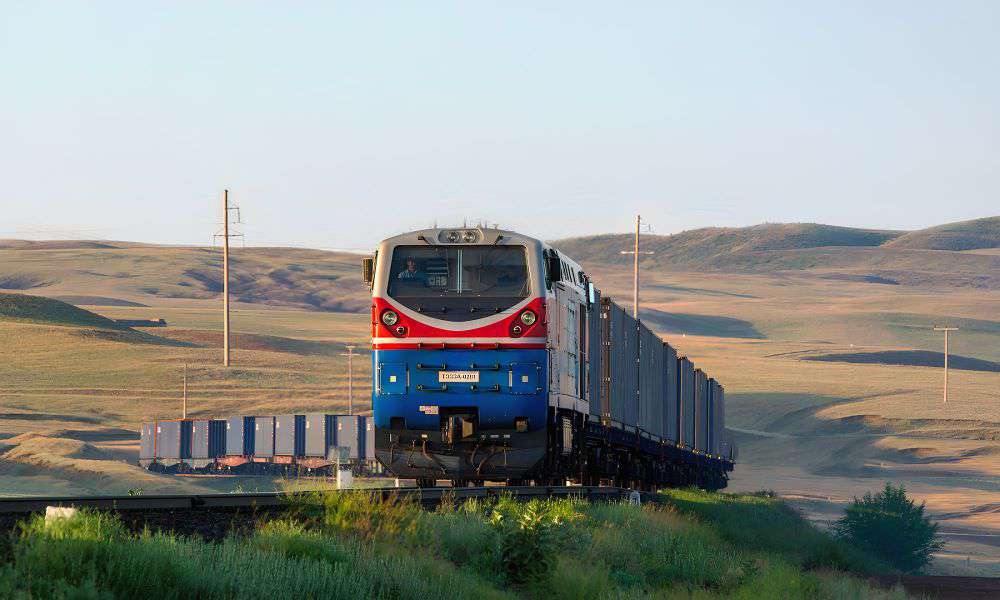

BAKU, Azerbaijan, July 30. The global trade map is rapidly changing. In recent years, deepening geopolitical rivalries, regional conflicts, sanctions, security challenges in the Red Sea, the Russia-Ukraine war and rising tensions in the Middle East have once again highlighted the resilience of global supply chains.
As the reliability of traditional routes that have carried major cargo flows for decades has come under pressure, governments and international businesses have begun searching for safer, shorter and more predictable alternatives. Against this backdrop, the Middle Corridor (Trans-Caspian International Transport Route), linking China, Central Asia, the Caspian Sea, Azerbaijan, Georgia, Türkiye and Europe, is becoming more than just an alternative route - it is emerging as one of the key elements of the global geoeconomic system. Azerbaijan stands at the center of this transformation.
Speaking at the opening ceremony of the 2026 Annual Meetings of the Islamic Development Bank Group in Baku, President of the Republic Azerbaijan Ilham Aliyev highlighted Azerbaijan’s growing role as an international transport and logistics hub.
“So today East-West and North-South corridors crossing Azerbaijan provide very important supply routes for growing number of countries,” President Ilham Aliyev said.
President Ilham Aliyev emphasized that efforts to further strengthen Azerbaijan’s position as a transport and logistics hub must continue.
“Our plan is to double the volume of cargo going through Azerbaijan. Today it's about 14–15 million tons. We look to doubling this figure. Of course, not everything will depend on us, because it will also depend on the geopolitical situation and also the situation in the neighborhood, but these are our plans,” President Ilham Aliyev said.
Assistant to the President of Azerbaijan Hikmet Hajiyev also believes that the Middle Corridor has already moved beyond the traditional understanding of a transport route. According to him, the route is transforming into a strategic geoeconomic system connecting Europe, the South Caucasus and Central Asia, reflecting fundamental changes in Eurasia’s transport architecture.
Hajiyev noted that Azerbaijan’s investments in railway, maritime, aviation and digital infrastructure have enabled the country to become one of Eurasia’s key connectivity hubs.
Azerbaijan strengthens its position on the geoeconomic map
In recent years, Azerbaijan has pursued a consistent policy aimed at transforming itself from a transit country into a logistics and transport hub with broader functions. Billions of dollars invested in railways, highways, port infrastructure, logistics centers and digital solutions have already begun delivering tangible results.
According to the State Statistics Committee of Azerbaijan, in January-May this year, international transport corridors passing through Azerbaijan carried 6.1597 million tons of cargo by rail, 4.731 million tons by road and 2.6525 million tons by sea.
Thus, rail transport accounted for 45.5% of total cargo volumes, road transport for 34.9%, and maritime transport for 19.6%. Compared with the same period last year, railway cargo transportation increased by 3.3%, while road transportation grew by 5.9%, demonstrating rising demand for Azerbaijan’s transit capabilities.
World searches for new logistics routes
Amid growing risks facing traditional routes, the European Union is also paying particular attention to the Middle Corridor. European Commissioner for Enlargement Marta Kos said that for many years Europe had relied mainly on the northern route through Russia and the southern route via the Suez Canal for trade with Asia.
However, current geopolitical realities have significantly reduced the reliability of these routes. According to her, this is precisely why the Middle Corridor passing through the South Caucasus is becoming a strategic alternative for Europe’s trade, energy and digital connectivity.
Kos noted that cargo volumes along the Middle Corridor have already increased fourfold since 2022, while the European Union aims to reduce delivery times along the route from 45 days to 15 days. Achieving this goal requires modernization of roads, railways and ports, as well as simplification of border procedures.
Azerbaijan’s investments are delivering results
Secretary General of the International Road Transport Union (IRU) Umberto de Pretto told Trend that Azerbaijan has become one of the key participants in the Middle Corridor thanks to its investments in transport and logistics infrastructure in recent years.
“Azerbaijan’s investments in transport infrastructure are now delivering results. The country is further strengthening its position as a reliable transit gateway between Europe and Asia and plays a leading role in the development of the Middle Corridor,” he said.
Secretary General of the TRACECA Intergovernmental Commission Asset Assavbayev also believes that projects implemented by Azerbaijan are already reshaping the region’s logistics landscape.
“Azerbaijan’s modern transport infrastructure and port capabilities are significantly increasing the competitiveness of the TRACECA route,” he told Trend.
Baku International Sea Trade Port enters a new stage
One of the key pillars of the Middle Corridor’s success is the Baku International Sea Trade Port. The port currently has an annual cargo handling capacity of 15 million tons. Upon completion of expansion works, this figure will increase to 25 million tons.
Deputy Minister of Digital Development and Transport Samir Mammadov said that the government’s Action Plan for 2024–2026 is aimed specifically at increasing Azerbaijan’s transit potential.
Baku International Sea Trade Port CEO Taleh Ziyadov told Trend that the goal is to transform the port from merely a cargo handling facility into an integrated logistics and industrial hub connecting Europe and Asia.
“We are developing the Baku International Sea Trade Port not simply as a cargo handling point, but as an integrated logistics and industrial center between Europe and Asia,” he said.
According to him, digital solutions, multimodal transportation and faster cargo processing are among the key priorities in this area.
Meanwhile, Deputy Chairman of Azerbaijan Railways CJSC Arif Agayev said that the port’s container handling capacity is also being expanded. “The current capacity stands at 150,000 TEU. Through ongoing expansion works and the installation of new equipment, it is planned to increase this figure to 260,000 TEU in the near term,” he said.
Alat Free Economic Zone plays a role beyond transit
Azerbaijan’s strategy is not limited to cargo transit alone. The Alat Free Economic Zone (AFEZ) is becoming the production and industrial component of the Middle Corridor.
AFEZ Board Chairman Valeh Alasgarov told Trend that the goal is to turn Azerbaijan into a regional production and export platform. “The Alat Free Economic Zone offers investors one of the most competitive business environments in the region,” he said.
According to him, companies operating in the zone will gain access through the Middle Corridor to markets with hundreds of millions of consumers.
Zangezur Corridor to create new opportunities
Experts believe that the next stage in the development of the Middle Corridor will be linked to the opening of the Zangezur Corridor.
The route could connect the East-West and North-South corridors, shorten transportation distances, reduce logistics costs and significantly expand Azerbaijan’s transit capabilities.
U.S. Special Envoy for Peace Missions (SEPM) Aryeh Lightstone told Trend that the TRIPP (Trump Route for International Peace and Prosperity) has a far greater capacity than originally understood.
According to him, Azerbaijan is no longer only a country ensuring connectivity with Nakhchivan, but is also becoming a key link between Central Asia and Europe.
At the same time, according to the Ministry of Digital Development and Transport, discussions with the US delegation included the expansion of the Middle Corridor, development of the Zangezur Corridor and prospects for participation of American companies in these processes.
Azerbaijan’s role highlighted by international organizations
Secretary General of the United Nations Conference on Trade and Development (UNCTAD) Rebeca Grynspan also believes that Azerbaijan has already become a country of global significance in the areas of logistics and regional connectivity.
According to her, Azerbaijan serves as an important bridge between Europe and Asia and is one of the key participants in shaping a new international economic architecture.
Azerbaijan’s strategic advantage in the emerging global order
Current geopolitical realities demonstrate that modern economies compete not only through production capacity, but also through reliable connectivity, secure logistics and flexible transport routes.
This is precisely why the Middle Corridor is gradually becoming one of Eurasia’s major economic arteries. Through its consistent infrastructure policy, expansion of the Baku International Sea Trade Port, development of the Baku–Tbilisi–Kars railway, establishment of the Alat Free Economic Zone, digitalization efforts and international partnerships, Azerbaijan is strengthening its position as one of the central links in this emerging geoeconomic system.
At a time when traditional routes face growing risks and governments and businesses are searching for reliable alternatives, Azerbaijan’s logistics infrastructure carries strategic importance not only for the region but also for the future of trade between Europe and Asia.
Thus, the Middle Corridor is evolving from a cargo transportation route into a new geoeconomic platform that supports economic integration, energy security and the resilience of global supply chains.



