


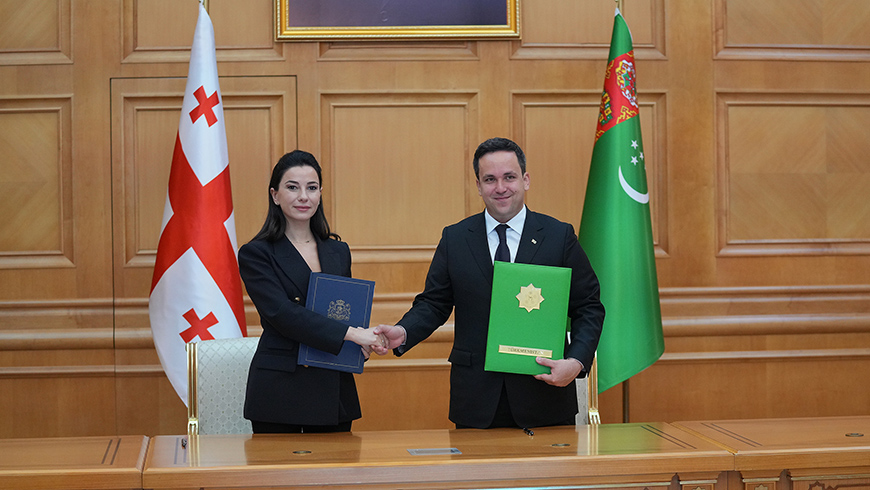
BAKU, Azerbaijan, May 8. The visit of Georgian Minister of Economy and Sustainable Development Mariam Kvrivishvili to Ashgabat and the 5th session of the Intergovernmental Georgian-Turkmen Commission on Economic Cooperation, held on May 7, confirmed the further deepening of interaction between the two countries in transport, trade, energy, and technological spheres. During the session, the parties discussed the current state of trade and economic relations and identified priority areas for expansion, including the development of transport and logistics potential, increasing freight transportation, including railway shipments, as well as issues related to energy, the chemical industry, and investment cooperation.
The main focus of the meeting was placed on the transport and logistics agenda. The sides emphasized the importance of increasing cargo volumes and expanding infrastructure cooperation, including railway routes and multimodal chains. Coordination between transport and infrastructure agencies was also discussed, along with creating conditions for more active engagement of business communities from both countries. At the end of the meeting, the Final Protocol of the 5th session of the Intergovernmental Commission was signed, consolidating the agreements achieved.
However, the recent session is not an isolated diplomatic event. It was preceded by a series of processes and negotiations that are effectively shaping a new geoeconomic configuration across the Caspian and Black Sea regions.
In recent weeks, Tbilisi has intensified negotiations around the development of the Middle Corridor - a route connecting China, Central Asia, the Caspian region, the South Caucasus, and Europe. One of the key elements of these discussions was Georgia’s engagement with China. On April 24, Mariam Kvrivishvili, leading the Georgian delegation in Beijing, discussed the development of the Middle Corridor and the strategic role of the Black Sea deep-sea port of Anaklia with Zhou Haibin, Vice Chairman of China’s National Development and Reform Commission. Tbilisi considers Anaklia one of the key logistics hubs of future Eurasian transit.
At the same time, Georgian authorities are advancing the modernization of domestic transport infrastructure. On May 5, “Georgian Railway” presented its “historic renewal” project, which foresees a large-scale reconstruction of the country’s railway system. On May 6, construction works on the deep-sea port of Anaklia officially began, with the participation of Mariam Kvrivishvili.
Thus, by the time of the delegation’s arrival in Ashgabat, Georgia already had a comprehensive strategy aimed at transforming the country into one of the central transit hubs of the Middle Corridor.
Against this backdrop, Turkmenistan is becoming increasingly important for Georgia. It is one of the key Caspian participants in the route connecting Central Asia with the South Caucasus and further with Europe. The implementation of such an architecture requires close coordination of transport, port, customs, and logistics infrastructure between Turkmenistan, Azerbaijan, and Georgia.
As previously noted in Trend’s analytical article “Turkmenistan pushes West via Georgia - with Azerbaijan as linchpin,” Azerbaijan plays a key connecting role between the Caspian and the Black Sea. Transport routes and a significant share of future energy and logistics projects within the Middle Corridor pass through Azerbaijani infrastructure.
Speaking in Baku on April 2, Deputy Chairman of the Cabinet of Ministers of Turkmenistan Nokerguly Atagulyyev stated that Ashgabat attaches “special importance” to the East-West transport corridor and emphasized the significance of the Trans-Caspian International Transport Route, the Caspian-Black Sea direction, and routes connecting Central Asia with the Middle East. According to him, the development of these corridors opens “new opportunities for trade growth and cooperation expansion.”
On April 3, a series of Azerbaijan-Turkmenistan meetings took place in Baku with the participation of Nokerguly Atagulyyev. During talks with Azerbaijan’s Minister of Economy Mikayil Jabbarov and Minister of Digital Development and Transport Rashad Nabiyev, the sides discussed expanding cooperation in energy, transport, logistics, and transit. Particular attention was given to multimodal transportation via the Baku International Sea Trade Port and the Port of Turkmenbashi, digitalization of transport operations, and increasing cargo flows along the Middle Corridor. At the same time, Azerbaijani Prime Minister Ali Asadov stated that in 2025, transit transportation along the Middle Corridor increased by almost 11%, reaching 5 million tons.
The above indicates that amid growing global interest in alternative Eurasian routes, Azerbaijan’s role as a central transit hub between these two countries continues to strengthen.
For Georgia, closer ties with Turkmenistan open opportunities to increase cargo flows through its ports, strengthen its position as a Black Sea logistics hub, and expand cooperation with Central Asia.
Moreover, Tbilisi aims to solidify its role as one of the key infrastructure partners of the EU and China within the Middle Corridor. The development of Anaklia, modernization of railways, and expansion of transport capacities are directly linked to this strategy.
For Turkmenistan, cooperation with Georgia is also becoming increasingly important. Ashgabat is interested in diversifying external trade routes, expanding access to the Black Sea direction, and strengthening transit links with European markets. At the same time, the Middle Corridor format allows Turkmenistan to integrate more actively into regional trade without abandoning its traditional policy of neutrality.
Additional interest lies in cooperation in digital economy, financial services, banking interaction, and technological platforms. Amid growing trade volumes and logistics integration, the sides are increasingly discussing mechanisms for simplifying settlements, coordinating customs procedures, and digitizing transit operations.
In this context, the recent session of the Intergovernmental Commission in Ashgabat may mark an important stage in the further deepening of Georgian-Turkmen cooperation across multiple strategic areas - from trade to digital economy and infrastructure integration within the Middle Corridor.
Energy issues also gain particular importance in this context. The question previously addressed by Trend in the article “Eurasia’s gas balance: How Galkynysh could reshape supply routes” is becoming increasingly relevant amid the launch of the “Galkynysh” field development on April 17 and Europe’s continued interest in alternative gas sources.
The sides may also explore cooperation in digital economy, high technologies, and the agro-industrial sector, including the introduction of technological solutions in agriculture and logistics. As special attention during the session was given to strengthening business-to-business contacts and preparing conditions for joint investment projects, it is expected that reciprocal business delegations will be organized in the near future to further develop practical areas of cooperation.
Within these visits, one of the relevant areas of mutual cooperation and experience exchange may become financial and banking cooperation. Georgia already has experience in expanding its financial institutions into Central Asian markets - in particular, TBC Bank is actively operating in Uzbekistan.
The Georgian financial system has already established itself as being well integrated into international capital markets: in early May, Minister Mariam Kvrivishvili participated in a London Stock Exchange ceremony marking the inclusion of Bank of Georgia (part of Lion Finance Group) in the FTSE 100 index - the main UK stock index comprising the 100 largest companies by market capitalization listed on the LSE. This made Bank of Georgia the first company from the country to enter the FTSE 100, signaling strong investor confidence in Georgia’s financial sector.
Overall, the recent session of the Commission represents a logical continuation of the growing convergence between Georgia and Turkmenistan. Given the accumulated momentum of political contacts, rising trade volumes, and parallel infrastructure developments in the region, the reached agreements are expected to gradually move into the practical phase. Future relations are likely to develop through regular meetings and reciprocal visits, including greater involvement of business communities from both countries.



