


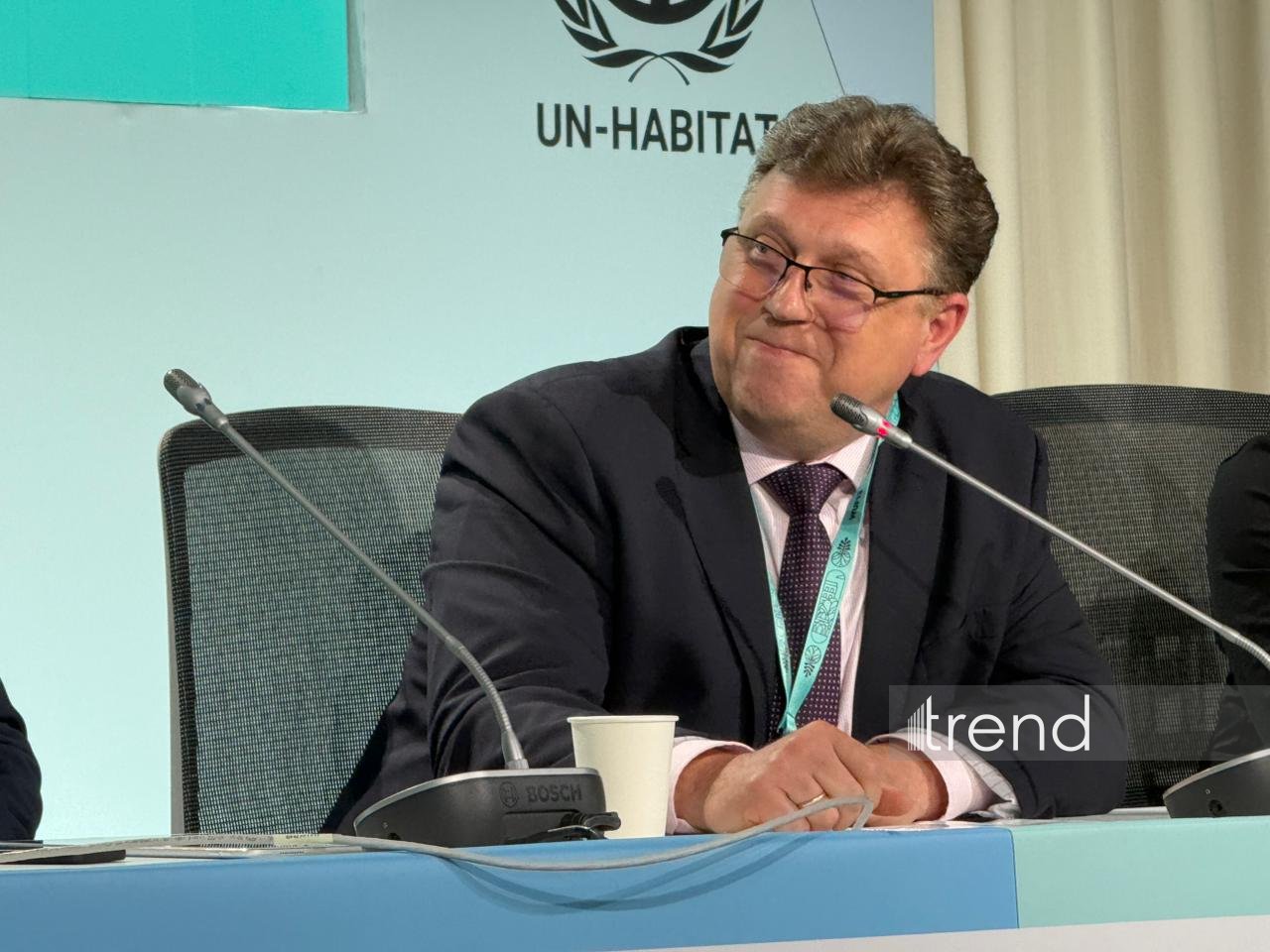

BAKU, Azerbaijan, May 17. Circular materials, such as recycled aluminum, both reduce greenhouse gas emissions and shape a more sustainable economic model for the housing sector, the Director of the Climate Regulation and International Certification Department at RUSAL, Alexey Spirin, said during the Business Assembly session, held within the framework of WUF13 in Baku, Trend reports.
According to him, the environmental savings achieved are substantial.
"During primary aluminum production, 12–14 tons of carbon equivalent emissions are generated per ton of product, requiring 12–16 megawatt-hours of electricity. In contrast, emissions in the production of recycled—meaning secondary—aluminum amount to just 0.5 tons, and it consumes only 5% of the energy compared to primary production," Spirin noted.
"In Europe, 75 to 95% of the aluminum used in the construction sector already consists of recycled materials. The carbon footprint of these products is less than 2.5 tons of CO2 per ton, which is five times lower than the global average for primary aluminum production."
The director emphasized that using aluminum also creates significant advantages for households.
"Modern aluminum windows reduce heat loss by 40–50%, ultimately allowing a typical European apartment to save 200–400 euros on annual heating costs," he said. "In addition, aluminum facade systems can be used for 50–80 years with minimal maintenance, whereas plastic facades typically require repairs every 10–15 years. High-quality energy efficiency renovation projects usually yield a financial return within 7–12 years."
Alexey Spirin added that the circular economy approach also reduces price volatility.
"Recently, the price of primary aluminum has fluctuated between 1,400 and 3,000 dollars per ton. In the recycled aluminum market, volatility is roughly twice as low, which establishes more stable costs for cities and the construction sector," the director explained.
"The recycling of construction waste is also vital because transporting and disposing of waste at landfills creates additional costs. Recycling helps reduce these fees and charges. For instance, in Amsterdam and Copenhagen, using recycled aluminum allows saving 30–50 euros per ton in landfill costs."
He noted that a design approach allowing for dismantling and reuse preserves 60–70% of the residual value of materials.
"This is particularly important for aluminum because one of the main challenges during recycling is contamination caused by aluminum mixing with steel, copper, and other metals," Spirin concluded. "Re-manufacturing aluminum into the correct alloy form after use becomes difficult because secondary aluminum, when contaminated with various materials, turns the acquisition of a high-quality product into a more complex process."



