


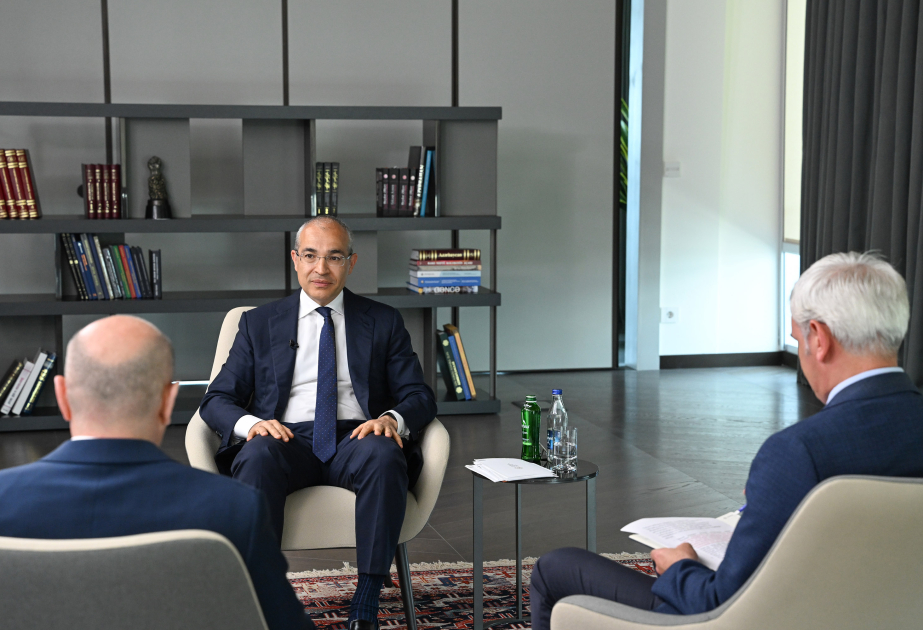
BAKU, Azerbaijan, June 11. The oil and gas sector continues to play a very important role in Azerbaijan’s economy today, Azerbaijan’s Minister of Economy Mikayil Jabbarov said in an exclusive interview with AZERTAC and İTV.
“The oil and gas sector still plays a very significant role in our economy today. As I have already noted, it accounts for 30 percent of gross domestic product (GDP), which is a very substantial figure. At the same time, it plays an important role in generating the country’s revenues. This is the case purely from an economic perspective, but at the same time, it is clear that for many decades there has been no real alternative to this sector. When shaping our economic policy, we must approach this as follows: recognize the importance of the oil and gas sector, but not tie our development to fluctuations in global market prices, and instead see the path forward in ensuring economic resilience.
As for our oil reserves and developments in the oil and gas industry, we passed the peak of production 16 years ago. That was in 2010, when around 51 million tons of oil were produced in the country. By comparison, in 2025 this figure stood at 27.7 million tons. Yes, natural gas production has increased significantly compared to that period. However, in value terms, these factors are not fully interchangeable. In the current new conditions, I would divide our strategy in this area into two parts.
The first is that Azerbaijan still possesses significant volumes of oil and gas. New projects will be launched, and stable and sustainable operations will be ensured at existing fields. Work is actively ongoing on the start of deep gas production from the Azeri-Chirag-Gunashli field, the full-scale development of the Absheron field, the commencement of production at the Babek field, the second phase of the Umid field development, the development of rich resources in the Bahar and Gum Deniz projects, as well as the Karabakh project. This is one side of the issue; therefore, our country will remain a reliable producer and exporter of oil and gas for many years and decades to come.
On the other hand, we should not forget that until now oil and gas production in the country has been carried out using traditional methods. Unconventional extraction methods that have emerged in the sector over the past decade have not yet been applied here, but they are currently being studied. Our country has relevant resources in this area. SOCAR and a number of foreign partners have already signed various memoranda of understanding and framework agreements in this regard. However, I would like to emphasize the following: when planning our economy and revenues, we should treat these projects as a kind of bonus. Even if they are not realized, our main path remains the development of a diversified economy capable of producing competitive goods in many sectors. Let us treat this as a bonus—if it does not materialize, we will still achieve our main goals.
The second part of the strategy is that we do not intend to lose the centuries-old traditions, knowledge, and expertise of our country in this field, or its position in global and regional markets. That is why you can observe that the activities of our leading institution in this area—SOCAR—have recently expanded into foreign markets and have become more active. Looking back 18 years, the entry into the energy market of friendly Türkiye and SOCAR’s subsequent transformation into the country’s largest energy investor, owner of one of the most modern oil refineries, the only petrochemical complex, logistics terminals, and key trunk pipelines marked the beginning of this long-term strategy and its tangible realization.
Today, however, SOCAR is acquiring stakes in various projects abroad not only in downstream infrastructure but also in upstream production. This year, investment projects were launched in the United Arab Emirates and, for the first time on the African continent, at a major field in Côte d’Ivoire. In addition, participation has been secured in a gas production project in Israel, and this activity will continue. We believe this is possible due to our resource base, expertise, professional capabilities, and the role our country plays internationally.
Let us not forget that today we supply natural gas to 16 countries, contributing to their energy security. Especially in geopolitically sensitive periods such as the present, this factor further enhances our country’s role. In this sense, we do not carry out this activity as charity. We are compensating for the declining portion of revenues previously generated from the export of our domestic resources through active engagement and investment in foreign markets. In return, the state-owned company—of which the state holds 100 percent of the shares—generates dividends for the country.
This is a special direction, and I could list many successful projects in this regard. The most recent among them is the acquisition of Italiana Petroli—a large company with a 35 percent share of the Italian market, owning two refineries and several thousand service stations. This activity will continue. We can also mention the signing of an agreement with Uzbekneftegaz and bp on the joint development of the Ustyurt field in friendly Uzbekistan. In other words, this is an ongoing process.
On the other hand, as I noted, we must ensure more active use of the country’s existing transport and oil transportation infrastructure. In the Caspian basin, where Azerbaijan is located, oil and gas fields exist not only in our country but also in neighboring states, and there are broad opportunities and extensive cooperation in this direction. Today, oil produced in both Turkmenistan and Kazakhstan is transported through Azerbaijan’s infrastructure and reaches external markets. Naturally, this is an important element of the Middle Corridor, ensuring connectivity of energy infrastructure and contributing to the activity of our fleet, ports, and overall transport system.
Therefore, we look to the future of our country’s oil and gas sector with optimism. I believe this area should no longer be seen purely as an oil and gas industry, but more broadly as the energy sector as a whole, because patterns of energy consumption by people, companies, and enterprises are changing, and we must be ready for this.
Some time ago, a decision was agreed upon to construct a new oil
refinery—likely one of the largest investment projects of recent
years in our country. We expect the project to be completed within
approximately 5–6 years. It will be a fully modern refinery meeting
today’s requirements. This does not only concern industrial and
environmental standards but also compliance with modern business
model requirements. The plant will produce not only liquid fuels
but also next-generation petrochemical products. At present, under
the coordination of the relevant government commission and with
state support, SOCAR has begun implementing this project,” said
Mikayil Jabbarov.



