


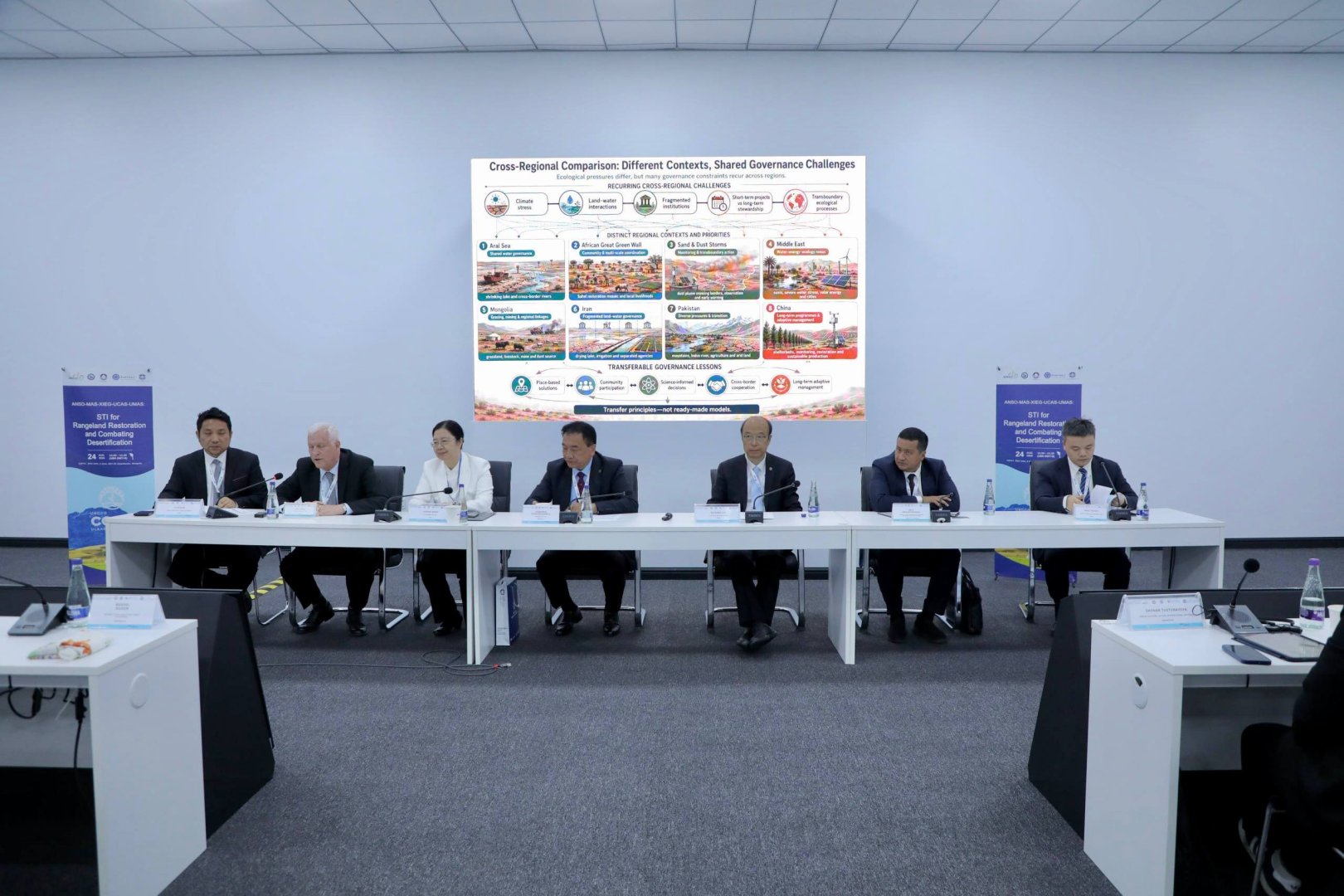

BAKU, Azerbaijan, August 26. Uzbekistan, China and Mongolia discussed green technologies and scientific solutions for restoring degraded land and improving sustainable pasture management.
This was reflected in the statement by the National Committee on Ecology and Climate Change of Uzbekistan, following a side event at the 17th session of the UN Convention to Combat Desertification (UNCCD COP17).
The event, titled “Green Technologies for Sustainable Pasture Restoration and Combating Desertification,” brought together experts and representatives from the three countries, as well as researchers from the Alliance of National and International Science Organizations in Regions of the Belt and Road (ANSO), the Mongolian Academy of Sciences and China’s Xinjiang Institute of Ecology and Geography.
The discussions focused on practical and innovative approaches to restoring degraded ecosystems and improving the long-term productivity of dryland areas.
Erkin Mukhtidinov, director of Uzbekistan’s Agency for Increasing Forests and Green Zones and Combating Desertification under the National Committee for Ecology and Climate Change, said the scale of land degradation requires a systematic response.
About 30 million hectares of Uzbekistan’s territory consist of natural desert and arid landscapes, while more than 11 million hectares are classified as degraded. Around 70% of the country’s territory is exposed to desertification risks.
“Restoration cannot be based on fragmented measures. We need solutions that are scientifically sound, technologically tested, measurable and scalable,” Mukhtidinov said.
The event placed particular emphasis on international scientific cooperation. Uzbekistan is working with Chinese research institutions, including the Xinjiang Institute of Ecology and Geography, on ecosystem restoration, combating desertification, developing halophyte gardens, introducing drought- and salt-resistant plants, environmental monitoring and more efficient water management.
A Uzbekistan-China Research Center for Ecology and Environment of Central Asia was opened in Tashkent in November 2025, providing a platform for further scientific research and practical cooperation.
Uzbekistan proposed moving from individual research projects toward joint regional technology programs. Among the initiatives were the creation of a Central Asian-North Asian Laboratory for Dryland Technologies and Projects, development of a regional standard for assessing the quality of land restoration and a monitoring, reporting and verification system, as well as a joint program for sustainable pasture management and community development.
The proposed projects could test technologies for sand stabilization, pasture restoration, drought- and salt-resistant vegetation, precision water use, and digital and satellite-based environmental monitoring.
Uzbekistan also offered pilot sites in Karakalpakstan, Bukhara, Navoi and other arid regions to test and demonstrate advanced land-restoration technologies.
Participants said combining the expertise of Uzbekistan, Mongolia, China and other countries could help move dryland research from isolated projects toward joint technology development and large-scale implementation, while supporting the emergence of more sustainable and productive dryland economies.



