


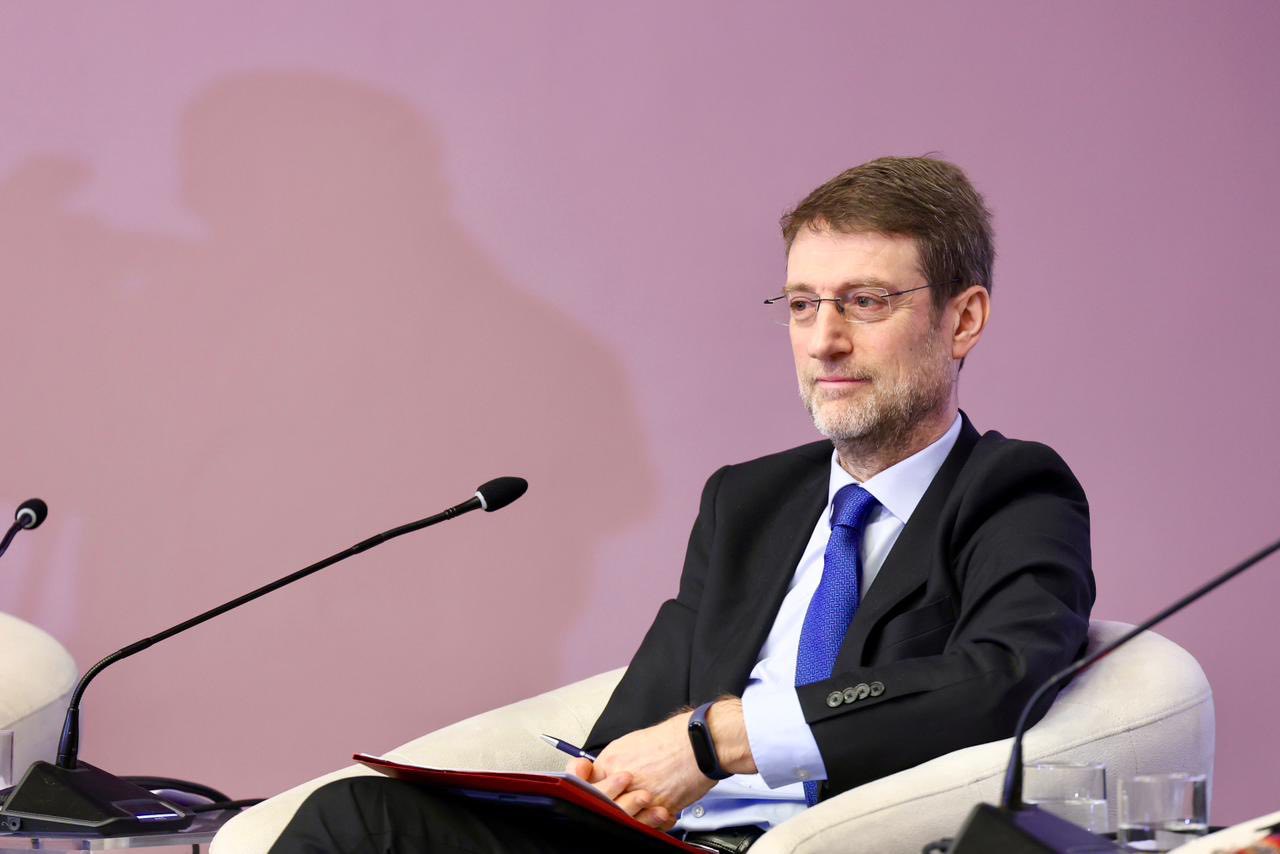

BAKU, Azerbaijan April 21. A strengthened cooperation with Azerbaijan is a part of a wider effort to build a more interconnected, resilient, and strategically coherent European space, Minister for Europe and Foreign Affairs of Albania, Ferit Hoxha said in an exclusive interview with Trend on the sidelines of the Antalya Diplomacy Forum.
"Our bilateral relations with Azerbaijan have considerably improved over the last years. We know that we can do more and we remain committed. There is no doubt that the role and the weight of a country, an actor that contribute to energy security, connectivity, and regional stability increases significantly in times of uncertainty. In this context, Azerbaijan is seen as an important partner for Europe, particularly in energy, and in the development of strategic transport and energy corridors," he said.
The minister believes that to fully realize this potential,cooperation should be structured around a set of concrete and forward-looking priorities:
- Deepening cooperation in energy and infrastructure, including the expansion and diversification of supply routes and interconnections;
- Increasing investments in networks, logistics, and green technologies, with a focus on sustainability and long-term resilience;
- Strengthening economic ties that enhance competitiveness, support integrated value chains, and facilitate trade flows;
- Enhancing regular and structured political dialogue on regional security and shared strategic interests.
"From Albania’s standpoint, such partnerships generate greater value when they are aligned with the broader objective of European integration. They also reinforce Albania’s role as a key node in regional connectivity and support its profile as a reliable and responsible Euro-Atlantic actor. In this sense, we see a strengthened cooperation with Azerbaijan as part of a wider effort to build a more interconnected, resilient, and strategically coherent European space," Hoxha added.
The Albanian minister also praised the progress in the Azerbaijan-Armenia peace process.
"First of all, we are happy that peace has prevailed. So, in this respect, any credible progress in strengthening long-term peace process between Azerbaijan and Armenia is a positive development, as it strengthens stability and development in a region known for its strategic importance for energy, connectivity, and broader European security. Sustainable peace will contribute to greater regional predictability, improve the climate for cooperation, and strengthen connectivity corridors between Europe and the wider Eurasian space.
It is therefore essential that this progress be consolidated through the full and consistent implementation of the agreements reached. Lasting peace requires not only political commitment at the highest level, but also sustained efforts to build trust, ensure transparency, and establish effective mechanisms for dispute resolution and regional cooperation. Without these elements, progress risks remaining fragile and reversible," he noted.
Hoxha pointed out that from the Albanian viewpoint, stability in the Caucasus carries implications that extend well beyond the region itself.
"It is closely linked to Europe’s energy diversification efforts, the resilience of key transport and trade routes, and the broader security architecture of the continent. In this context, peace in the Caucasus should be understood not only as a regional objective, but as a strategic contribution to Europe’s overall stability, resilience, and long-term prosperity," the Albanian minister added.
Further, speaking about Albania's priorities at the Antalya Diplomacy Forum, Hoxha said this year’s forum delivers a clear and timely message: in an international environment marked by multiple, overlapping uncertainties, diplomacy must evolve—becoming not only reactive, but also preventive, strategic, and focused on building resilience.
"From Albania’s perspective, this requires a sharper understanding of ongoing geopolitical transformations, stronger coordination with Euro-Atlantic partners, and, crucially, the ability to translate political priorities into concrete state, economic, and institutional capacities. Diplomacy today must bridge vision with implementation. For Albania, “mapping the future” means recognizing that security, the economy, energy, and European integration are no longer separate domains. They are deeply interconnected. Developments in one sphere increasingly generate immediate spillover effects across others—impacting trade, supply chains, fiscal stability, and social cohesion.
In this context, Albania sees multilateral diplomacy, a strong Euro-Atlantic partnership, and the acceleration of EU integration not only as strategic priorities, but as essential responses to a more complex and unpredictable global environment. These are the tools through which we can better anticipate risks, enhance resilience, and contribute meaningfully to regional and international peace, stability, and sustainable development," he explained.
Hoxha believes that Europe and the Western Balkans must adapt their strategies by moving beyond reactive crisis management toward building sustainable, long-term resilience.
"This requires not only stronger state capacities and improved inter-institutional coordination, but also targeted investments in critical sectors such as energy security, infrastructure, digital transformation, and regional connectivity. From Albania’s perspective, the Western Balkans are an integral part of the European and Euro-Atlantic security architecture. As such, the region’s stability is inseparable from that of Europe as a whole. Accelerating integration into the European Union is therefore not only a national aspiration for our countries, but a strategic investment in Europe’s own security, cohesion, and global credibility.
In this context, advancing reforms in the rule of law, strengthening public financial management, deepening digitalization, and promoting sustainable and inclusive economic growth are essential. These efforts enhance institutional resilience, improve governance, and increase the region’s capacity to withstand external shocks—whether geopolitical, economic, or energy-related," said the minister.
At the same time, he believes that strengthening regional cooperation remains key.
"By fostering trust, improving connectivity, and aligning more closely with EU standards and policies, the Western Balkans can position themselves as a reliable and proactive partner in addressing shared challenges. Ultimately, resilience is not only about preparedness—it is about transformation. It means building societies and economies that are adaptable, competitive, and anchored in democratic values, capable not only of managing uncertainty, but of shaping a more stable and secure future for the region and for Europe as a whole," said Hoxha.
The Albanian foreign minister noted that from his country's perspective, Europe should pursue a strategy built on three mutually reinforcing tracks.
"First and foremost, the EU should pursue the enlargement process with the Western Balkans with conviction and without hesitation. In the current geopolitical environment, enlargement is not a just a policy, it is a strategic imperative. By advancing accession in a credible and merit-based manner, the EU would reinforce stability, strengthen democratic institutions, and reduce the space for external influence in a region that remains central to Europe’s long-term security.
Throughout the history of the European Union, enlargement has
proved to be EU’s most effective geopolitical investment. Previous
enlargements are irrefutable proof. In the short term, effect of
joining ther EU anchors reforms, boosts investor confidence, and
enhances policy alignment across critical areas such as energy,
infrastructure, and the rule of law. Over time, it contributes to a
more cohesive and resilient European continent, better equipped to
manage economic shocks, security risks, and global competition," he
explained.
Second, said Hoxha, the EU should further strengthen economic and
energy security through sustained investment in energy
interconnections, transport corridors, and critical infrastructure.
Improving cross-border connectivity and resilience would not only
reduce vulnerability to supply disruptions but also enhance
regional integration and long-term stability.
"It should more decisively support economic diversification and competitiveness, particularly in the Western Balkans. This requires empowering the private sector, accelerating the digitalization of value chains, fostering technological innovation, and addressing structural weaknesses. Such efforts are essential to mitigate the spillover effects of external shocks on production, supply chains, and employment, while enabling more sustainable and inclusive growth.
This is precisely what the EU is already advancing, together with all of us, through the Growth Plan. More than a financial instrument, the Growth Plan represents a forward-looking framework that accelerates economic convergence, supports structural reforms, and brings the Western Balkans closer to the EU’s single market even before formal accession. In the case of Albania, it overlaps perfectly with the accession process," he noted.
Third, as pointed out Hoxha, Europe should reinforce and if possible, diversify creatively, its political and financial instruments for partner and candidate countries, ensuring that the process of European integration serves as a credible anchor for stability.
"For Albania, EU accession is not merely a political aspiration; it is a strategic instrument for strengthening state resilience, consolidating Europe’s southeastern flank, and improving the capacity to withstand geopolitical and economic pressures," the Albanian minister concluded.



