



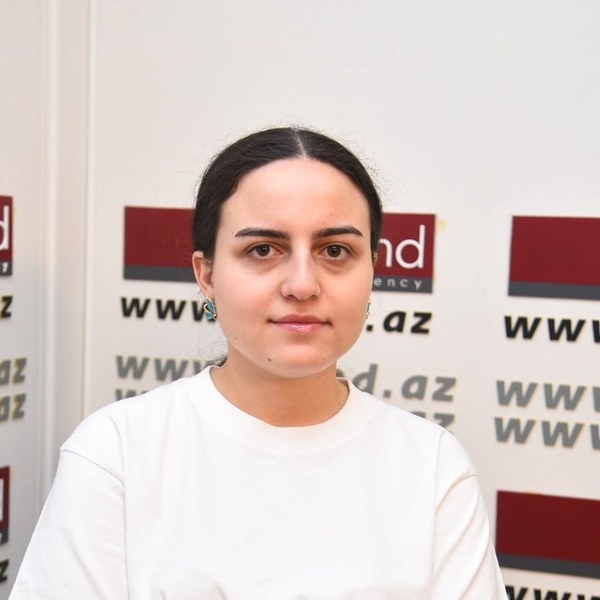
BAKU, Azerbaijan, May 23. Azerbaijan’s second-largest city Ganja has successfully developed its Green City Action Plan and moved to the active implementation stage under the EBRD Green Cities programme, with the European Bank for Reconstruction and Development (EBRD) expecting other Azerbaijani cities to follow suit, EBRD Director, Head of Energy Eurasia (covering Türkiye, Caucasus, Central Asia &Mongolia) Sule Kilic said in an exclusive interview with Trend.
“Ganja’s success story fills us with confidence that other cities will follow suit across Azerbaijan. We stand ready and will be delighted to support other cities in joining our Green Cities programme!” she said.
Kilic highlighted that the EBRD’s support in Azerbaijan goes far beyond urban projects, extending to renewable energy and sustainable infrastructure.
“In Azerbaijan alone, we’ve financed over 1.2 gigawatts of utility-scale wind and solar power and we remain the sole multilateral development bank that has supported all such wind and solar developments in Azerbaijan,” she said.
She added that the Bank has also provided extensive technical support to the country’s energy sector, including renewable auctions launched during COP29 in Baku, regulatory reforms, grid integration, low-carbon pathway development and support for a green hydrogen strategy.
“One big advantage that we bring to the table is that the EBRD is actively supporting renewables and energy infrastructure development in both Central Asian and European countries, so we are well-positioned to engage across borders, supporting preparation with our people on the ground, helping mobilise private capital together with our international partners and financing sustainable infrastructure for further integration,” Kilic explained.
Discussing the integration of renewable energy into ageing urban grids in cities such as Baku and Istanbul, she stressed that this requires grid modernisation, investment in transmission and distribution infrastructure, deployment of smart-grid technologies and storage solutions, as well as improved interconnections and grid management systems.
“The EBRD plays an important role in reducing the risks associated with this large-scale transition. In addition to providing long-term financing, we support such projects through policy dialogue, regulatory reforms and technical assistance aimed at strengthening the investment framework and improving bankability,” she said.
Kilic added that the Bank works closely with governments, utilities, sponsors and commercial lenders to mobilise private-sector participation and improve investor confidence in cleaner and more resilient energy systems.
Touching upon Azerbaijan’s liberated territories, she confirmed that the EBRD is preparing a new programme together with the European Union to support internally displaced persons returning to Karabakh.
“The Bank is currently working with the European Union on a programme to support Internally Displaced Persons returning to Karabakh by creating sustainable economic opportunities for them. This will include private sector support and skills development,” Kilic said.
“The programme is currently on the preparation stage. And Baku Resident Office will be able to share more details about this soon,” she added.
Kilic also discussed the Bank’s work in Central Asia. She highlighted that the EBRD is the region’s largest investor in renewable energy, having financed more than 6.5 gigawatts of installed renewable capacity and mobilised 4.2 billion euros for the energy sector.
“The Bank takes a holistic approach to supporting energy transition, not only investing in renewable energy capacity but also helping to build the supporting auxiliary infrastructure needed to facilitate integration into the power system, and therefore prioritising investments in grid and regional network infrastructure projects,” she said.
She noted that Kazakhstan’s national grid operator KEGOC has been a long-standing EBRD partner since the 1990s, with the Bank supporting seven projects to date, including the Integration of the West Zone Project connecting the country’s isolated western power zone with the national grid through more than 600 kilometres of high-voltage transmission lines.
“In April 2026, at the Regional Ecological Summit in Astana, the EBRD signed a memorandum of understanding with the Government of Kazakhstan announcing the Just Energy Transition Investment Platform (QaJET). The platform is expected to mobilise up to 20 billion euros of investments to deploy 10 gigawatts of renewable capacity by 2035,” Kilic said.
According to her, the EBRD has already financed the first QaJET project — the one-gigawatt Mirny Wind project developed by TotalEnergies and local partners, including a 300-megawatt battery storage component.
“We hit the ground running within the framework of QaJET and financed its first project, a one-gigawatt Mirny Wind, with a 300-megawatt, 600 megawatt hour battery storage component developed by TotalEnergies together with its local partners, for which the Bank mobilised around $550 million,” she said.
“The inclusion of the battery storage component is a critical element in ensuring the sustainable integration of the project into Kazakhstan’s energy system,” Kilic added.
Speaking about Uzbekistan, she noted that the EBRD supports the country’s renewable energy expansion through investments in transmission infrastructure and cooperation with the National Electric Grid of Uzbekistan (NEGU).
“We have financed high-voltage transmission lines spanning several hundred kilometres, as well as major substations, connecting new wind and solar capacity in remote areas to the central grid. We are also developing a strong pipeline of new grid projects to support further expansion,” she said.
Kilic also stressed that the Bank provides technical assistance to strengthen NEGU’s corporate governance, improve project delivery and enhance capacity to manage increasingly complex power systems.



