


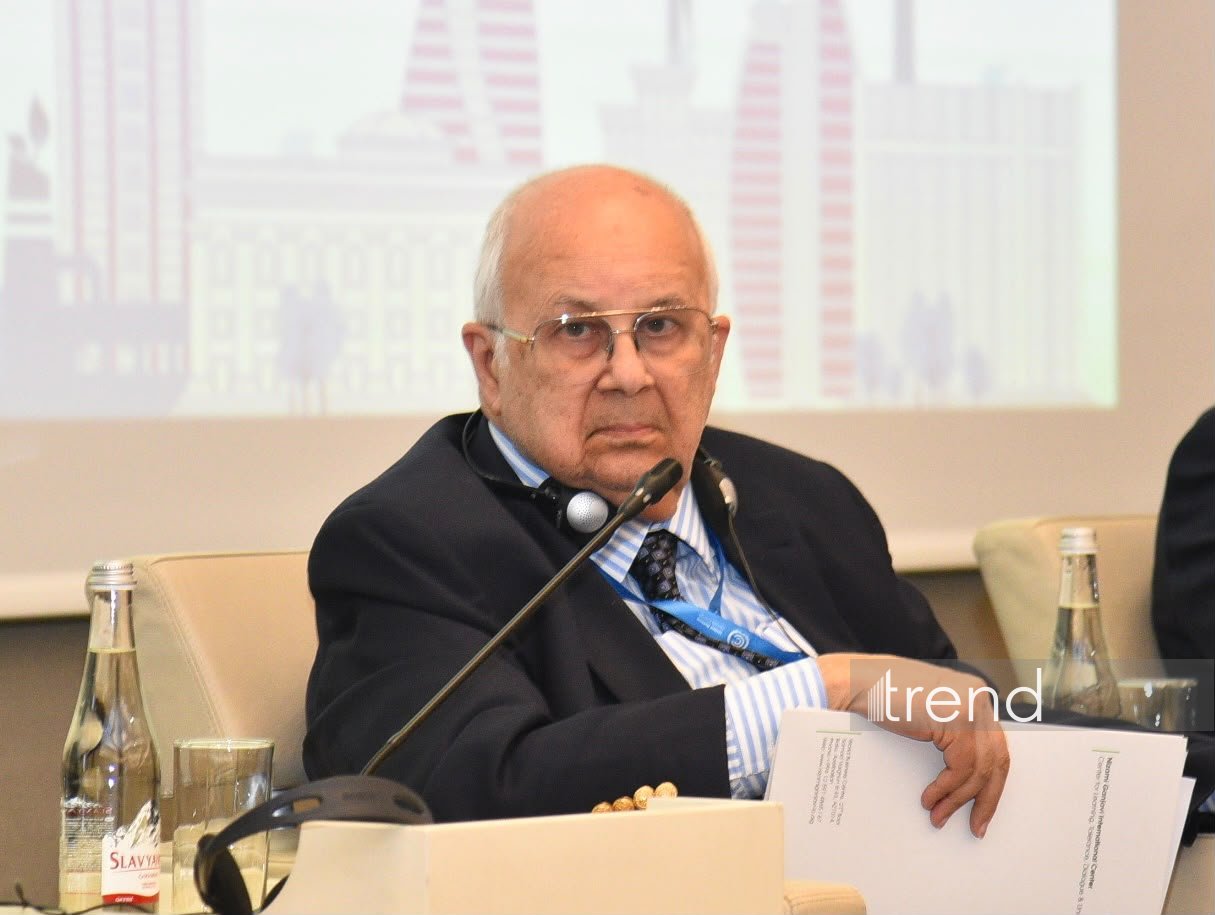

BAKU, Azerbaijan, September 8. The Caspian Sea region should prioritize nature-based solutions and preserve ecological balance when developing new areas, Co-Chair of the Nizami Ganjavi International Center Ismail Serageldin said, Trend’s correspondent reports from the event.
He made the remarks during the panel session titled “Climate change challenges on the inland water bodies: Caspian Sea case” held as part of Baku Climate Action Week 2026.
Serageldin stressed that when developing new territories, it is not appropriate to focus only on the immediate economic aspects of creating infrastructure. “We all have to remember that cutting down trees led to our failure to properly appreciate the importance of the ecosystem services provided by forests. As a result, we faced floods and a number of other problems that were not anticipated at the time. All of this happened because we failed to take into account nature’s capacities, focusing only on obtaining timber and other resources,” he said.
According to him, if a regional cooperation program is developed to address the current situation, it should focus on three key areas. “First, there should be cooperation in science, modelling, measurements and early warning signals related to the processes taking place. This information should be shared at the technical level across the region and should serve as a basis for political decision-making,” Serageldin noted.
He identified the involvement of local communities as the second important area. “Local communities are the part of society that is directly affected by these processes. They can immediately suffer from changes occurring in coastal areas or, on the contrary, benefit from them,” he said.
Serageldin highlighted the use of nature-based solutions wherever possible as the third priority. “The third and, in my view, extremely important issue is to prioritize nature-based solutions as much as possible and find ways to preserve this balance,” he added.
He also noted that human activity is having a significant impact not only on the climate but also on the hydrological cycle. “As the Global Commission on the Economy of Water has pointed out, for the first time we are now affecting not only the climate but also the hydrological cycle through human activity. We all used to think that the hydrological cycle was unchanging: water evaporates here, then moves and falls as rain somewhere else. However, today the balance between water resources known as ‘green water’ and ‘blue water’ is changing, and a large part of this is driven by human activity,” Serageldin said.
According to him, protecting the hydrological cycle should be recognized as a global public good and incorporated into economic assessments of projects. “It is time to take care of this and recognize that the protection of the hydrological cycle, as a global public good, must be included in economic evaluation frameworks. Human activity affects this process, and this factor must be taken into account when assessing projects and investments,” he emphasized.



