


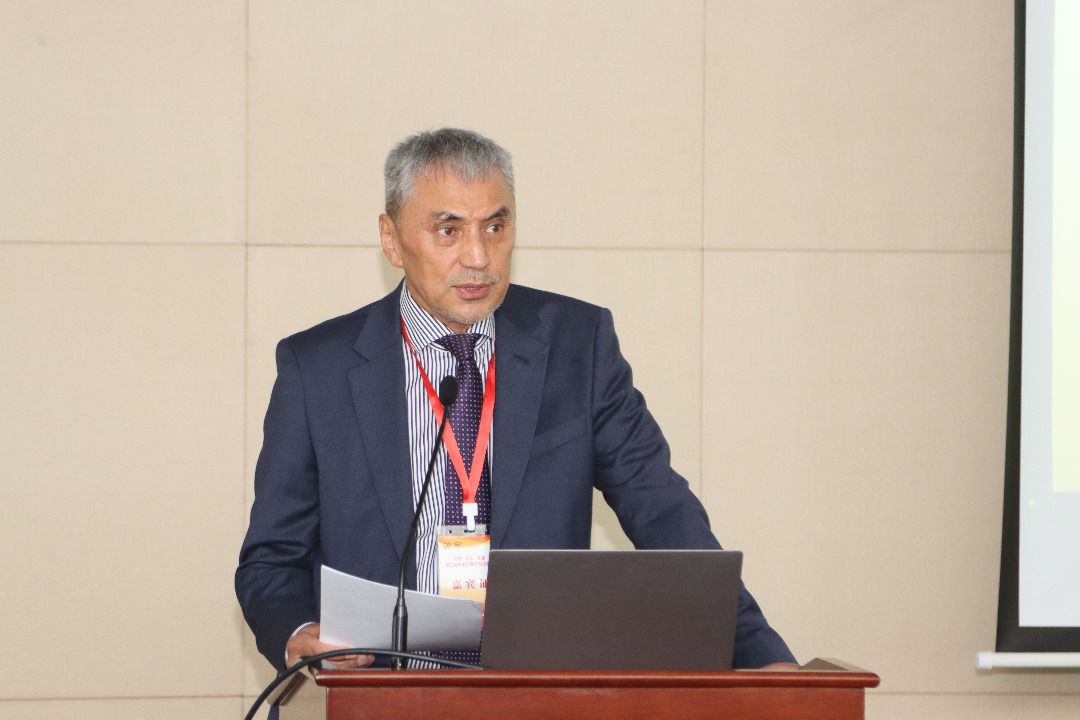

BAKU, Azerbaijan, August 31. Kyrgyzstan needs to leverage its geographic position not only as a transit factor, but also as a basis for developing new production and logistics chains between China, Central Asia and further south and west, Professor at Ala-Too International University (Bishkek, Kyrgyzstan) Kubanychbek Taabaldiev told Trend.
“Kyrgyzstan needs to leverage its geographic position not only as a transit factor, but also as a basis for developing new production and logistics chains between China, Central Asia and further south and west. Kyrgyzstan is primarily interested in maintaining, and even more so in accelerating, the current pace of economic development. Over the past four years, Kyrgyzstan’s GDP has grown 2.5 times. No other country in the region has recorded such growth. What is driving this? Foreign investment. Then there are areas such as transport, trade, energy, construction and security.
The transport sector is under particular attention from the country’s authorities. The start of construction of the China-Kyrgyzstan-Uzbekistan railway at the end of 2024 marked the beginning of Kyrgyzstan’s emergence from its transport isolation,” he said.
According to him, energy, digitalization and joint responses to climate and emergency challenges are no less important.
“Construction of new large hydropower plants on the country’s rivers is progressing at an accelerated pace. Negotiations are underway and terms are being discussed with Rosatom on the construction of small-capacity nuclear power plants, as the acute shortage of generating capacity is already becoming apparent due to the growing number of companies requiring a stable electricity supply. At the same time, humanitarian cooperation remains an important tool for strengthening trust between the societies of SCO countries,” he noted.
The professor added that Kyrgyzstan pursues a multi-vector foreign policy, and the SCO provides the country with an opportunity to pursue such a policy, allowing Bishkek not to become tied to a single center of power.
“Within one platform, Bishkek interacts with China, Russia, India, Iran, Pakistan and the Central Asian states, which expands the space for diplomatic maneuver. At the same time, participation in the SCO does not replace bilateral diplomacy but, on the contrary, creates additional channels for its development. For a country like Kyrgyzstan, this is particularly important: multilateral formats can significantly increase Kyrgyzstan’s diplomatic weight and visibility,” he added.
At the same time, Taabaldiev emphasized that after any major political processes, such as summits, virtually everyone is interested in how the event concluded, what documents were adopted and signed, and so on.
“The key issue is how far they will translate into real projects. For Kyrgyzstan, these are primarily transport, trade, energy, investment and digital connectivity – areas where the country can achieve a tangible economic effect.
As a neighbor of one of the SCO’s key leaders, China, Kyrgyzstan can reasonably expect certain preferences in relations. Some of these are already becoming evident. For example, Beijing’s introduction of 240-hour visa-free stays for Kyrgyz citizens in China already says a lot. Beijing is also clearly committed to the construction of the China-Kyrgyzstan-Uzbekistan railway, which is why the project is being financed with the full support of the Chinese side and minimal burden on the other participants. And there are increasingly more such examples.
It is important for Kyrgyzstan to leverage its geographic position and become a more prominent link between China and Central Asia, and through the region, between East and West. If Bishkek manages to maintain this momentum after its SCO chairmanship ends, the current summit could become not a point of completion for Kyrgyzstan, but a launching pad for a new stage of regional cooperation,” he concluded.
The SCO was established in 2001 and initially comprised China, Russia, Kazakhstan, Kyrgyzstan, Tajikistan and Uzbekistan. Over the past 25 years, its membership has expanded to 10 countries. The 26th SCO summit will be held in Bishkek on August 31-September 1, 2026, under Kyrgyzstan’s chairmanship. The meeting will focus on the organization’s further development, strengthening economic and transport cooperation, and security cooperation. Following the summit, the leaders are expected to consider a number of documents related to the development of the SCO’s financial and economic mechanisms, including initiatives to expand settlements in national currencies and establish new cooperation institutions.



