


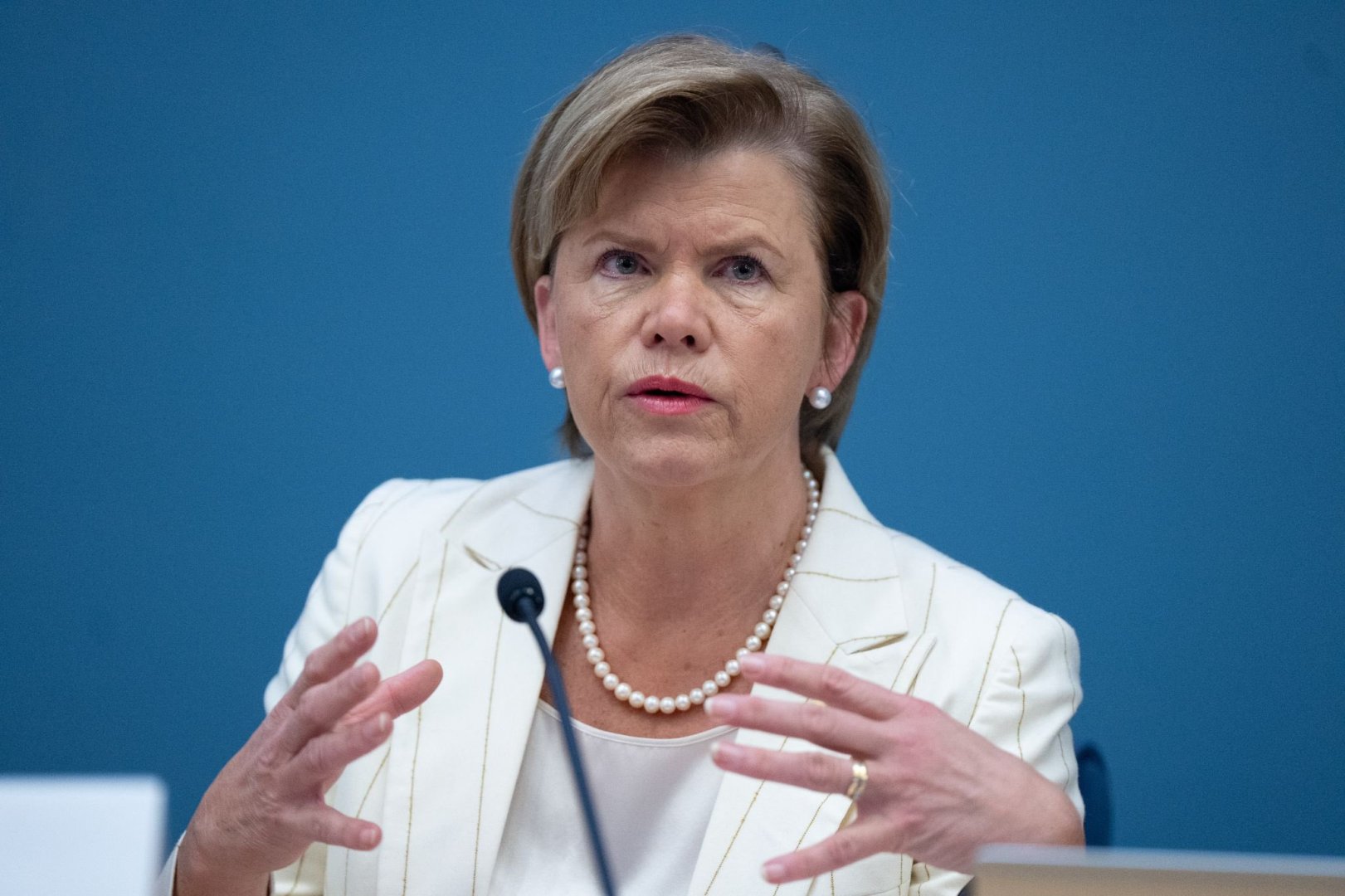

BAKU, Azerbaijan, April 20. Latvia is engaged in fostering practical cooperation between Azerbaijan and the European Union (EU), Minister of Foreign Affairs of Latvia, Baiba Braže said in an exclusive interview with Trend during the Antalya Diplomacy Forum.
She pointed out that relations between Latvia and Azerbaijan are traditionally close and constructive, encompassing excellent political dialogue, inter-parliamentary exchanges, sectoral cooperation, economic and people-to-people contacts.
“Moreover, since 2017 these relations have been elevated to the level of a strategic partnership, reflecting a high degree of mutual trust and understanding. In the current turbulent geopolitical environment, the importance of such strategic relations cannot be underestimated. We share a common understanding of the importance of the UN Charter, namely multilateralism, international law, and the rules-based international order, as well as respect for the sovereignty and territorial integrity of independent states. Our partnership helps us in defending these principles together, using both our bilateral engagement, as well as cooperation within international organizations,” said the minister.
Braže noted that Latvia’s current membership as an elected member in the UN Security Council provides an additional opportunity to work in support of the core principles of the UN Charter.
“We also commend the positive dynamics in the EU – Azerbaijan relations, where Latvia, as an EU Member State, is engaged in fostering closer dialogue and practical cooperation for mutually beneficial engagement,” she added.
Speaking about the progress in the peace process between Armenia and Azerbaijan, Latvia’s foreign minister noted that her country commends the agreements reached on 8 August 2025 in Washington D.C., in the presence of U.S. President Donald Trump.
“They mark a significant breakthrough to end decades of conflict. Latvia fully supports the Armenia-Azerbaijan normalisation process, where we see continued constructive engagement from the both sides. Latvia considers it important for the international community to promote and facilitate this process. The eventual signing of a peace treaty will significantly contribute to security, stability as well as prosperity in the South Caucasus region, while also opening new opportunities for closer cooperation with Europe, including in the field of connectivity,” she said.
The Latvian foreign minister also talked about the issues which were high on the agenda of her participation at the Antalya Diplomacy Forum.
“My central message was that it is crucial to maintain NATO’s 360-degree approach to defence and deterrence, as security challenges and threats from different directions are increasingly interlinked. Russia’s full‑scale war of aggression against Ukraine has exposed critical gaps in Europe’s defence industrial capacity, prompting large-scale investments in ammunition production, supply chains, and long-term procurement. To ensure that the Alliance remains militarily and politically strong, European and Canadian allies must devote more resources to collective defence and generate substantial capabilities and forces. This is the “peace through strength” approach that the security environment demands and it must guide our national and collective efforts in the preparations for the NATO Summit in Ankara,” she explained.
Braže went on to add that the EU could operationalise its economic‑security toolbox under the European Economic Security Strategy and its reinforcement in the joint communication on Strengthening EU Economic Security, notably through de‑risking critical dependencies, countering economic coercion, and aligning trade, investment‑screening and industrial instruments.
“From Latvia’s perspective, EU economic security needs to be built through our partnerships – our FTAs, our Economic Security dialogues, work within the G7 and possible plurilateral initiatives. The EU has a strong shared interest in working closely with like-minded partners, where cooperation to ensure a shared understanding and strengthened economic security is already underway. Deepening partnerships and reinforcing the rules‑based international order – an explicit pillar of the Economic Security Strategy – is essential to contain regional crises and prevent them from mutating into systemic economic disruptions.
Energy price volatility remains one of the most immediate transmission channels of instability. Also here the EU has already tools at its disposal. For example, REPowerEU – a comprehensive plan to rapidly end dependence on Russian fossil fuels, accelerate the green energy transition, and increase energy efficiency. It is an imitative that is specifically aimed at diversifying supply, stabilising markets and containing price volatility,” she added.
The Latvian minister noted that the European Union’s response to the crisis intensified by the war against Iran builds directly on the lessons learned from overcoming its past energy dependencies.
“Reliance on Russian energy created disproportionate vulnerabilities, and reducing that dependence required major political effort and significant economic cost. This experience has strengthened the EU’s ability to react quickly and implement coordinated measures, including joint gas purchasing, reinforced strategic reserves and targeted market interventions. At the same time, the crisis reaffirms that sustained investment in renewables has been the right strategic choice. Work on wind, solar and hydropower is being accelerated across the Union, with nuclear energy remaining under discussion as an additional option. For Latvia, strong hydropower capacity provides an important foundation, but diversification of the energy mix remains essential to adapt to changing conditions. The Baltic states’ disconnection from the Russian BRELL system has been a crucial step, speeding up integration into the wider EU energy network and improving the ability to move energy where it is most needed. These efforts strengthen both Europe’s security and its global competitiveness [and additionaly increase energy price affordability],” Braže concluded.



