


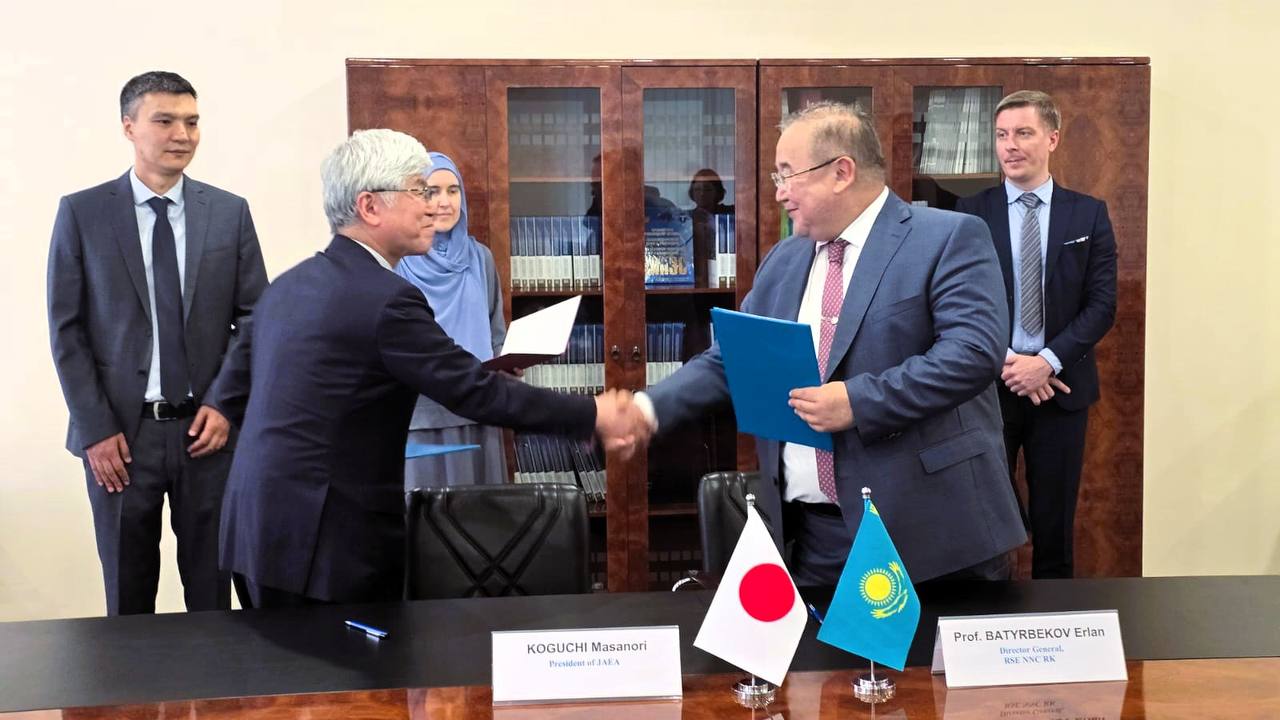

BAKU, Azerbaijan, June 3. Erlan Batyrbekov, Director General of Kazakhstan’s National Nuclear Center, and Masanori Koguchi, President of the Japan Atomic Energy Agency (JAEA), discussed expanding cooperation in nuclear safety research for Generation IV reactors during a meeting in Almaty, Trend reports via the Kazakh Agency for Atomic Energy.
The sides reviewed joint achievements and prospects for further cooperation in research on the safety of fast neutron reactors. A key topic of the talks was the continued implementation of the EAGLE experimental project, aimed at studying safety aspects of sodium-cooled fast reactors, including severe accident scenarios involving core melting.
The parties also discussed the signing of a Memorandum of Cooperation between JAEA and Kazakhstan’s National Nuclear Center, as well as an agreement on the implementation of the first stage of the next phase of the project.
The EAGLE project has been implemented since the early 2000s and focuses on experimental research into the safety of fast neutron reactors. Over the past two decades, approximately 200 methodological tests, two medium-scale and nine full-scale reactor experiments, as well as more than 65 out-of-reactor experiments, have been conducted.
Earlier EAGLE program stages, including EAGLE, EAGLE-2, and EAGLE-3, have been successfully completed, while preparatory analytical work for the next phase (post-EAGLE-3) was carried out with the participation of Marubeni Corporation.
The new phase, EAGLE-4, will involve a series of in-reactor and out-of-reactor experiments, along with small-scale tests. It will focus on experimental testing of fuel assemblies for advanced Japanese Generation IV reactor designs, research using Kazakhstan’s IGR research reactor, and other installations at the National Nuclear Center.
The sides expect the results of EAGLE-4 to contribute significantly to the development of scientific approaches to reactor safety and further strengthen Kazakhstan–Japan cooperation in the peaceful use of nuclear energy. Discussions are ongoing on extending the project through 2031.



