


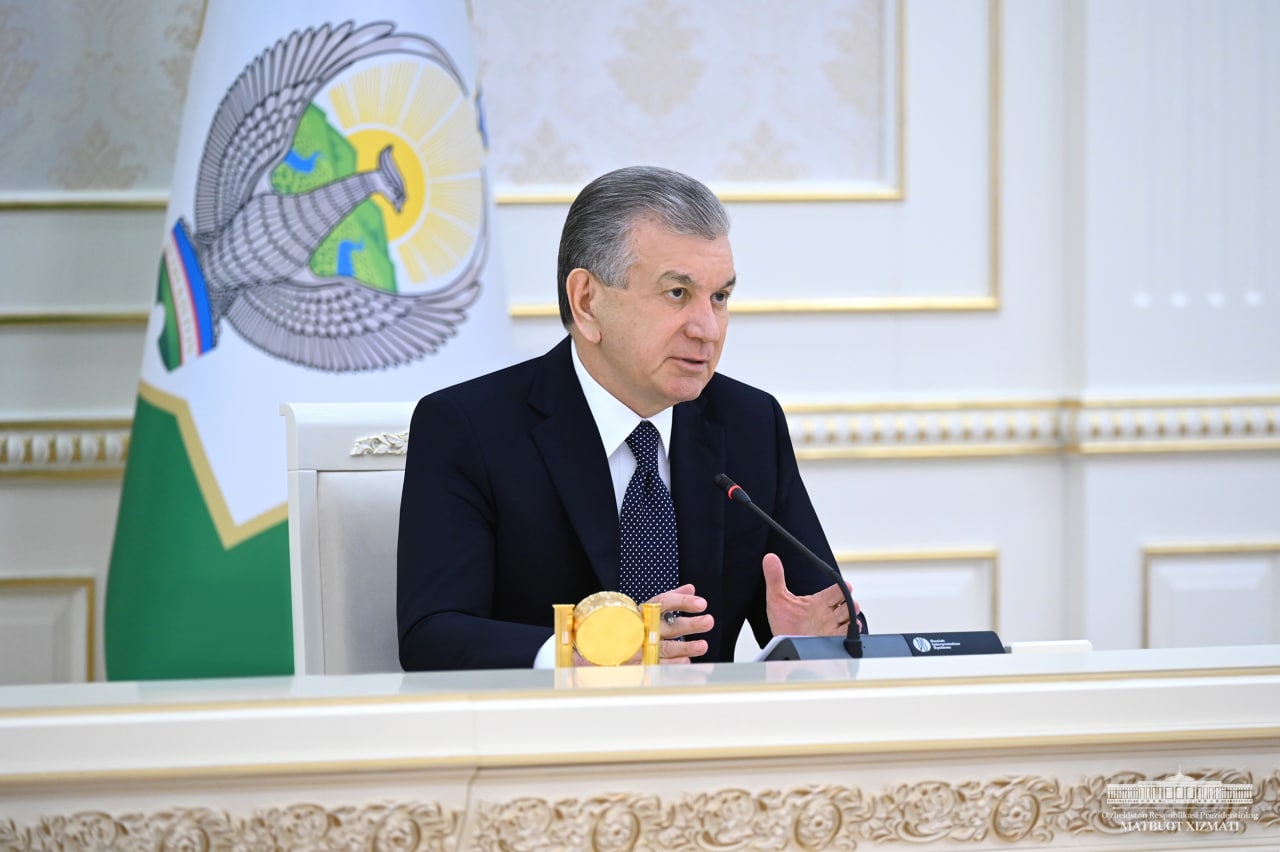

BAKU, Azerbaijan, June 10. President Shavkat Mirziyoyev has reviewed a comprehensive package of reforms aimed at modernizing Uzbekistan’s urban planning and construction sectors.
This was reflected in a statement by the press service of the Uzbek President.
According to information, more than 50% of Uzbekistan’s population now lives in urban areas, with that share expected to continue rising in the coming years. The government says growing population pressures and accelerating construction activity require more effective urban planning, better infrastructure coordination, environmental protection, and preservation of historical and cultural heritage sites.
Currently, only 2,506 of Uzbekistan’s 8,604 settlements, or about 29%, are covered by approved master plans. Authorities plan to develop master plans for an additional 154 settlements in 2026 and 144 more in 2027. More than 1,000 existing plans have already been digitized.
The administration acknowledged that while 275 development master plans were prepared during 2024–2025, many remain disconnected from broader urban planning frameworks, creating challenges in coordinating transportation, utilities, social infrastructure, and land use.
To address these issues, the government proposed a new system for managing urban planning documents. The initiative includes collecting and updating planning data, digitizing records, introducing monitoring mechanisms, and creating an integrated information and analytical platform.
A unified electronic registry of urban planning documentation will be established, and documents not registered in the system will have no legal validity. The Urbanization Center will receive expanded responsibilities, including management of a national geospatial information system and coordination of surveying and planning activities.
The government also outlined plans to strengthen workforce development in urban planning, geodesy, cadastral management, and geographic information systems.
Under the proposal, the Tashkent College of Geodesy and Cartography will be reorganized into the College of Urban Studies, Geodesy and Cadastre, while the Tashkent University of Architecture and Civil Engineering will establish a new faculty focused on modern urban planning and agglomeration management.
Creation of creative parks in every region was also proposed, bringing together specialists in architecture, urban design, engineering, software development, and project planning. Residents of these parks would receive tax incentives, including reduced personal income and social tax obligations.
The presentation highlighted persistent challenges in the construction sector, including unauthorized building activity, delays in project completion, and inefficient land use.
Authorities reported that 1,952 illegal construction projects were identified in 2025 and said existing penalties have failed to provide an effective deterrent. As a result, stronger financial sanctions for construction-related violations are being proposed.
The government also reviewed reforms aimed at protecting citizens participating in shared-equity housing developments.
Construction of apartment buildings financed through shared participation has increased significantly in recent years, with annual construction volumes exceeding 11 million square meters in 2025. However, authorities said violations in the sector have also grown, causing losses of approximately 668 billion soms (about $55 million) to nearly 3,000 citizens last year alone.
To address these risks, officials have drafted a new law on shared-equity construction that would strengthen consumer protections, improve transparency, and introduce stricter oversight of developers.
A key element of the reform package is the introduction of escrow accounts, under which buyers' funds would be held in special accounts at authorized banks and released to developers only after construction milestones are completed.
Under the proposed system, escrow funds would be protected from creditors, transactions would be conducted exclusively through authorized banks, developers would receive funds only after property transfer requirements are met, and buyers would receive full refunds if contracts are terminated.
Authorities also plan to launch a unified digital platform known as "Uy-joy" ("Housing"), which will consolidate information on developers, permits, construction progress, escrow accounts, contracts, and project ratings into a single electronic system.
The platform is intended to address fragmentation among existing government databases, including land registry, auction, permitting, and construction information systems, enabling authorities to track a project's entire lifecycle through a unified digital framework.
The government further proposed introducing digital land passports, project passports, and facility passports, each linked through a single identifier to improve transparency and data integration.
Another major focus of the presentation was urban renewal. Officials noted that more than 17,000 residential buildings constructed before 1991 could eventually be replaced with modern, energy-efficient housing equipped with updated infrastructure.
To support this effort, the government has drafted a new Urban Renovation Law, which would establish legal procedures governing redevelopment zones, public consultation requirements, compensation mechanisms, resettlement processes, investor obligations, and government responsibilities.
It was said that renovation projects could help modernize aging housing stock, improve public safety, expand green spaces, upgrade utilities, and enhance social infrastructure.
Mirziyoyev emphasized that urban development policies must prioritize sustainable growth and improve living conditions for citizens. He instructed officials to accelerate the digitalization of planning documents, launch the Uy-joy platform, implement escrow mechanisms, strengthen protections for homebuyers, and establish transparent renovation procedures.



