


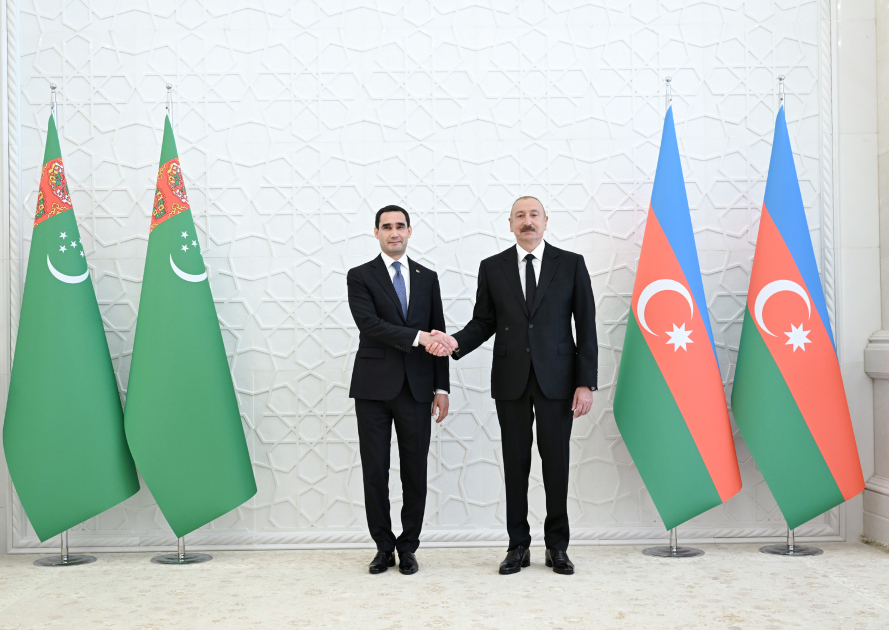
BAKU, Azerbaijan, June 23. Turkmenistan President Serdar Berdimuhamedov's state visit to Baku made one thing clear: relations between Azerbaijan and Turkmenistan are entering a new phase - one defined by concrete projects and long-term partnership.
Talks between Presidents Ilham Aliyev and Serdar Berdimuhamedov showed that the bilateral agenda has moved well beyond conventional diplomacy. Energy, transport, industry, trade, and people-to-people ties emerged as the main areas of cooperation, each receiving fresh momentum during the visit.
The key takeaway was not simply a reaffirmation of political closeness, but the establishment of concrete mechanisms for the work ahead. The visit concluded with a package of agreements covering the full spectrum of bilateral engagement: energy, industry, the economy, agriculture, food security, healthcare, social welfare, sport, and diplomatic cooperation.
Among the documents signed were an energy cooperation agreement, an industrial cooperation program for 2026–2028, and agreements on economic interaction, food security, agriculture, customs cooperation, healthcare, and more.
The economic dimension remains one of the pillars of the relationship. Despite year-to-year fluctuations, bilateral trade between Azerbaijan and Turkmenistan consistently runs in the hundreds of millions of dollars.
In 2024, trade turnover approached 303 million, while Azerbaijani goods exported to Turkmenistan exceeded $`80 million.
Trade continued to grow in 2025. In the first six months, total turnover reached $140.2 million - $30.3 million in Azerbaijani exports and `$109.8 million in imports from Turkmenistan. By the end of July, the figure had risen to approximately $154 million.
These numbers point to a solid economic foundation, though the current phase of the relationship is about broadening the trade structure and opening up new areas of cooperation.
Energy remains one of the top priorities. Both countries hold significant resources and view their energy partnership as strategic. The flagship project is the Dostlug field in the Caspian Sea, whose joint development was formalized in a 2021 agreement.
The project stands as one of the clearest examples of how the two countries have aligned their economic interests and tapped into the potential of the Caspian region. Cooperation on energy supplies and infrastructure development is ongoing alongside it.
Another symbol of the energy and transport partnership was the oil tanker Dostlug, handed over by Azerbaijan to Turkmenistan during the visit. Built at the Baku Shipbuilding Yard, the vessel is 141 meters long, 16.9 meters wide, and has a deadweight of 7,875 tonnes.
The handover speaks to several dimensions of the partnership at once: Azerbaijan's growing industrial capabilities, the strengthening of Caspian maritime infrastructure, and both countries' willingness to deliver on tangible, regionally significant projects.
Transport was another central theme in the presidential talks. Both Azerbaijan and Turkmenistan see the Caspian as a critical link in East-West international routes. The development of the Middle Corridor is opening new pathways for Central Asian cargo to reach Georgian, Turkish, and European markets via Azerbaijan.
The current level of transport cooperation is itself the product of sustained high-level dialogue. In August 2025, President Ilham Aliyev visited Turkmenistan to take part in the first trilateral summit in the Azerbaijan–Uzbekistan–Turkmenistan format.
A key focus of that meeting was Caspian connectivity - expanding capacity at the ports of Baku and Turkmenbashi, digitizing freight procedures, improving cargo route efficiency, and creating conditions for higher transit volumes.
Those agreements are now providing the foundation for further growth in both countries' transport potential. Azerbaijan and Turkmenistan are not simply looking to leverage their geography - they want to turn the Caspian into a more effective bridge between themselves, Central Asia, and global markets.
In that context, the customs cooperation agreements and statistical data-sharing arrangements signed during this visit carry real weight. Mechanisms like these directly affect transit speeds and make shipping routes more competitive.
But the partnership extends beyond economics. The mosque being built in Fuzuli - an initiative by National Leader of the Turkmen people and Chairman of the Halk Maslahaty Gurbanguly Berdimuhamedov - has become a symbol of Turkmenistan's support for Azerbaijan's reconstruction of Karabakh.
Cultural ties remain strong as well: Days of Culture are held regularly, creative exchanges between artistic groups continue, and the sister-city relationships between Baku and Ashgabat, as well as Arkadag and Fuzuli, are deepening.
Political cooperation matters too. Azerbaijan and Turkmenistan back each other at international forums, including the UN, the Organization of Turkic States, and other regional platforms. Baku consistently supports Turkmenistan's permanent neutrality, while Ashgabat advocates for further bilateral engagement.
What defines this phase of the relationship is that political trust between the two countries is closely tied to the personal rapport of their leaders. Presidents Ilham Aliyev and Serdar Berdimuhamedov have, in recent years, built the foundation for expanded partnership - maintaining a regular high-level dialogue and championing new joint initiatives.
Speaking to journalists after the talks, President Ilham Aliyev stressed that the relationship rests on deep roots that go beyond the current political moment.
"Our relations are built on a solid foundation of historical ties, cultural connections, and spiritual bonds. We regularly host performances by creative collectives. Just recently, at the beginning of this month, the Days of Culture of Azerbaijan were held in both Ashgabat and Arkadag. Last year, cultural figures from Turkmenistan visited us for the Days of Culture in Baku and Ganja. I should also note that Baku and Ashgabat are twin cities, just as Arkadag and Fuzuli are. All of this demonstrates our unity. We strive to fill our cooperation with concrete content and to deepen our interaction," President Ilham Aliyev said.
President of Turkmenistan Serdar Berdimuhamedov, for his part, noted that the current level of cooperation reflects the sustained efforts of both sides.
"The relations between the two countries are developing dynamically and progressively based on the principles of equality and mutual benefit. We reaffirmed our readiness to continue active cooperation between the two countries within authoritative international and regional organizations," he said.
It is precisely this political commitment that is allowing Baku and Ashgabat to move from broad statements to concrete outcomes - from energy projects and transport corridors to industrial cooperation and humanitarian initiatives.
President Berdimuhamedov's visit was a continuation of a course already set. It confirmed that Azerbaijan-Turkmenistan relations are moving forward, and that the personal engagement of Presidents Ilham Aliyev and Serdar Berdimuhamedov remains one of the key drivers of that progress.
Over recent years, the two countries have built a model of relations in which political trust, economic interests, and a shared regional agenda reinforce one another. Today, Azerbaijan and Turkmenistan see each other not merely as Caspian neighbors, but as long-term partners with the capacity to deliver projects that matter for the entire region.



