


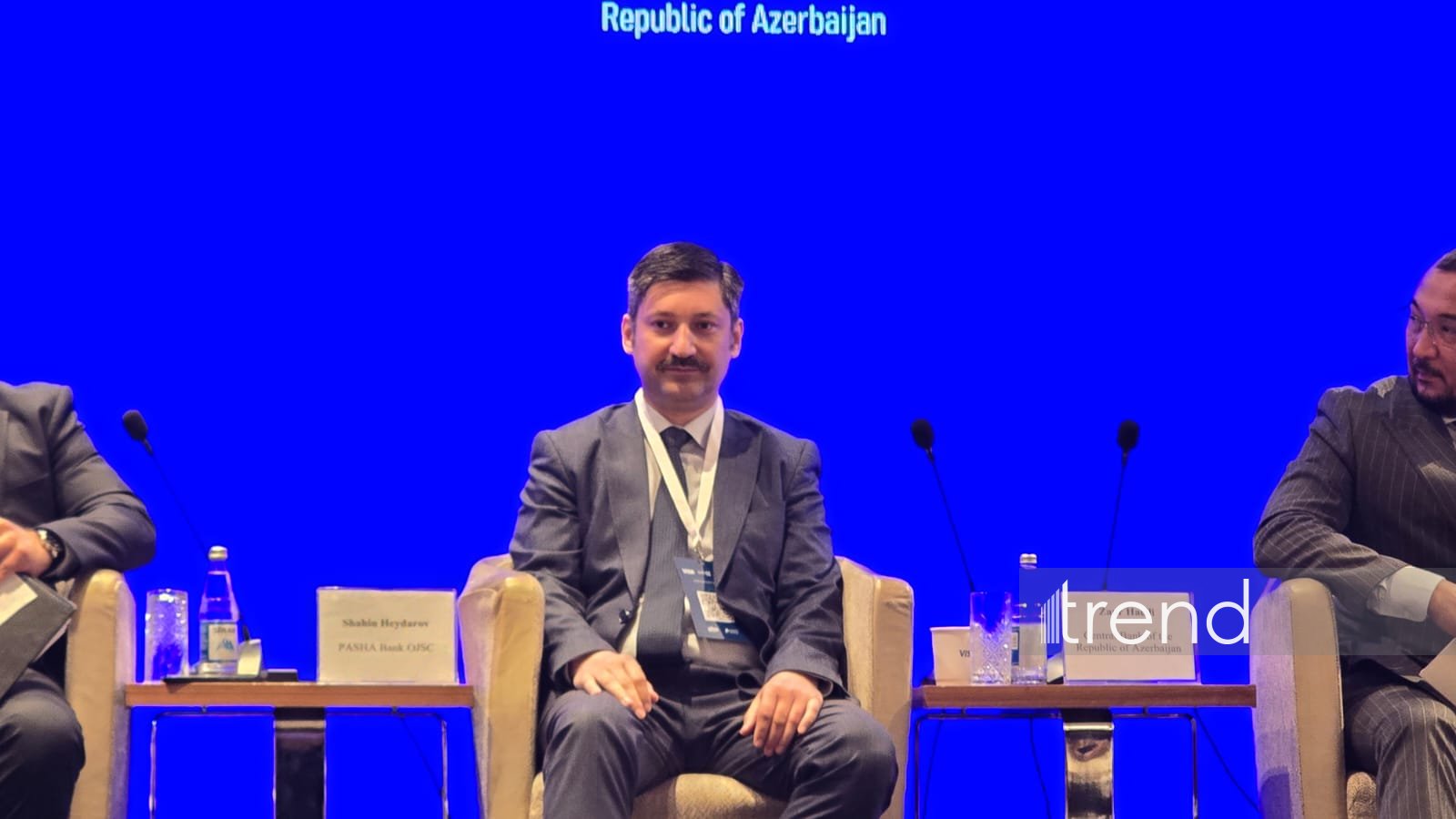

BAKU, Azerbaijan, June 10. A unified compliance (activities in accordance with legislation and regulations) ecosystem is essential for the region's financial stability, Director of the Financial Monitoring Policy and Regulation Department of the Central Bank of Azerbaijan (CBA), Zaur Hajili, said during the second day of “International Finance and Banking Summit 2026: Global Financial Integration of Turkic States” in Baku, Trend reports.
He noted that in modern times, it is no longer possible for supervisory and regulatory bodies to operate in isolation, and the traditional "hard supervisor" model is outdated. According to him, the rapid development of fintech technologies, virtual assets, and artificial intelligence in particular necessitates a change in the regulatory approach.
Hajili pointed out that there are differences in compliance approaches on a macro-regional scale, including the countries of Central Asia and the Caspian basin.
"These differences are manifested both in the regulatory framework and in the implementation mechanisms, and as a result, regulatory arbitrage, as well as 'gray zones', are formed. This increases the country risk for international investors and first-tier correspondent banks," the bank representative explained.
According to him, investors no longer evaluate individual countries, but the region as a whole, and look at financial stability on a regional scale.
"Therefore, it is important to form a single 'compliance' ecosystem. This ecosystem should act as an adaptive environment where international standards, corporate and compliance culture, high-tech solutions, and synchronized rules between countries are applied," he mentioned.
The director of the department emphasized that modern "compliance" rules should no longer be perceived as a burden, but rather as a factor that creates competitive advantage.
"This approach is based on four main pillars, the first of which is international standards, in particular the FATF (Financial Action Task Force) recommendations on combating money laundering, and a risk-based approach," Hajili clarified.
He said that since the Azerbaijani economy is an integral part of the global economic system, elements of a number of European Union directives are also taken into account and applied in the country's legislation. According to him, against the backdrop of the complexity of the current geopolitical environment and international sanctions regimes, the approach of supervisory and regulatory authorities should be even more decisive and principled.
"The financial system must comply with the integrity of the global financial system and be kept away from systemic risks. The established rules and requirements are not restrictions, but rather transparent rules of the game, which creates an advantage for large investors and partners," the official announced.
He added that the second main pillar is regulatory digital solutions.
"The region has developed a unique experience of supervisory and regulatory bodies, a large amount of data is collected, and manual analysis of this data is no longer possible. For this reason, the application of SupTech technologies is expanding," Hajili also said.
According to him, the goal of modern innovations is not to limit them, but to ensure their safe development. In this context, cybersecurity, the fight against money laundering, as well as the protection of consumer and investor rights are particularly priorities.
The department director highlighted that within the framework of the new regulatory approach, innovative technologies are tested using special regimes, which creates a favorable environment for the introduction of technologies in the country.
Hajili added that the third and most important pillar is the culture of compliance, which is a key component of corporate ethics.



