


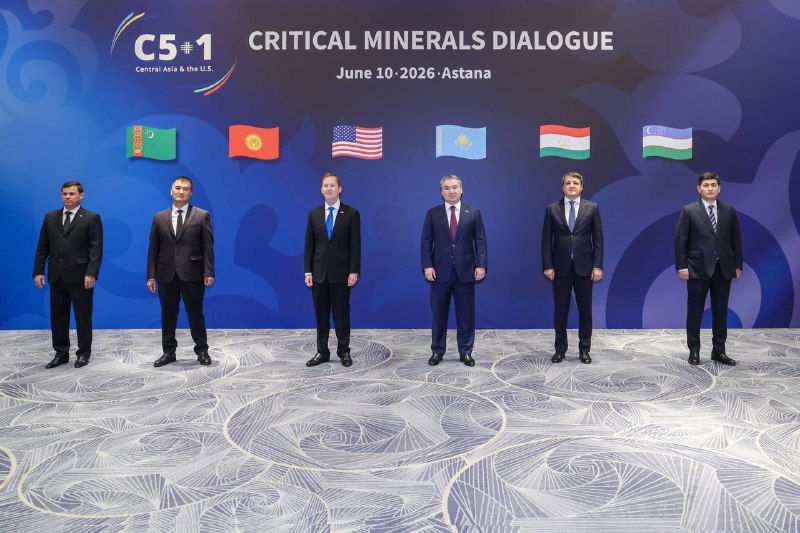

BAKU, Azerbaijan, June 10. Kazakhstan's Astana hosted the C5+1 Critical Minerals Dialogue, which brought together Central Asian countries and the United States to discuss cooperation in the exploration, extraction, and processing of strategic raw materials, according to a statement from the Ministry of Industry and Construction of Kazakhstan.
The meeting was held under the co-chairmanship of Kazakhstan’s Minister of Industry and Construction Yersaiyn Nagaspayev and the U.S. Special Envoy for South and Central Asia Sergio Gor, ahead of the 16th International "Astana Mining & Metallurgy" Congress.
The event brought together government representatives from Kyrgyzstan, Tajikistan, Turkmenistan, Uzbekistan, and the United States. Participants focused on strengthening cooperation in critical minerals development, including geological exploration, production, processing, and integration into global supply chains.
“Kazakhstan’s President Kassym-Jomart Tokayev places special emphasis on the C5+1 platform as a new format of engagement between Central Asia and the United States. The C5+1 Critical Minerals Dialogue is aimed at deepening cooperation in ensuring sustainable access to strategic raw materials, developing technological partnerships, and building reliable global supply chains. In the context of growing global demand for critical minerals, these areas are becoming increasingly important,” Nagaspayev said.
He noted that Kazakhstan’s critical minerals sector is a key priority of its industrial policy and long-term economic development strategy, with more than 9,500 deposits, including over 100 containing rare and rare-earth metals.
Nagaspayev added that digitalization reforms and the adoption of international standards have significantly increased investment inflows, attracting global companies such as Rio Tinto, Barrick Gold, First Quantum, Ivanhoe, Teck, Fortescue, Cove Capital, and others.
The participants identified priority areas for long-term cooperation under the C5+1 framework, including the development of high-tech processing industries, industrial clusters, technology transfer, workforce training, and scientific cooperation, with particular attention to logistics and supply chain resilience.
The sides reaffirmed their commitment to expanding multilateral cooperation and advancing joint industrial and infrastructure projects.



