


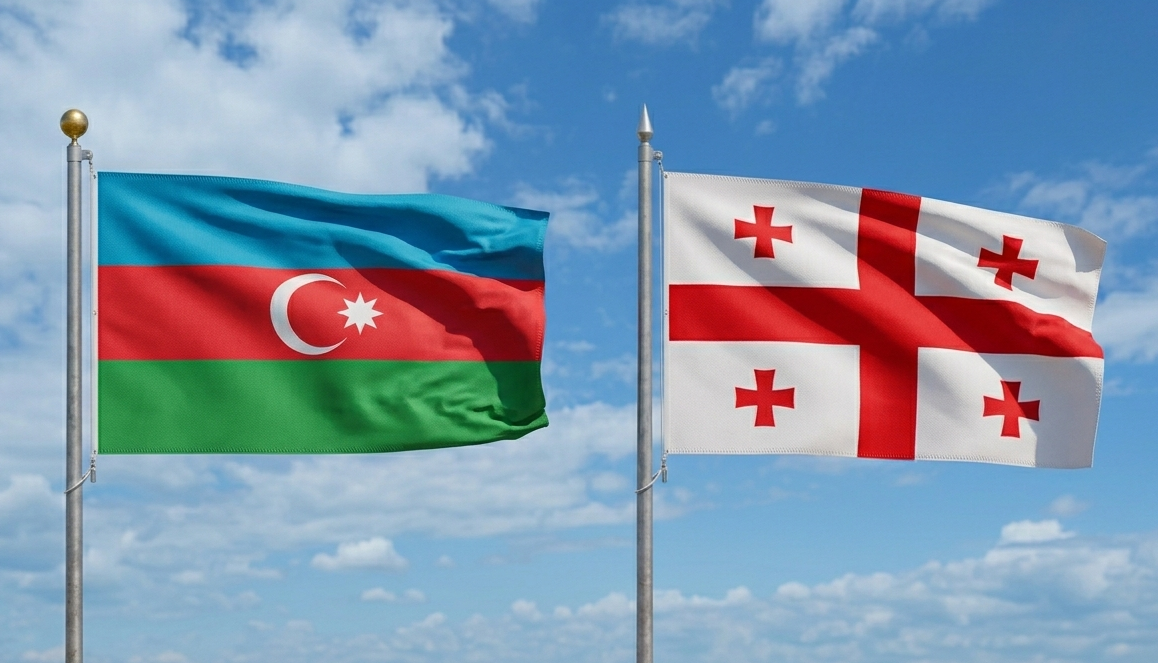

BAKU, Azerbaijan, April 5. While the world continues to argue over the redistribution of trade routes, two neighboring states in the South Caucasus are doing what others only talk about: turning their geographic position into real money and real influence. Azerbaijan and Georgia are not just partners in the Middle Corridor - they have already become the backbone of this crucial transport route.
The numbers speak for themselves - and loudly. In 2025, container traffic through Azerbaijan grew by 19%, reaching 135,000 TEU. Transit increased by 20% to 66,300 TEU. More than 390 container block trains traveled along the China–Europe route via the Middle Corridor. This is not just growth - it is acceleration. At the Georgian end of the chain, the picture is just as telling: by the end of 2025, transit accounted for nearly 58% of the country’s total rail freight turnover. Azerbaijan confidently took first place among sources of railway imports into Georgia - 32% in the third quarter. For comparison, at the beginning of the same year, this share was half as much. The partnership, as we can see, is not just working - it is gaining speed.
Behind these figures lies concrete work that has largely gone unnoticed in the broader agenda but has tangible consequences for any shipper. In October 2025, in Almaty, the railway administrations of Kazakhstan, Azerbaijan, and Georgia signed a plan for the digitalization of freight transport. The result was striking: the time required to process documents for transit cargo passing through Georgia dropped from eight to nine hours to just forty minutes - nearly an order of magnitude faster. In logistics, time is literally money, and this step has made the corridor significantly cheaper for all its users. This is not just a technical improvement - it is a signal to the market: the corridor is operating in earnest.
Looking at the timeline of recent months, one thing stands out: Baku and Tbilisi are practically living in negotiation rooms. In February 2026, the Director of the Georgian Maritime Transport Agency, Ivane Abashidze, met with Azerbaijan’s Consul General Fuad Azizov - discussing maritime transport, regional connectivity, and the strategic role of the Middle Corridor. During the same weeks, Georgia officially joined the international association “Eurasian Transport Route,” a structure Azerbaijan had been building together with Uzbekistan, Kyrgyzstan, and Tajikistan since 2024. The association’s goal is unified tariffs, unified transport technologies, and unified logistics products. Georgia has entered this architecture as a full-fledged participant. On February 26, at a Georgia–Azerbaijan–Türkiye business forum, Azerbaijan’s Minister of Economy Mikayil Jabbarov spoke no longer about intentions, but about concrete mechanisms for deepening integration.
It would be naive to discuss all this in a vacuum - transit has long become part of larger geopolitics. After 2022, global shippers began urgently searching for routes bypassing traditional ones. The Northern Corridor through Russia became toxic for Western businesses. The Southern route through Iran remains closed to most Western companies due to sanctions, and given the developments around the Islamic Republic in recent weeks, the future of any logistics via Iran is drifting into the realm of theoretical discussions. Against this backdrop, the Middle Corridor has emerged not just as an alternative, but as the only viable alternative. President of Azerbaijan Ilham Aliyev stated this directly in his speech at the 13th Global Baku Forum in March this year: “What we are doing now is just investing additional funds in order to expand the capacity of existing corridors, because the demand to go through Azerbaijan is growing. And we provide critical transit for many countries to the east and to the west of Azerbaijan."
Behind these words are concrete figures: over the past three years, cargo volumes passing through the country have increased by nearly 90%. Kazakhstan, Azerbaijan, Georgia, and Türkiye recognize this moment - which is why, back in 2022, they agreed on a joint roadmap for the development of the route through 2027, and meetings of transport authorities have become almost more frequent than summits of heads of state.
The horizon is already clearly defined on both sides. Georgian Prime Minister Irakli Kobakhidze put it plainly: by 2030, the country will complete construction of all segments of the Middle Corridor on its territory - highways, railways, and port infrastructure. “We are a small country, but we have a very strategic location, and we are making use of it,” he said. Ilham Aliyev looks at the same timeline with the same confidence: according to him, by 2030 the capacity of the Middle Corridor will triple compared to 2021, while transit time will be cut in half. Two leaders are speaking about the same project - and in unison.
Competition for transit flows will only intensify. In this situation, Azerbaijan and Georgia have one key advantage - predictability. The route works, documents are processed in forty minutes, trains run on schedule, and agreements are honored. In a world where logistics increasingly resembles a geopolitical chessboard, that is worth a great deal - in the most literal sense.



