


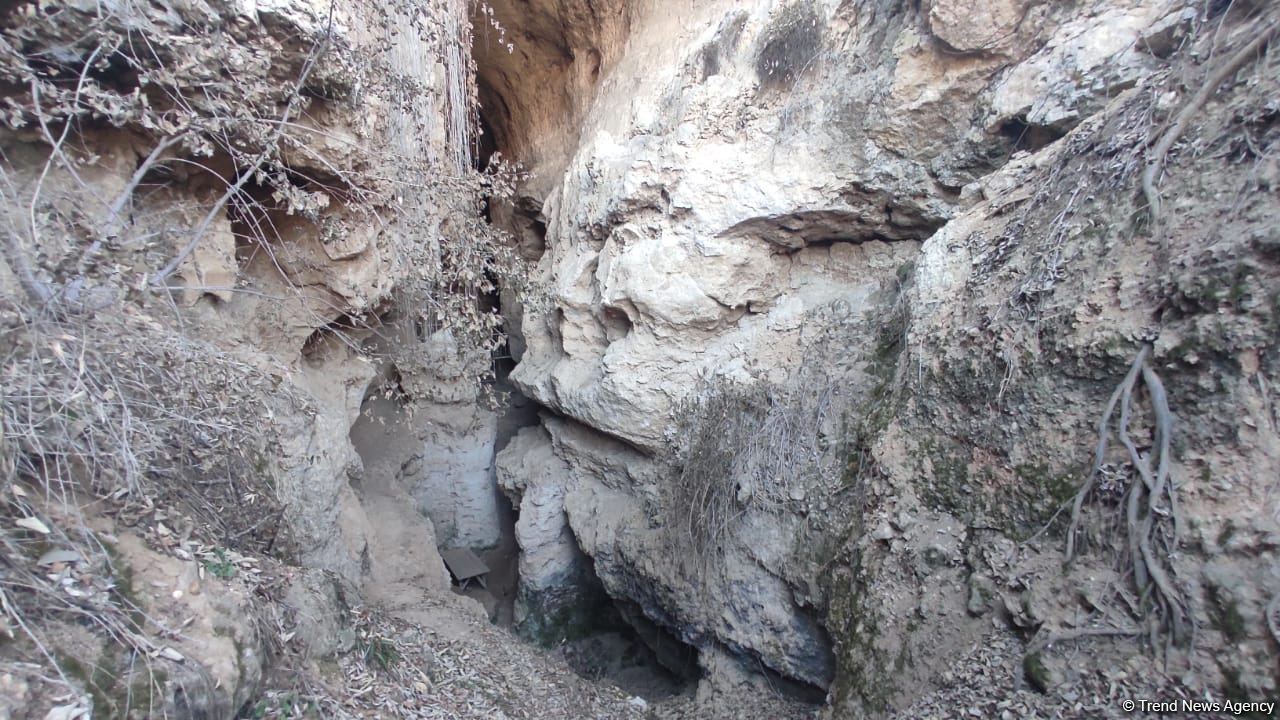

BAKU, Azerbaijan, September 10. The Azikh Cave in Azerbaijan had been used by Armenia as a weapons depot at the beginning of the occupation, Head of the State Service for the Protection, Development and Restoration of Cultural Heritage under the Ministry of Culture, Sabina Hajiyeva, said at an event held within the framework of the Baku Climate Action Week, Trend's correspondent reports from the event.
According to her, years later, illegal archaeological excavations were conducted in the cave with the participation of foreigners, and many samples were taken away from the cave.
She noted that the world-famous Azykh cave is a monument of the Paleolithic era and combines a large number of protected elements, cultural parts, and samples.
Besides, according to the official, as of November 3, 2020, an inventory has been conducted on 575 out of 749 monuments, including 196 monuments in Shusha city.
"During the inventory work, field surveys were conducted, digital maps of monuments were prepared, and photo documentation and drone filming were carried out. Archival documents and other resources were also examined," the official pointed out.
Hajiyeva said that the monitoring showed that during the occupation, the cultural heritage of Azerbaijan was seriously damaged, and monuments were subjected to destruction and vandalism.
"In general, 68 monuments were completely destroyed in the liberated territories. These figures refer to monuments registered in the official list of monuments in the territory of Azerbaijan. However, the number of monuments in the territory of Karabakh and East Zangezur is much higher," she emphasized.
The head of the state service noted that the last official list of monuments was adopted in 2001, precisely during the occupation. According to her, as a result of the currently conducted monitoring, a large number of other interesting monuments are also being discovered in those territories.
She added that 115 monuments suffered serious damage, while others were damaged to varying degrees. The total material damage to 434 monuments is currently estimated at 700.15 million manat ($411.8 million).
"This is a general figure that reflects only the damage to the walls and does not include the damage to culture," Hajiyeva explained.
According to her, during the inventory, it was determined that many monuments, including Islamic religious monuments, were vandalized, desecrated, and used as stables by Armenia.
Hajiyeva noted that in general, Islamic religious monuments were either completely destroyed or desecrated.
"In particular, 9 tombs, 3 cemeteries and 7 mosques registered in the liberated territories were destroyed. 25 mosques, 14 tombs and 2 crypts were damaged to varying degrees," she said.
The service chief further highlighted that Christian monuments were also vandalized.
"During the inventory work, it was determined that several monuments, including Islamic religious monuments, were subjected to vandalism. Christian monuments were also subjected to vandalism," Hajiyeva said.
According to her, many of the small monuments were not preserved, and in relation to large monuments, illegal restoration work was carried out, aimed at falsifying history, among other things.
Hajiyeva cited the 13th-century Khudavang Monastery as an example and noted that restoration work had been carried out here in the last 10-20 years of the occupation period. According to her, these works were not only illegal, but also aimed at falsifying its history.
She said that the frescoes on the walls of the monastery were later stolen.
"One of the most important points is that the frescoes restored by them were stolen from the walls. These frescoes were not painted separately; they were on the walls. The frescoes were stolen after the Armenians left the area," the official said.
According to Hajiyeva, information about the theft of the frescoes was submitted to Interpol.
"We have sent this information to Interpol, and I hope that the entire international community will help us return these parts of our heritage," she stressed.



