


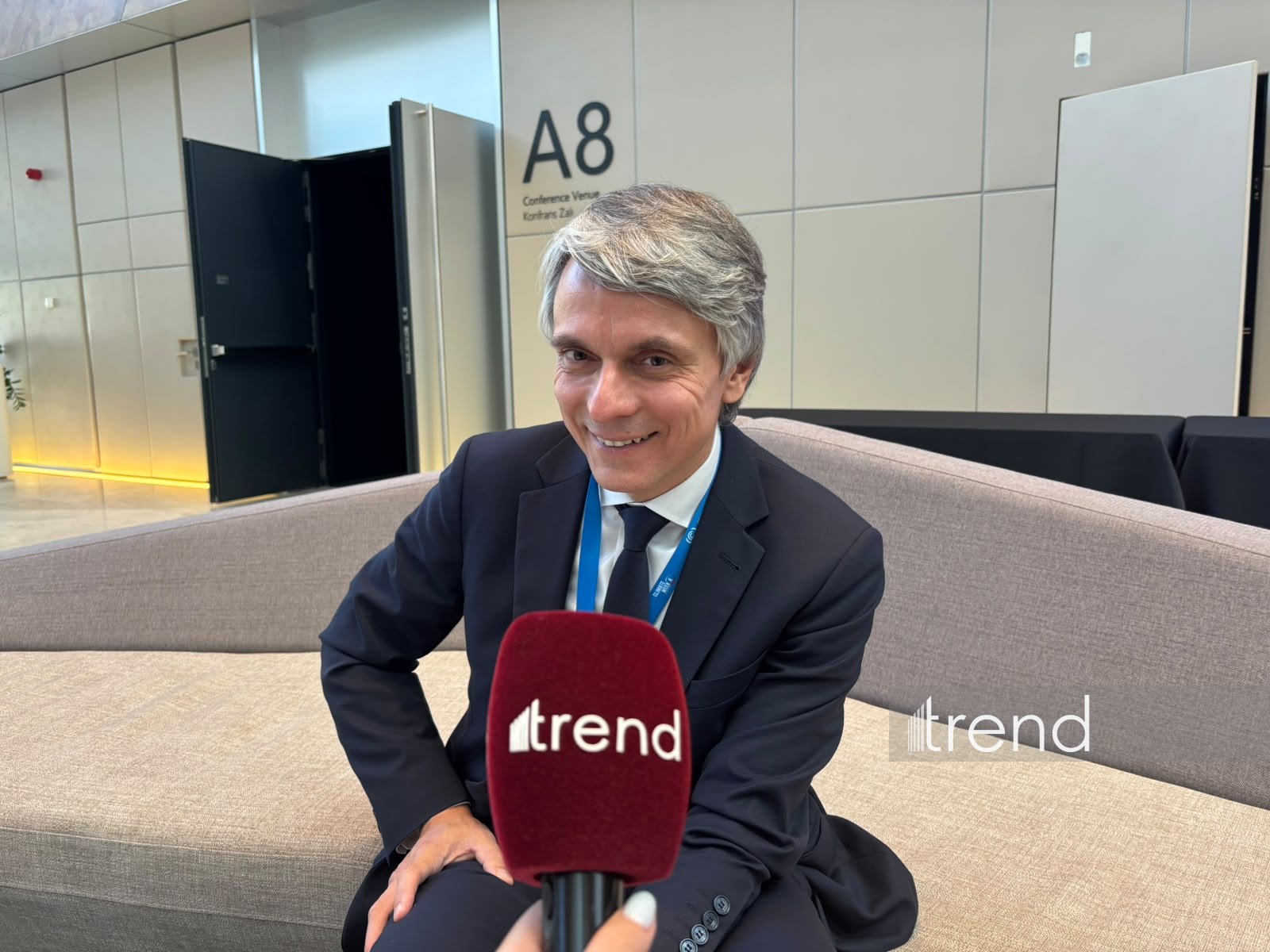

BAKU, Azerbaijan, September 9. The UN Economic Commission for Europe (UNECE) looks forward to cooperating with Azerbaijan on methane capture, Deputy Executive Secretary of the UNECE, Dmitry Mariyasin, told Trend in an exclusive interview on the sidelines of Baku Climate Action Week.
According to him, the UNECE works closely with Azerbaijan through the country's Permanent Mission in Geneva, as well as with various ministries and government agencies in Baku.
"Key areas of our cooperation include transport—particularly connectivity issues and the Middle Corridor—as well as the environment, specifically regarding water resources and transboundary waters. Cooperation also extends to the energy sector, covering energy efficiency, hydrogen, and methane emission reductions. Methane is currently a crucial topic for the region and the world, as well as for Azerbaijan as a major oil and gas exporter," he added.
Mariyasin also highlighted Azerbaijan's leadership within the UN Special Programme for the Economies of Central Asia (SPECA).
"Under Azerbaijan's leadership, the first-ever SPECA summit was held in Baku in November 2023. This resulted in the creation of a crucial initiative—the SPECA Multi-Partner Trust Fund. It's already receiving funding, including contributions from Azerbaijan, and will foster practical outcomes for regional cooperation in Central Asia, with Azerbaijan playing an active role," he explained.
Addressing the digitalization of transport along the Trans-Caspian International Transport Route (the Middle Corridor), Mariyasin noted that a digitalization roadmap was approved by national leaders at the 2023 Baku summit.
According to him, one of the areas outlined in the roadmap was the full digitalization of the TIR Convention.
"The electronic TIR system now operates from Central Asia, through Azerbaijan, and on to Europe. This is one of major achievements. It was part of the roadmap, and the task has been completed. The TIR system allows trucks to cross multiple customs borders without the cargo being opened en route. The truck is sealed at the point of departure after all necessary customs documents have been processed, with a guarantee system in place. It then proceeds along an expedited route and is not opened by customs authorities until it reaches its final destination," said Mariyasin.
He noted that UNECE is currently working on other aspects of digitalization, including the electronic CMR—a digital consignment note for road transport—as well as the associated liability regime.
"We are also working on utilizing the electronic trade standards of the UN Centre for Trade Facilitation and Electronic Business (UN/CEFACT)—which is also hosted by UNECE—to support transactions across the entire value chain. An important role is played by the Middle Corridor Coordination Committee, which operates under the auspices of UNECE. We are working to ensure that tariffs, digital solutions, customs procedures, and all the rules and regulations necessary for the operation of the corridor are harmonized,” he said.
According to him, modeling container transportation from Tashkent to Istanbul and back, carried out about a year and a half ago, revealed a number of remaining problems.
“We found that there are still many bottlenecks, inconsistencies, and issues that need to be resolved in terms of harmonization of procedures and digital tools. The next task is to consistently eliminate these “bottlenecks,” said Mariasin.
He pointed out the need to ensure that major investments—including those supported by the European Union’s Global Gateway, the Asian Development Bank, and the CAREC program, as well as investments from China and the Gulf states—utilize UN instruments, rules, and norms as a foundation and a common, harmonized language for freight forwarders, customs authorities, and digital service providers.
Mariyasin also spoke about potential projects and initiatives involving UNECE and Azerbaijan for the coming years.
"I would like to highlight the importance of piloting UN digital trade standards—specifically the UN/CEFACT standards—in Azerbaijan and in its trade with neighboring countries along the Trans-Caspian route," he clarified.
According to him, UNECE, in cooperation with TRACECA, held a seminar on this topic earlier this week.
He identified cooperation in the water sector as another key area.
"We work very closely with Azerbaijan as a party to the UNECE Water Convention, and we look forward to continued collaboration with countries in the region on the shared use of water and lake resources. Reducing methane emissions is another important priority. Like any country that produces and exports oil and gas—and like its neighbors around the Caspian Sea—Azerbaijan has older wells. Much can be done to capture methane, convert it into useful energy, and thereby reduce atmospheric emissions while also improving business operational efficiency," the official mentioned.
Mariyasin emphasized that this initiative is part of the climate agenda and represents a significant project that UNECE aims to implement in partnership with Azerbaijan's energy sector.



