


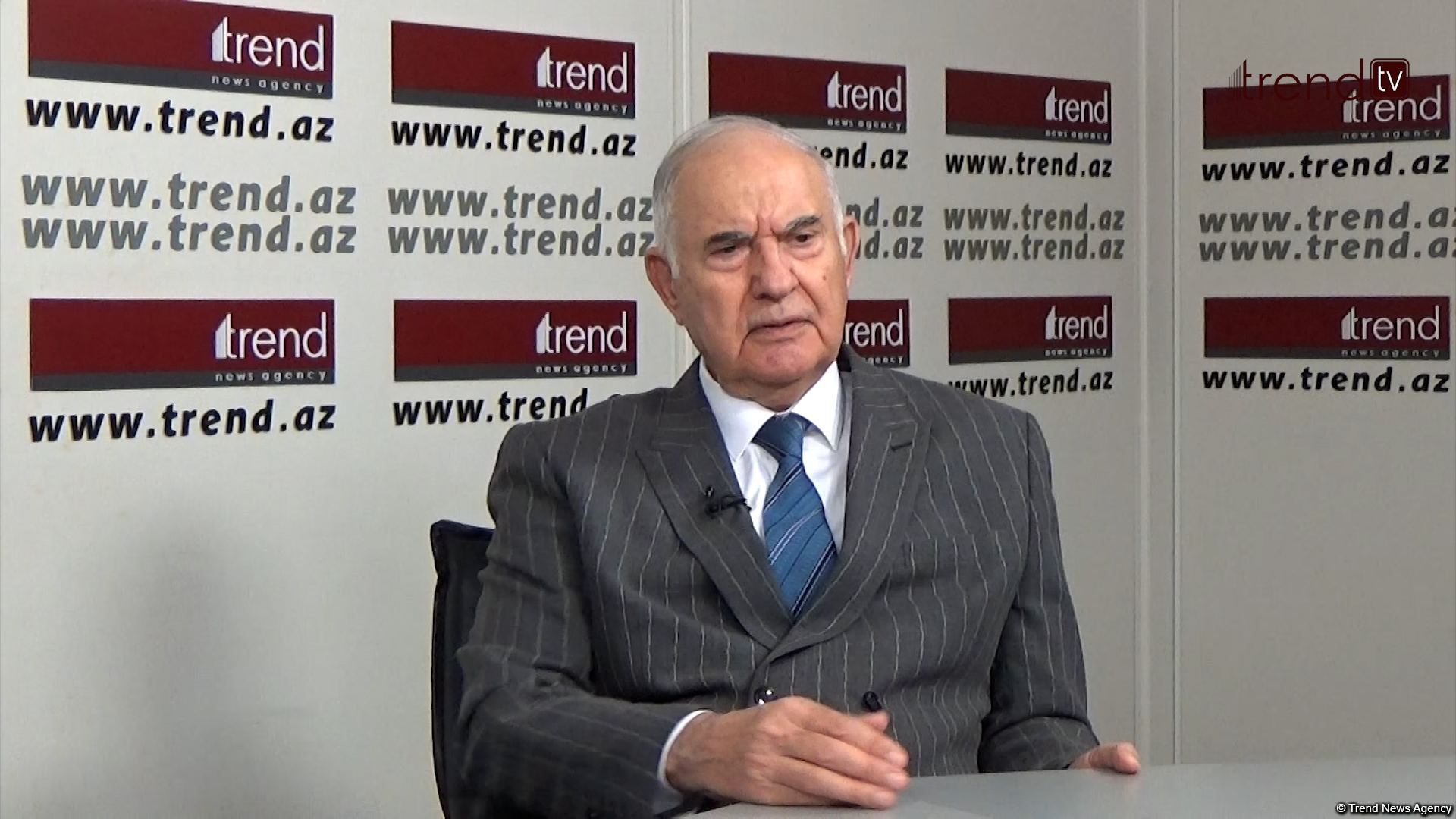

BAKU, Azerbaijan, September 9. Demining is one of the main conditions for the restoration of liberated territories and the safe return of former internally displaced persons in Azerbaijan, political analyst Azer Garayev told Trend.
He noted that the 4th International Mine Action Conference held in Baku on the theme "Humanitarian Demining for Urban Recovery: Setting Standards of Excellence for Safe Settlements" is of great importance in terms of bringing the scale of the mine problem facing Azerbaijan to the attention of the international community.
"It would not be right to approach humanitarian mine clearance only as a technical or security measure. This process is directly related to the reconstruction of cities and villages, the restoration of infrastructure, the revival of economic activity, and the safe return of people to their native lands. If the territory is not safe, it is also impossible to establish sustainable living and economic activity there. In this regard, mine clearance is one of the basic conditions for the post-conflict reconstruction of Azerbaijan," the analyst said.
Garayev recalled that at the opening of the conference, address of the President of Azerbaijan Ilham Aliyev to the conference participants, read by the Assistant to the President of Azerbaijan - Head of the Foreign Policy Department of the Presidential Administration Hikmet Hajiyev, emphasized that mine clearance is a key condition for the creation of safe settlements, the implementation of reconstruction work and the return of people to their native lands.
"The address of President Ilham Aliyev, voiced by Hikmet Hajiyev, highlights a very important point: it's impossible to talk about the full restoration of territories without eliminating the mine threat. The essence of the approach emphasized by the head of state is that until the lands are cleared of mines and explosive remnants of war, it's impossible to fully rebuild cities, villages, and settlements, ensure the safe operation of schools and hospitals, return people to their homelands with dignity, and ensure sustainable economic activity. This clearly shows why mine clearance is of strategic importance in Azerbaijan's post-conflict agenda," he pointed out.
The analyst noted that the figures presented in President Ilham Aliyev's address allow us to more clearly imagine the scale of the mine problem that Azerbaijan is facing.
"According to the preliminary calculations announced in the address of the head of state, more than 13% of the territory of Azerbaijan has been affected by mines and unexploded ordnance. This indicates that we are talking about a fairly large area. Considering the scale of the restoration work carried out in Karabakh and East Zangezur, it's possible to see how many resources, time, and technological capabilities are required to eliminate the mine threat," Garayev explained.
The expert also pointed out that the most serious aspect of the mine problem is the constant threat it poses to human life.
"According to the statistics presented in the address of President Ilham Aliyev, 437 Azerbaijani citizens have been victims of mine and explosive incidents since 2020, while 73 of them lost their lives and 364 were seriously injured. It's reported that since the beginning of Armenia's aggression against Azerbaijan, more than 3,500 of our citizens have been injured by mines. The main point to note here is that although the war has ended, the threat it poses to people's lives continues in the form of mines. In this sense, mines are one of the most serious and long-term humanitarian consequences of the conflict," the analyst emphasized.
According to Garayev, the inaccurate and incompleteness of the maps of mined areas provided by Armenia further complicates the solution to the problem.
He noted that the President's address also pays special attention to the fact that mines and mine traps were discovered not only in former military positions, but also along roads, near residential areas, cemeteries, agricultural lands, forests, river banks, and other civilian areas.
"This fact shows that the problem is not purely military, but clearly humanitarian in nature. We are talking about a threat that prevents people from living their daily lives, moving freely, engaging in agriculture, returning to their homes and building a normal life. The presence of mines and mine traps, especially in civilian areas, significantly complicates ensuring people's security in the post-conflict period," the analyst said.
He expressed an opinion that the scale of demining work carried out by Azerbaijan at its own expense in these difficult conditions should also be assessed separately.
"According to the information presented in the address of President Ilham Aliyev, to date, more than 298,000 hectares of land have been cleared, 260,147 mines and unexploded ordnance have been discovered and neutralized. These are quite significant indicators and demonstrate how Azerbaijan has mobilized significant resources for the demining process. At the same time, the overall scale of mine contamination shows that a large amount of work still lies ahead," he clarified.
Garayev noted that the speed of the demining process directly affects the pace of the Great Return and large-scale construction work carried out in the liberated territories.
"Today, cities and villages are being rebuilt in Karabakh and East Zangezur, roads, tunnels, airports, energy infrastructure, schools, hospitals, and settlements are being created. People are gradually returning to their native lands. However, safe land is the starting point of all these processes. It is not possible to build settlements, build infrastructure, or safely return people to an area that has not been cleared of mines," he mentioned.
The analyst added that the linking of mine clearance with broader national priorities in President Ilham Aliyev's address is also an important message.
"Here, mine clearance is presented not as a separate process, but as an integral part of a single system with reconstruction, safe return, agricultural revival, infrastructure development, environmental protection, social reintegration, and economic recovery. This approach is one of the main features of Azerbaijan's post-conflict recovery model. The territory is first secured, then infrastructure is created, economic opportunities are formed, and people's permanent livelihoods are ensured," he announced.
According to Garayev, the scale of the problem facing Azerbaijan also requires a more active and practical participation of the international community:
"Azerbaijan continues mine clearance work by mobilizing large financial, technical, and human resources. However, such large-scale mine contamination also requires international cooperation. This is not just about financial assistance. The application of modern demining technologies, the provision of special equipment, the transfer of technology and experience, the training of specialists, and the creation of long-term partnership mechanisms can make a significant contribution to accelerating the process," he said.
The analyst emphasized that holding international demining conferences in Baku shows that Azerbaijan has put the mine problem on the international agenda not only as a national issue, but also as a global humanitarian and security challenge.
According to him, Azerbaijan's message is that the political and military end of the conflict does not mean that its humanitarian consequences will automatically disappear.
"As long as mines remain on the ground, the threat of war also continues in some form. Therefore, in the post-conflict period, the attention of the international community should be focused not only on political processes, but also on ensuring the real security of people," he noted.
Garayev shared that Azerbaijan's parallel implementation of demining, rehabilitation, and the Great Return processes can be a practical experience for other countries facing similar problems in the future.
"The address of President Ilham Aliyev also states that Azerbaijan is ready to share its experience with countries and regions facing similar consequences of the conflict. The main feature of Azerbaijan's approach is the management of mine clearance, urban development, infrastructure, social services, economic activity, and return of people as a single process. This is a comprehensive approach to post-conflict reconstruction," he said.
According to the analyst, all this shows that the main message of the 4th International Mine Clearance Conference is not limited to presenting the mine problem facing Azerbaijan.
"The main issue is under what conditions safe and sustainable living can be established. The example of Azerbaijan shows that the first condition for this is land security. As the mine threat is eliminated, the return of people is accelerated, economic activity expands, infrastructure projects are implemented, and normal life is restored. In this context, mine clearance is not just clearing the land of explosive ordnance. It's the foundation of the Great Return, economic revival, and the establishment of a safe, sustainable future in the liberated territories," concluded the analyst.



