


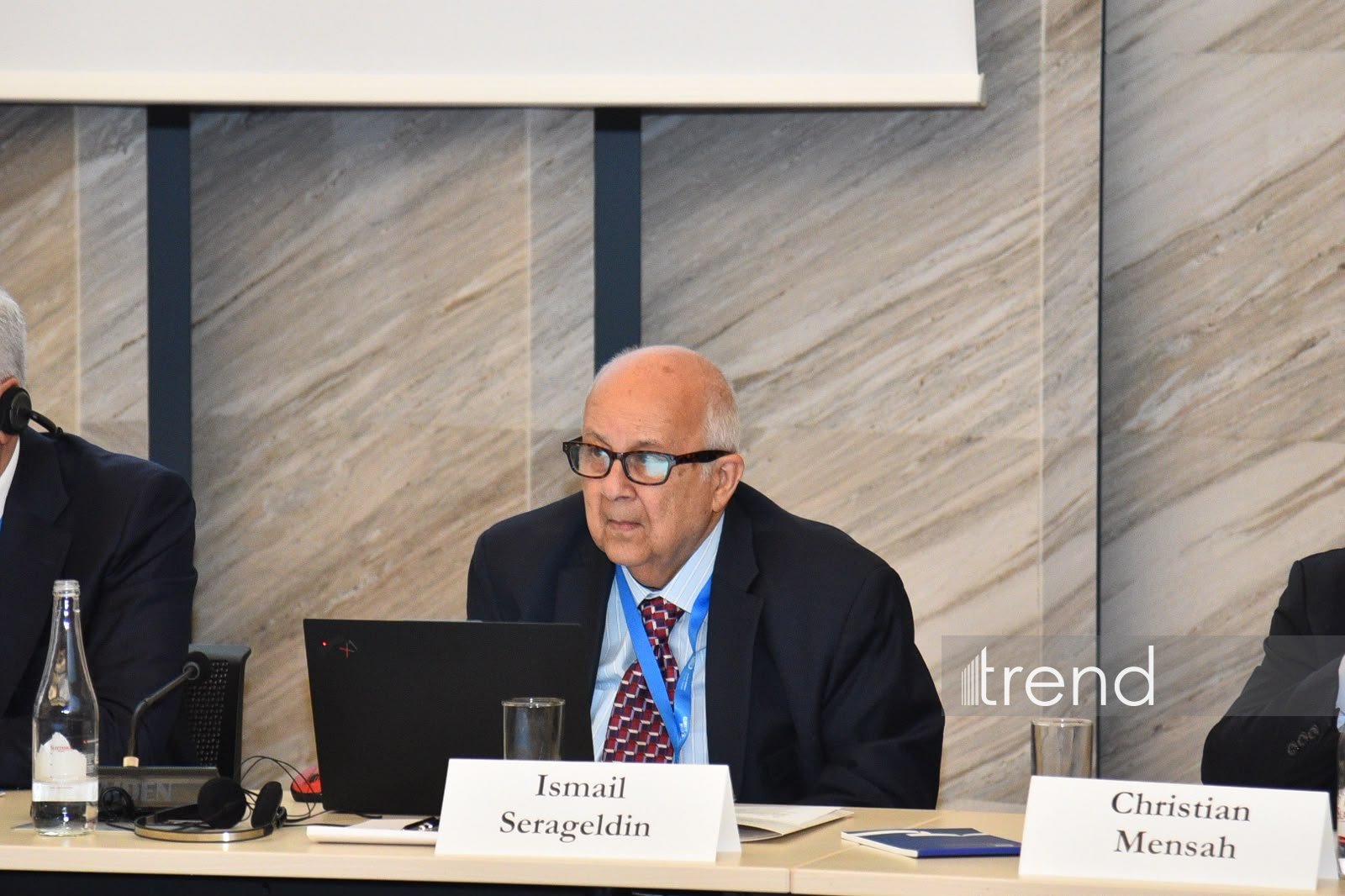
BAKU, Azerbaijan, September 9. There is no shortage of capital for financing climate action on a global scale, the main problem is to direct the available funds to specific, developed and attractive projects for investment, Co-Chairman of the Board of Trustees of the Nizami Ganjavi International Center, former Vice President of the World Bank, Ismail Serageldin, said during the 2026 Baku Climate Action Week (BCAW 2026), Trend's correspondent reports from the event.
According to him, in recent years, the main discussions on financing climate action have been based on the provision of financial assistance by developed countries to developing countries.
"We always say that we need $ 3 trillion a year. But the main issue is that there is no shortage of capital. In 2026, for the first time, the volume of funds under private management exceeded $ 500 trillion," Serageldin noted.
He pointed out that the amount of funds allocated by developed countries as part of official development assistance is about $200 billion, and increasing this amount 10 times to $2 trillion is not a realistic target.
"However, if we say that we want to attract $3 trillion a year from the $480-500 trillion capital managed by the private sector, this is already becoming a realistic and feasible target," he emphasized.
According to Serageldin, the main difficulty is the lack of ready-made projects for making investment decisions.
"In order to make investment decisions, the project must be fully ready. For example, if I went to Niger and allocated $1 billion to increase climate resilience, what would you do? The projects have not been identified, prepared, and assessed," he explained.
He also noted that international financial institutions, multilateral banks, and various UN agencies can play an important role in this direction.
"International financial institutions and multilateral banks, as well as UN agencies, including FAO in the field of agriculture, WHO in the field of health, and other organizations, can help countries develop projects. Then, by combining these projects into a single system, we can turn the financial gap into a new reality," Serageldin noted.
According to him, this requires not only requesting additional funding, but also changing institutional structures.
Serageldin said that $3 trillion per year is approximately 1/10 of the total savings generated annually on a global scale.
"Given the nearly $500 trillion already under management, this is not an impossible goal. It's possible to direct these funds to investment to transform the world economy in the desired direction, especially in poorer countries," he added.
The third day of the Baku Climate Action Week 2026 (BCAW 2026) is underway.
The program of the third day will focus on issues such as the transition from climate commitments to concrete action, climate financing, youth participation in climate processes, artificial intelligence and climate technologies, energy efficiency, methane emissions reduction, water resources management, and cultural heritage protection.
Representatives of governments and international organizations, experts, financial institutions, the private sector, and civil society from various countries are attending the events.
Now in its third year, Baku Climate Action Week is being held in parallel with the UN Framework Convention on Climate Change (UNFCCC) Climate Week for the first time this year. The Fourth Climate Week and Baku Climate Action Week will feature a series of sessions, panel discussions and other events on climate change, climate finance, sustainable development and accelerating climate action.
BCAW 2026 will continue until September 11.



