


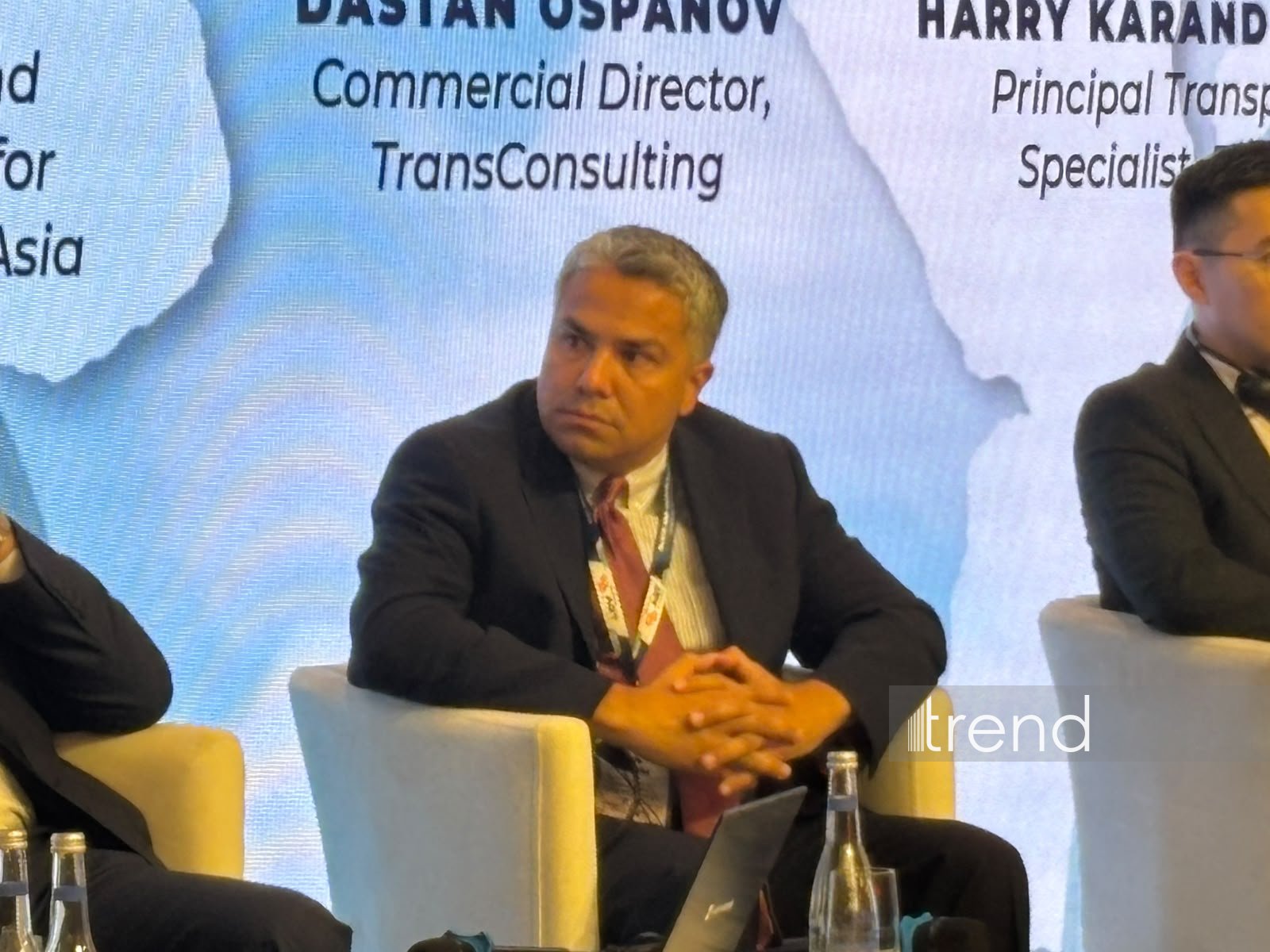

BAKU, Azerbaijan, September 8. The World Bank is preparing to publish a second report on the Middle Corridor, which will cover all nine countries participating in the Trans-Caspian Transport Corridor, on September 27, Senior Transport and Logistics Specialist for Europe and Central Asia at the World Bank, Luis Blancas, said during the 5th International Forum on Freight Transport in the Black and Caspian Regions – 2026 in Baku, Trend's correspondent reports from the event.
According to him, the World Bank's first report on the Middle Corridor was prepared in 2023. He noted that the report covered only three countries along the corridor and wasn't enough comprehensive.
"We are currently preparing a new flagship report, which will build on the previous one. It will be published on September 27," Blancas said.
He noted that the new report covers all nine countries participating in the Middle Corridor, as well as all types of cargo, infrastructure, service provision, cross-border cooperation, trade facilitation, and the economic impact of the corridor.
“This is a truly comprehensive report,” he said.
According to Blancas, the first event to present the report is scheduled for October 1 in Tbilisi. He noted that the event will be broadcast live, and its recording will be available later.
“We will also conduct additional presentations of results in other parts of the corridor, likely in Astana, Türkiye nd possibly other parts of the region, including Baku,” he said.
Blancas pointed out that the World Bank report identified 16 of the most important, critical and urgent issues related to the development of the corridor.
"Their total estimated cost is about $25 billion. The good news is that most of them are already being implemented. Of this $25 billion, investments worth more than three-quarters are already underway," he said.
As one example, he cited the project to create an alternative crossing of the Bosphorus in Istanbul, which, according to him, is important for the development of the Turkish branch of the TSTC.
"The World Bank is the leading financing institution, but far from the only one. Many of our partners are also involved in financing: the ADB, the EBRD, the Asian Infrastructure Investment Bank, and the Islamic Development Bank," he said.
According to Blancas, the volume of this operation is $8.2 billion.
He also noted the need to modernize the 660-kilometer railway line between Divrigi and the Georgian border.
"The most constrained section along the entire Middle Corridor—from the border of China and Kazakhstan to the border of Türkiye and Bulgaria—is the railway line from Divrigi to the Georgian border," he said.
According to him, this line is currently being reconstructed and modernized with funding from the World Bank, the Asian Infrastructure Investment Bank, and the Islamic Development Bank. The transaction volume is $1.2 billion.
Blancas cited the throughput capacity of Georgia's seaports as another example.
"Poti has practically reached its technical limit: the container terminal's utilization rate is 98%.
The Georgian government is developing the port of Anaklia, in which the World Bank and the Asian Development Bank will participate. These factors compel us to prioritize investments. This is only the first and certainly necessary step, although far from sufficient. First and foremost, we need to create capacity to handle cargo flows," Blancas added.
The Middle Corridor is a transport and trade route connecting Asia and Europe, passing through several countries in the region. It serves as an alternative to the traditional Northern and Southern Corridors.
The route begins in China and passes through Central Asian countries such as Kazakhstan, Uzbekistan, and Turkmenistan, reaching Europe via the Caspian Sea, Azerbaijan, Georgia, and Türkiye. The Middle Corridor offers a land route connecting East Asia, including China, with Europe, bypassing the longer sea routes.



