


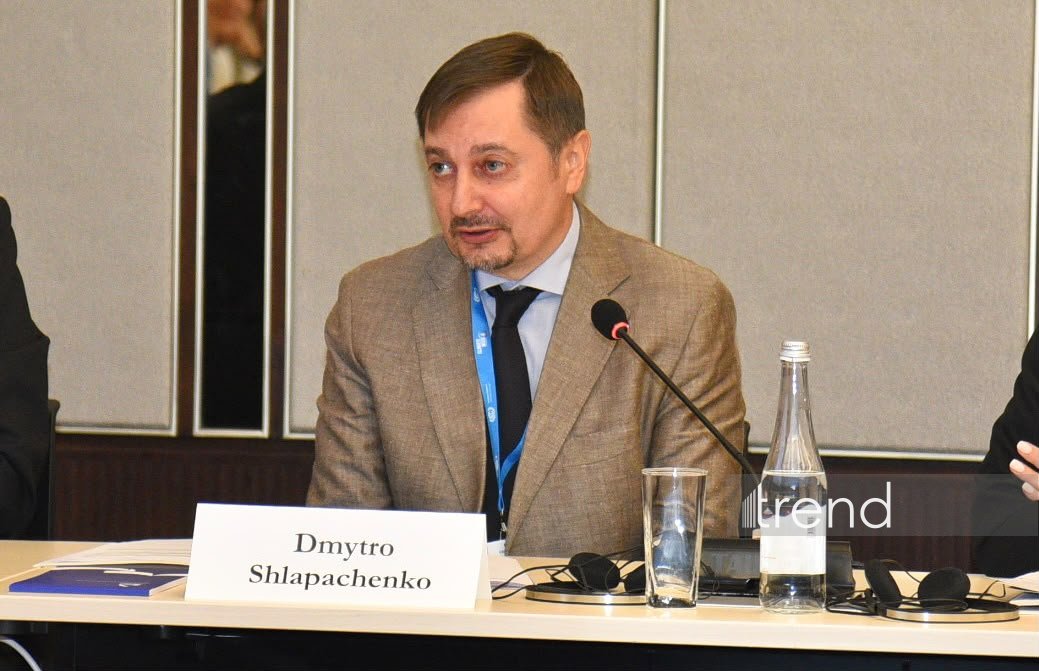
BAKU, Azerbaijan, September 9. Azerbaijan shows how climate leadership can create dynamics at a global level, UN Resident Coordinator in Azerbaijan, Dmytro Shlapachenko, said during the 2026 Baku Climate Action Week (BCAW 2026), Trend's correspondent reports from the event.
According to him, Azerbaijan's hosting of COP29 has put the country at the center of global climate diplomacy, and this momentum is being continued within the framework of the Baku Climate Action Week.
"We have witnessed how climate leadership in Azerbaijan can create momentum. COP29 has put the country at the center of global climate diplomacy, and this momentum is being continued through the Baku Climate Action Week, as well as broader efforts to promote sustainable development and climate action," said Shlapachenko.
The UN official noted that the main issue now is to translate the achieved momentum into concrete and measurable results.
"The main challenge facing us on a global scale is to translate the momentum that we have all created into measurable results," he stressed.
Shlapachenko said that in the second decade of the Paris Agreement, the main issue is not only the adoption of new climate commitments, but also the acceleration of their implementation.
"The world has made significant progress over the past decade. Climate action has moved from the margins to the center of global policy discussions. Renewable energy is expanding at an unprecedented pace, awareness is growing, and countries continue to demonstrate their commitment to the goals of the Paris Agreement, but science shows that we are not moving fast enough," he said.
According to him, the increased likelihood of exceeding the 1.5°C limit should not lead to a postponement of climate action.
"On the contrary, it should strengthen our resolve. Our collective responsibility is to limit the scale and duration of temperature increase exceeding the 1.5°C limit, return global temperatures below this limit as soon as possible, and avoid irreversible tipping points," Shlapachenko emphasized.
The UN official noted that the main directions of climate action are reducing emissions, strengthening adaptation and resilience to climate change, as well as ensuring access to affordable finance for developing countries.
He said that reducing the cost of capital, mobilizing private investment, and strengthening multilateral development banks are essential for developing countries to achieve ambitious climate goals.
"After COP31, climate leadership will not be measured by the promises we make. It will be measured by the emissions we reduce, the resilience we create, the finance we mobilize, and the people and their livelihoods we protect," added Shlapachenko.
The third day of the Baku Climate Action Week 2026 (BCAW 2026) is underway.
The program of the third day will focus on issues such as the transition from climate commitments to concrete action, climate financing, youth participation in climate processes, artificial intelligence and climate technologies, energy efficiency, methane emissions reduction, water resources management, and cultural heritage protection.
Representatives of governments and international organizations, experts, financial institutions, the private sector, and civil society from various countries are attending the events.
Now in its third year, Baku Climate Action Week is being held in parallel with the UN Framework Convention on Climate Change (UNFCCC) Climate Week for the first time this year. The Fourth Climate Week and Baku Climate Action Week will feature a series of sessions, panel discussions and other events on climate change, climate finance, sustainable development and accelerating climate action.
BCAW 2026 will continue until September 11.



