


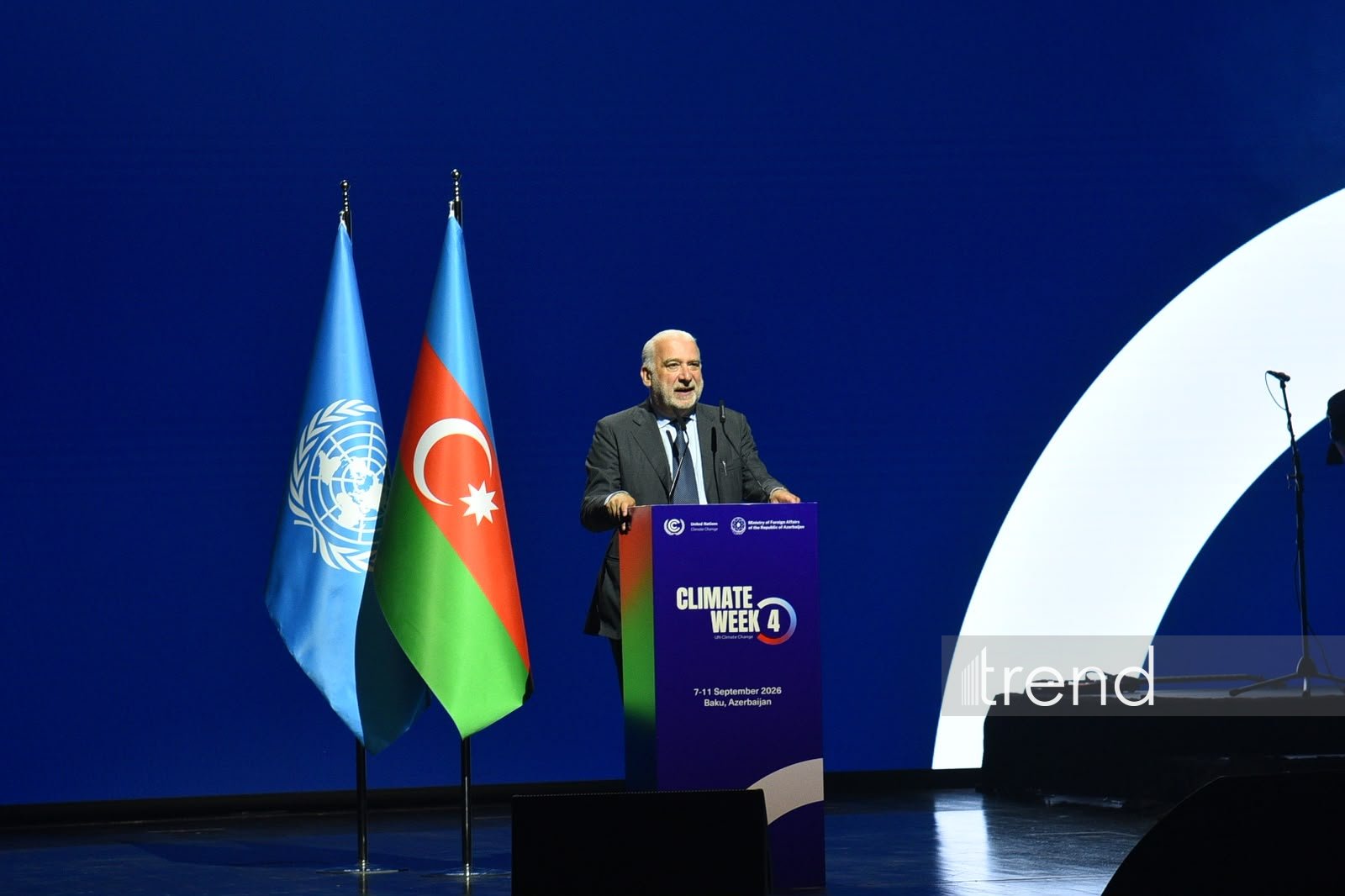
BAKU, Azerbaijan, September 9. Solutions to combat climate change exist, and the challenge now is to accelerate their implementation, identify the obstacles to action, and find practical ways to overcome them, Senior Director of the Programmes Coordination at the United Nations Framework Convention on Climate Change (UNFCCC), Daniele Violetti, said during the official opening ceremony of the 4th Climate Week in Baku, Trend's correspondent reports from the event.
He noted that the UN climate process is currently at a stage of significant progress.
"The COP29 presidency presented the new Collectively Quantified Climate Finance Target (NCQG) and finalized the rules for international carbon markets under Article 6 of the Paris Agreement. These decisions will open up new financial flows for developing countries and allow them to achieve their emission reduction targets more efficiently," Violetti pointed out.
The UNFCCC official stressed the importance of coming together again for Climate Week in Baku and thanked Azerbaijan for its hospitality.
"We thank Azerbaijan for its warm hospitality and its continued commitment to rally the world around practical climate solutions," he said.
Violetti noted that the midpoint of Climate Week has already been reached and various discussions, including the Presidency Guidelines on the "Road to Antalya", are ongoing.
According to him, climate negotiations and the global climate action agenda are separate but parallel processes.
"They complement each other: the negotiations provide the international framework that allows for action, while the action agenda strengthens the implementation of these decisions through practical and scalable solutions. This week is where that complementarity comes into play," Violetti emphasized.
He said that the implementation labs held within the framework of Climate Week are discussing the issues of attracting climate finance for agriculture, decarbonizing the heavy industry and construction sectors, as well as making risky projects more attractive and scalable for investment.
"Our task now is to accelerate such implementation, identify the reasons that hinder action and find practical ways to remove these obstacles," he said.
Violetti noted that governments cannot carry out this process alone.
"Business, the financial sector, cities and civil society are important partners in this process," the UNFCCC official emphasized.
He said that the targets set for the main directions of the global climate action agenda form the basis of future climate action.
"The incoming Turkish presidency of COP31, in close cooperation with the Australian presidency of the COP31 negotiations, has identified key targets that will unite everyone," Violetti said.
According to him, these targets include increasing the share of electricity in final energy demand to 35% by 2035, halving the growth of global emissions, and reducing the energy intensity of the construction sector by 25%.
Violetti noted that sessions on electrification, the circular economy and climate-positive buildings held during Baku Climate Week are helping to shape action in this direction.
“We saw how this connection works at the last Climate Week in Incheon. Real-world solutions are now available on the Climate Week website for all to benefit from,” he added.
The UNFCCC official said that, along with the results emerging in Baku, these experiences show that implementation is moving forward.
“However, we need to step up the pace and scale up our ambition. Let us focus in the coming days on connections that lead to concrete results, partnerships that mobilize investments and translate parties’ NDCs (Nationally Determined Contributions) and NAPs (National Adaptation Plans) into tangible results,” Violetti urged.
He added that this dynamic should continue from Fiji to the Pre-COP meetings in Tuvalu and until COP31 in Antalya, where the second Global Stocktaking will officially begin.
"Let's connect our process to the real economy and fully align it with the goals of the Paris Agreement," stressed Violetti.



