


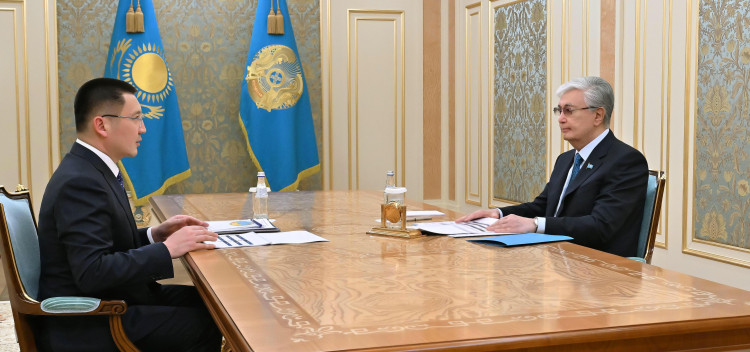

ASTANA, Kazakhstan, April 8. Pavlodar region's
economy grew across all key sectors in 2024, with its Gross
Regional Product rising by 5.8 percent and investments reaching a
record high of 1.1 trillion tenge (approximately $2.09 billion),
marking a 38 percent increase, said regional Governor Asain
Baykhanov during a meeting with the President of Kazakhstan,
Trend reports.
The President of Kazakhstan, Kassym-Jomart Tokayev, was briefed on
the results of the region’s socio-economic development in 2024 and
its plans for the upcoming period.
Tokayev was updated on the progress of two major projects: one focused on processing gold-containing concentrate, and the other on producing ferroalloys.
“ Three ferroalloy plants with a total capacity of 460,000 tons are planned to be built in Ekibastuz. Once operational, these plants will position Kazakhstan as the second-largest producer of ferroalloys in the world,” the press service of the President reported.
Kassym-Jomart Tokayev was also informed about the consistent fulfillment of social commitments.
“Over 30,000 new jobs have been created in the region. Forty new social facilities have been launched, and 83 others have been modernized. Three additional education centers, schools for 1,800 students, three schools replacing outdated buildings, and 26 renovated educational institutions have been completed,” said Asain Baykhanov.
The Akim also noted that, for the first time in 20 years, the wear and tear of heating networks has been reduced by 1.3 percent. Additionally, 80 percent of public transportation has been updated, with 230 new buses delivered. Thanks to a loan from the European Bank for Reconstruction and Development, the tram fleet is being renewed, with the first 25 new trams expected to be delivered in September.
The President stressed the importance of continuing efforts to attract investments and ensuring the effective and timely execution of the national “Comfortable School” project.
Following the meeting, Kassym-Jomart Tokayev issued several directives aimed at further diversifying the region’s economy, developing its social sector, modernizing infrastructure, and preparing for the upcoming spring agricultural season.



