


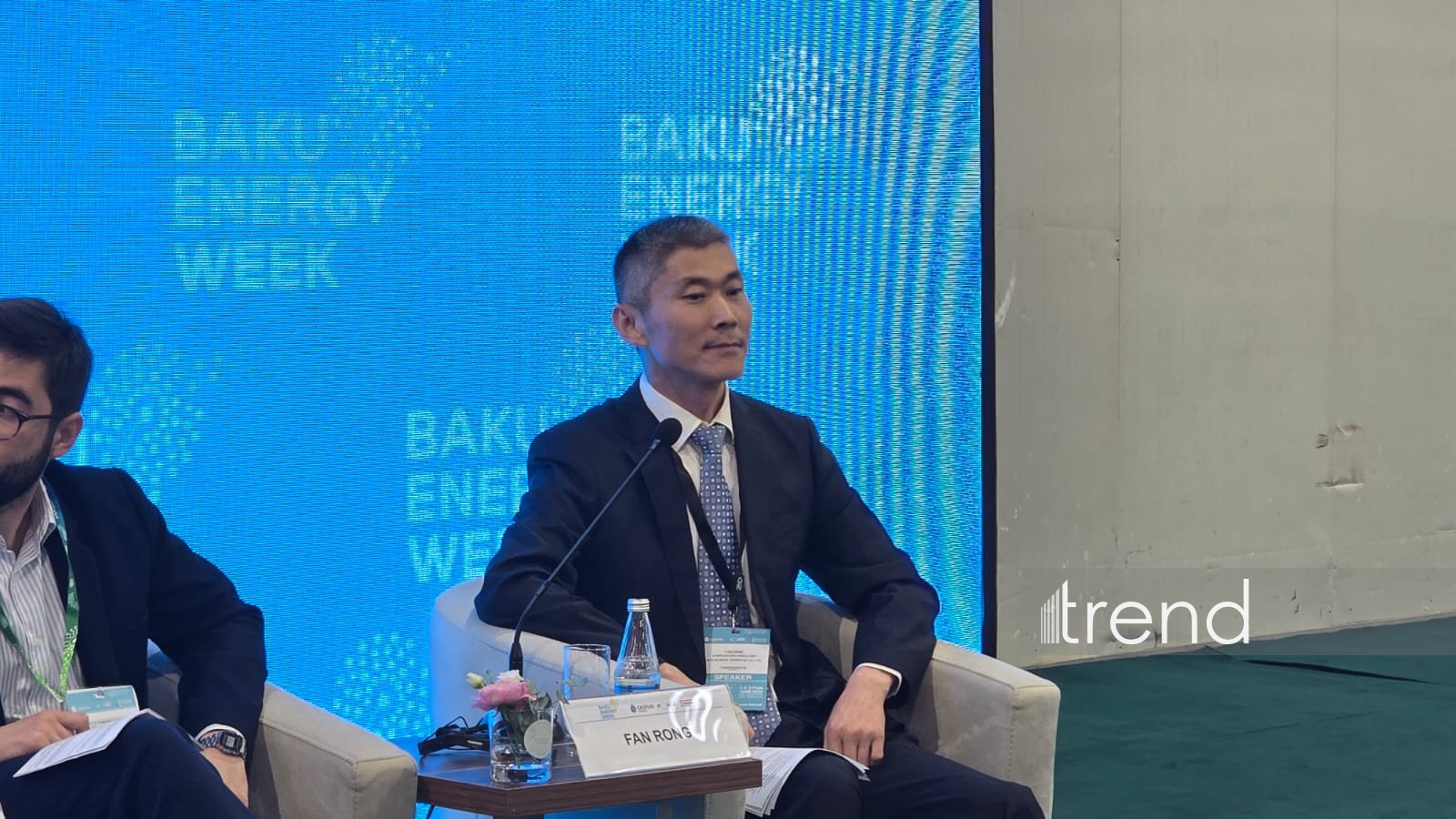

BAKU, Azerbaijan, June 1. Artificial intelligence helps fill gaps in seismic data, a consultant on the application of artificial intelligence at Kunlun Digital Technology CO, Fan Rong said, Trend reports.
He made the remark during a panel discussion held within the framework of the 31st International Caspian Oil and Gas Exhibition in Baku today, Trend reports.
According to him, the main feature of modern AI-based systems is that they are built on an “AI-oriented” approach, that is, an approach focused on artificial intelligence.
Fan Rong added that artificial intelligence opens up new opportunities in the oil and gas industry in terms of decision-making, data analysis, and operational automation.
“In such systems, the architecture and processes are designed from the outset with the capabilities of artificial intelligence in mind. This approach allows the systems to make autonomous decisions, perform self-management functions, and operate on a closed-loop principle. At the same time, these solutions can be integrated into existing systems as additional tools,” he said.
Furthermore, Fan Jun noted that Kunlun Digital, a subsidiary of CNPC, is one of the key players in the digital transformation of the oil and gas industry and plays an important role in implementing the “Digital Oil China” concept.
According to him, the company’s AI strategy is based on three key areas: close integration with business processes, the combined use of large and small language models, and the creation of intelligent agents.
“The most important issue is tailoring AI-based solutions directly to the needs of the oil and gas industry. Intelligent agents, created through the collaboration of large and small models, enable more effective management of operations,” he emphasized.
In addition, Fan Rong cited a seismic data reconstruction project as an example.
“Seismic data can be viewed as a CT scan of the Earth. For various reasons, gaps appear in historical databases. The AI-based solution we developed allows us to reconstruct this missing data. For example, AI was used to reconstruct a 5-kilometer gap in the data, and the results demonstrated a high degree of correspondence with real data,” he added.



