


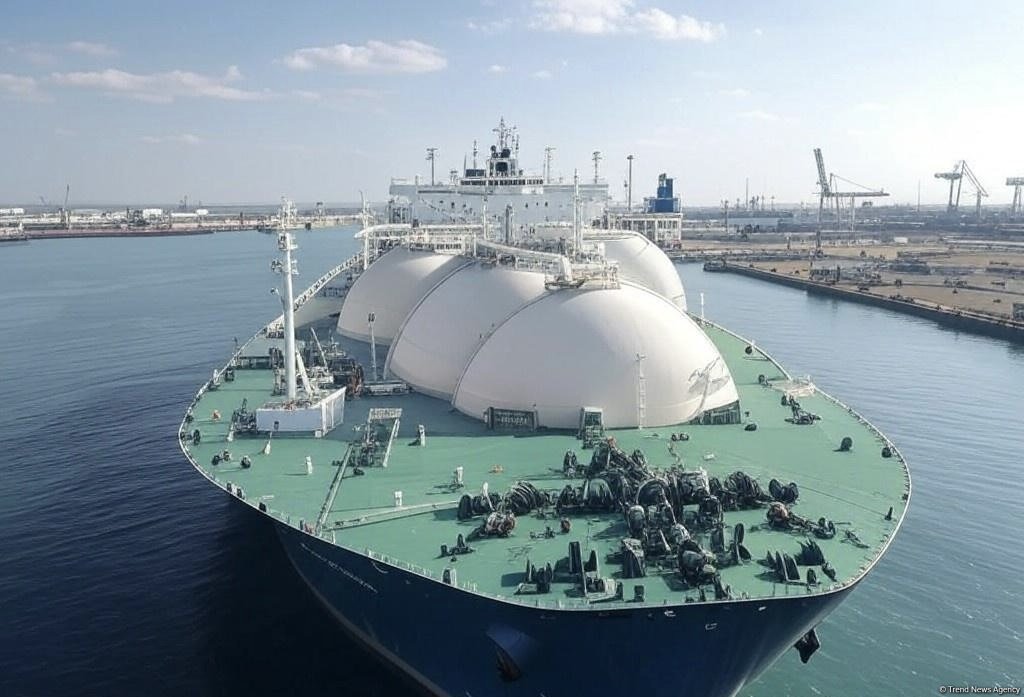

BAKU, Azerbaijan, November 16. Global liquefied natural gas (LNG) trade is set for significant growth over the next decade, driven by rising demand in Asia, the United States’ flexible exports, and expanded Middle Eastern capacity, the International Energy Agency (IEA) said in its latest outlook, Trend reports.
In 2024, around 1,100 billion cubic meters (bcm) of natural gas were traded over long distances, split between 45% via pipelines and 55% as LNG. Total LNG trade is expected to grow from 560 bcm in 2024 to 880 bcm by 2035 under the IEA’s Stated Policies Scenario (CPS), with more than 70% of exports destined for Asia. Europe’s LNG imports rise by 80 bcm over the period, while Asian imports climb 240 bcm.
China, which imported over 100 bcm of LNG in 2024 alongside 80 bcm by pipeline, saw LNG imports drop early in 2025 due to high prices and robust domestic production. In the CPS, LNG imports rise by 75 bcm to 2035, while pipeline imports increase by 40 bcm, mainly from Russia and Central Asia. Southeast Asia’s LNG imports grow from 35 bcm in 2024 to 80 bcm by 2035, supported by an additional 50 bcm per year of regasification capacity. India’s LNG imports rise from 35 bcm to 50 bcm, while other emerging Asian markets, including Pakistan and Bangladesh, see a 60% increase to around 75 bcm. Japan and Korea remain fully dependent on LNG, with combined imports rising roughly 10 bcm to 2035.
The United States remains the world’s largest LNG exporter, delivering 120 bcm in 2024 and expanding capacity to more than 250 bcm by 2035, half of which is shipped to Asia. Qatar leads Middle Eastern growth, doubling LNG exports to 260 bcm by 2035, while the UAE’s Ruwais complex adds over 10 bcm of capacity by 2028.
Russia doubles gas exports to China from 40 bcm in 2024 to 80 bcm by 2035 via the Power of Siberia I and II pipelines and also increases exports to the Caspian region. However, annual LNG exports remain near current levels at around 50 bcm, and net income from gas exports remains below 2021 levels despite finding alternative outlets following disruptions to European markets.


