


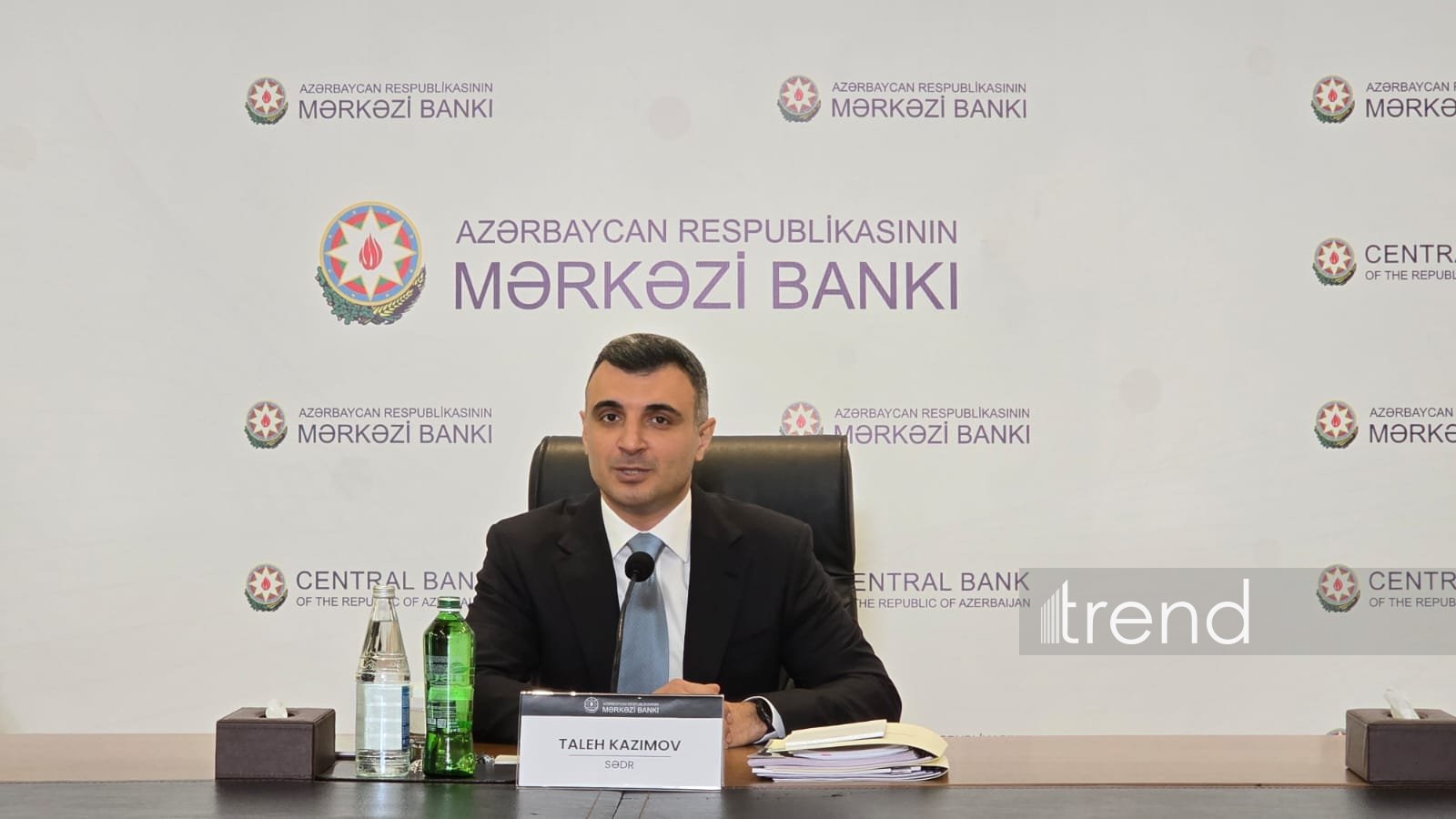

BAKU, Azerbaijan, November 16. Azerbaijani banks have 4.6 billion manats ($2.7 billion) in available funds that can be channeled into financing the real sector after meeting all mandatory reserve and prudential liquidity requirements, Governor of the Central Bank of Azerbaijan (CBA) Taleh Kazimov said during discussion of the draft law "On the state budget of the Republic of Azerbaijan for 2027" in its first reading at plenary session of the parliament today, Trend’s correspondent reports from the event.
He remarked that despite operating amid excess structural liquidity in Azerbaijan's banking sector, financial stability has been maintained.
According to him, the banking sector's excess liquidity has increased 2.2-fold since the beginning of the year.
Kazimov noted that, based on the results of the first 10 months of this year, the banking sector's total capital adequacy ratio stood at 16.5%, while the liquidity coverage ratio reached 153%, compared to the regulatory minimum of 100%.
He noted that the share of problem loans, which characterizes the quality of the loan portfolio, stood at 2.7%, representing a satisfactory level.
According to the CBA chairman, banks' total loan portfolio increased by 14% over the 10 months, while business loans grew by 17.1%. Compared to the end of 2021, both the total loan portfolio and business lending doubled.
Kazimov also noted positive trends on the liability side of banks' balance sheets, saying that individuals' deposits increased by 14.6% in the first 10 months of this year, while term deposits grew by 16.4%.
"Compared to 2021, we have seen a twofold increase in both the volume of deposits and the number of unique depositors," he emphasized.
Kazimov also highlighted continued positive trends in the insurance and capital markets.
He said that insurance premiums increased by 8% in the first nine months of 2026, while insurance payouts rose by 29%. Over the past five years, the insurance market has doubled in size. Voluntary insurance classes accounted for 80% of insurance premiums, while life insurance represented 56%.
Addressing capital markets, the CBA chairman noted that the total turnover of the securities market had reached 35 billion manats ($20.6 billion). In the first 10 months of this year, stock market turnover increased ninefold to 2.6 billion manats ($1.5 billion).
According to him, the second public share offering in the history of Azerbaijan was also successfully executed this year. Financial institutions, specifically banks, served as the primary organizers for both public share offerings carried out over the past two years.
Kazimov stated that the CBA holds a positive view of the draft state budget for 2027 and supports the proposed plan.
He attributed this stance to several key factors.
"First and foremost, we view the coverage of current expenditures through non-oil and gas revenues as a positive development. This allows current spending to be financed via sustainable financial sources," the CBA governor noted.
He added that reducing transfers from the State Oil Fund of Azerbaijan helps ensure the long-term sustainability of strategic foreign exchange reserves. Furthermore, an increase in the share of non-oil revenues within the state budget's total income is significant for reducing the economy's dependence on the oil sector.
Kazimov also emphasized that the CBA has analyzed the impact of budget expenditures on inflation.
"Our analyses indicate that current expenditures have an impact of 0.34 percentage points on inflation. We do not consider this to be a significant impact. Meanwhile, the impact of capital expenditures on inflation is neutral," he noted.
Pointing out that close coordination between fiscal and monetary policies has developed in recent years, the CBA governor expressed hope that this cooperation would continue in the coming years, further contributing to macroeconomic stability.
Kazimov also addressed the priorities for monetary policy for 2027.
He said that price stability remains the Central Bank's primary objective, and that the institution intends to utilize all tools at its disposal to ensure exchange rate stability.
"Price stability is our main goal. We will employ all available instruments to ensure exchange rate stability, which serves as the primary anchor for monetary policy," he emphasized.
The CBA chief mentioned that the implementation rate of the financial sector development strategy for 2024–2026 currently stands at 91%, with completion of the document's implementation expected by the end of the year.
According to him, a new financial sector development strategy covering the years 2027–2030 is currently being drafted. This new strategy will prioritize two main directions.
The first direction focuses on the development of the financial sector, specifically expanding the financing of the real sector, advancing digitalization, implementing innovative solutions, and increasing both the accessibility and reach of financial services.
The second key direction involves refining regulatory and supervisory policies, thereby strengthening the resilience of the financial sector.
Kazimov pointed out that the primary objective of the new strategy will be to both enhance the financial sector's role in financing the economy and further solidify the sector's resilience.



