


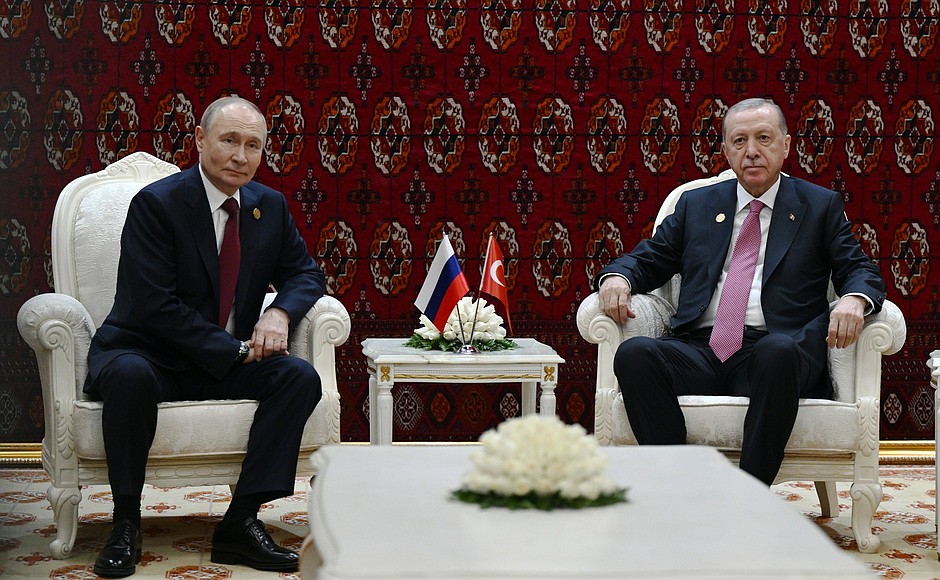
BAKU, Azerbaijan, December 12. Russia and Türkiye discussed progress on their key bilateral projects with particular focus on the construction of the Akkuyu Nuclear Power Plant, Trend reports via the press service of the Russian President.
The discussions took place during an expanded-format meeting between Russian President Vladimir Putin and Turkish President Recep Tayyip Erdoğan, held on the sidelines of the International Forum of Neutrality in Turkmenistan.
A central topic of the dialogue was the Akkuyu Nuclear Power Plant project, the largest bilateral energy initiative between Russia and Türkiye, and Türkiye's first nuclear power facility. The sides reaffirmed their commitment to advancing the remaining stages of the project, underscoring its significance for Turkey's long-term energy security.
The agenda also encompassed a comprehensive review of ongoing economic cooperation, including initiatives in transportation, industry, and the energy sector, all of which continue to progress despite a challenging global context. Officials highlighted that the diverse nature of Russian-Turkish collaboration has played a key role in ensuring stability in trade flows and investment activities.
Furthermore, Putin and Erdoğan exchanged perspectives on regional and international issues, while reaffirming that practical economic cooperation, anchored by flagship projects such as Akkuyu, remains a strategic priority for both nations.
The Akkuyu Nuclear Power Plant (NPP) stands as the cornerstone of the energy partnership between Türkiye and Russia. Located in the southern province of Mersin, the facility represents a substantial investment, estimated between $20 billion and $25 billion. The plant will feature four VVER-1200 Generation III+ reactors, collectively designed to deliver a total capacity of 4,800 MW, with each unit providing 1,200 MWe. Upon its completion, with the first unit scheduled for operation in 2026, the NPP is projected to supply approximately 10% of Türkiye's total electricity demand, significantly diminishing the nation’s dependence on imported natural gas and oil. This transition is expected to reduce Türkiye’s annual natural gas import costs by approximately $1.5 billion.
Developed under the Build-Own-Operate (BOO) model, the project is spearheaded by a subsidiary of Russia’s state-owned Rosatom, which bears the responsibility for the full spectrum of investment, construction, and operation.



