


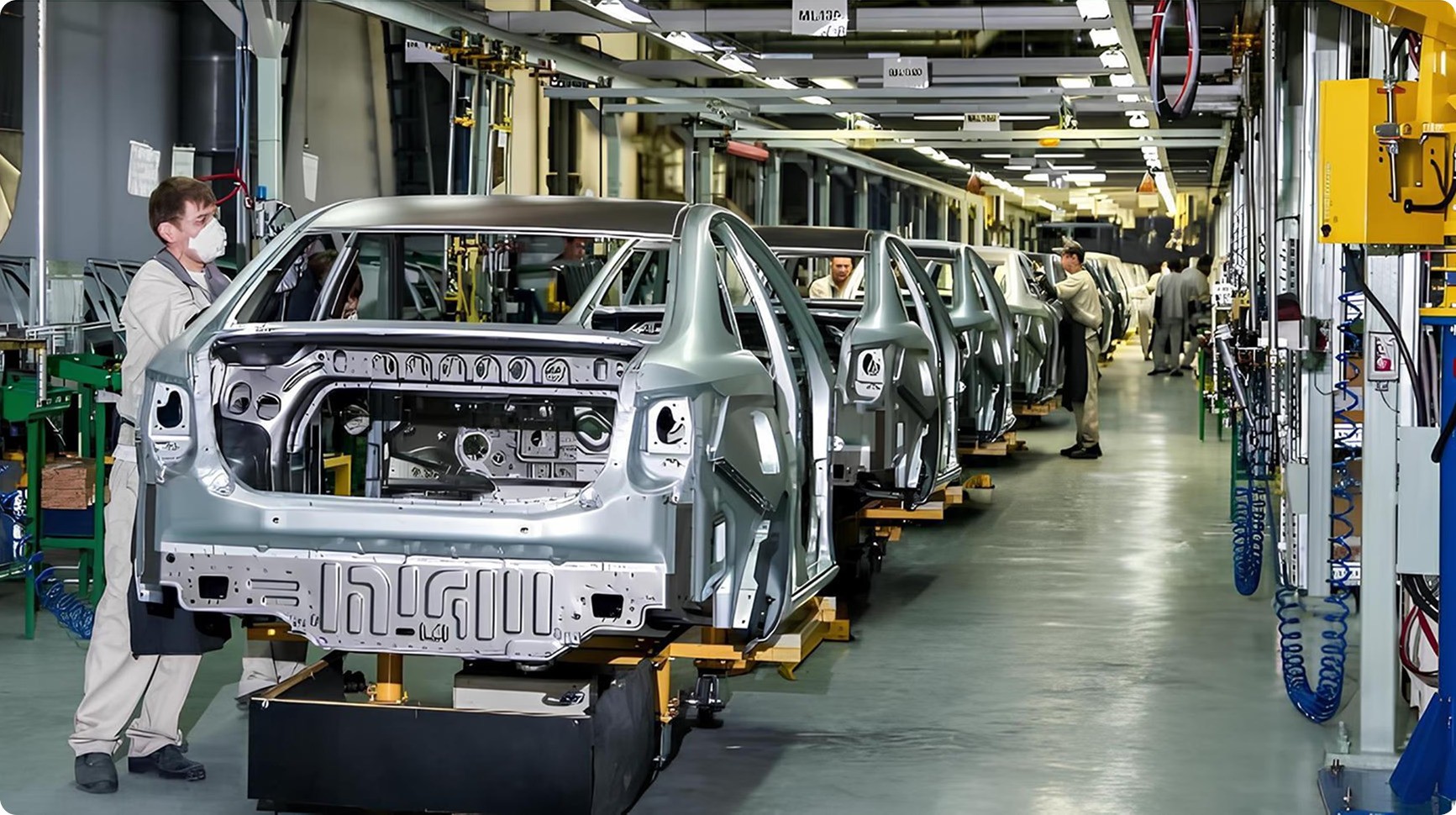

BAKU, Azerbaijan, July 3. Türkiye’s manufacturing sector rolled out 1,216,140 automobiles in 2025.
This is reflected in the annual PRODCOM statistics released by the Turkish Statistical Institute (TÜİK).
The official data outlines production volumes across several primary consumer goods and industrial segments for the fiscal year.
According to the report, manufacturing output for the year included 8,329,500 domestic refrigerators and freezers, alongside 334.02 million tons of ready-mixed concrete. The country's industrial facilities also produced 1,266,183 hermetic gas boilers, 9,557,361 tons of detergent and washing preparations, and 774,970 motorcycles.
TÜİK also provided a regional breakdown of the industrial sales performance, highlighting a heavy concentration of manufacturing centers in specific industrial zones.
The statistics reveal that 83.1% of total sales in the manufacture of motor vehicles, trailers, and semi-trailers were concentrated in just five provinces. Kocaeli took the largest individual share, accounting for 34% of production sales, closely followed by Bursa at 29.8%. Sakarya generated 11.8% of the sector's sales, while Aksaray and İzmir contributed 3.9% and 3.6%, respectively.
Trend's analysis shows that the sector is also undergoing a structural shift toward electrification. As of 2025, nearly 18% of new car sales in Türkiye were electric, placing the country fourth in Europe by EV sales share. In early 2025, EV and hybrid vehicle sales were outpacing internal combustion engine models in monthly growth rates, with EVs up 56–80% year-on-year in January and February 2025, while gasoline vehicle sales declined 32-34%. This shift has implications for the production geography mapped in the TÜİK data: Kocaeli hosts the Togg electric vehicle plant in Gemlik, meaning the province's already-dominant 34% share is likely to grow further as domestic EV production scales.
The automotive corridor running through Kocaeli, Bursa, and Sakarya is also directly relevant to the Middle Corridor's role as a transit route for finished vehicles and components between Türkiye's production base and markets in Central Asia and the Caucasus. TCDD Taşımacılık - Türkiye's state railway freight operator - told Trend in an exclusive interview that Türkiye's strategic position in rail transit along the East-West axis is central to the corridor's competitiveness.
"Türkiye occupies a strategic position in rail transit along the East-West axis between Asia and Europe. Particularly within the scope of the Middle Corridor, Türkiye serves as an important logistical bridge connecting the South Caucasus, the Caspian Sea crossing, and Central Asia to European markets," the TCDD Taşımacılık said, adding that digitalization, data sharing, and harmonization of international transport documents are being treated as strategic elements to increase the corridor's competitiveness.



