


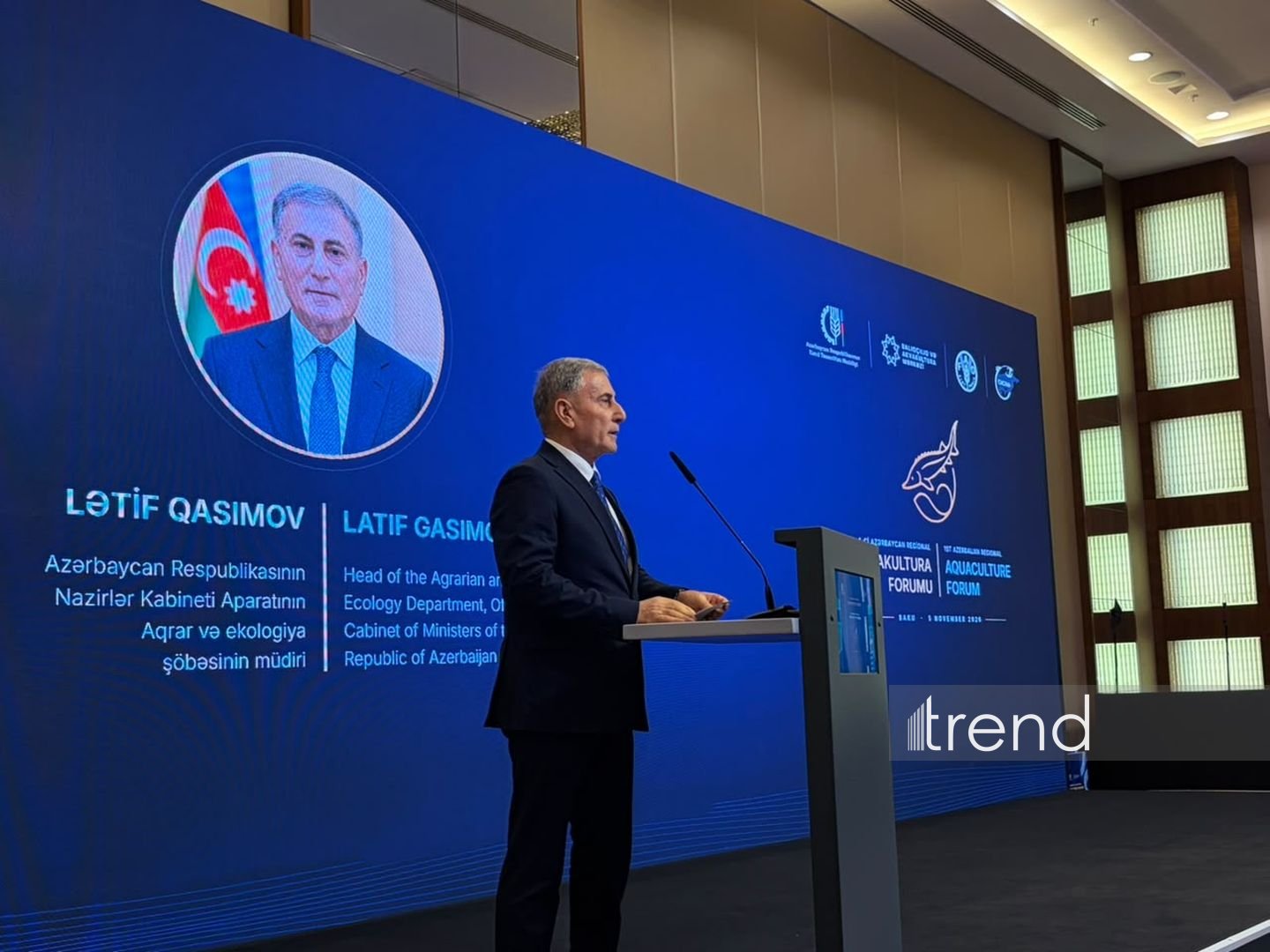

BAKU, Azerbaijan, November 5. The abundant and clean water resources of the Karabakh and East Zangezur economic regions create opportunities to establish sustainable aquaculture clusters while preserving the ecological balance in these areas, Head of the Agricultural and Ecology Department of the Cabinet of Ministers' Office Latif Gasimov said, Trend's correspondent reports from the event.
He made the remarks at the First Azerbaijan Regional Aquaculture Forum held in Baku on Thursday, November 5.
He said that the liberated territories are considered a priority area for establishing sustainable aquaculture clusters.
"Modern, high-tech facilities established in these areas could significantly expand not only our domestic market but also our regional export potential," Gasimov noted.
The department head emphasized that climate change and water scarcity require a shift toward climate-resilient aquaculture practices. In this regard, the introduction of artificial intelligence-based monitoring systems at aquaculture facilities is becoming increasingly important.
According to him, real-time monitoring of water temperature, oxygen levels and biochemical composition through digital sensors would help increase productivity while also making it possible to anticipate environmental risks.
Gasimov said that protecting and restoring native and endemic fish species in inland water bodies, particularly the valuable genetic resources of the Caspian basin, should remain a priority. The development of commercial aquaculture should reduce pressure on natural ecosystems and dependence on wild fish stocks.
He noted that the State Program for the Development of Agricultural, Fisheries and Aquaculture Production and Processing in the Republic of Azerbaijan for 2026–2030, approved by an order of President Ilham Aliyev dated May 25, 2026, serves as the main roadmap for the sector's development.
"Implementation of the State Program, the organization of fishing activities based on sustainable principles, the introduction of digital monitoring and tracking systems, and the expansion of fish-breeding activities will contribute to restoring aquatic biological resources, increasing productivity and establishing a sustainable development model," he added.
According to Gasimov, the establishment of the Fisheries and Aquaculture Center under the Ministry of Agriculture will help achieve the goals of the State Program by bringing state regulation and support mechanisms for producers together under a "one-stop shop" approach.
He also stressed that sustainable aquaculture clusters could create new opportunities for agritourism and ecotourism in the regions.


