


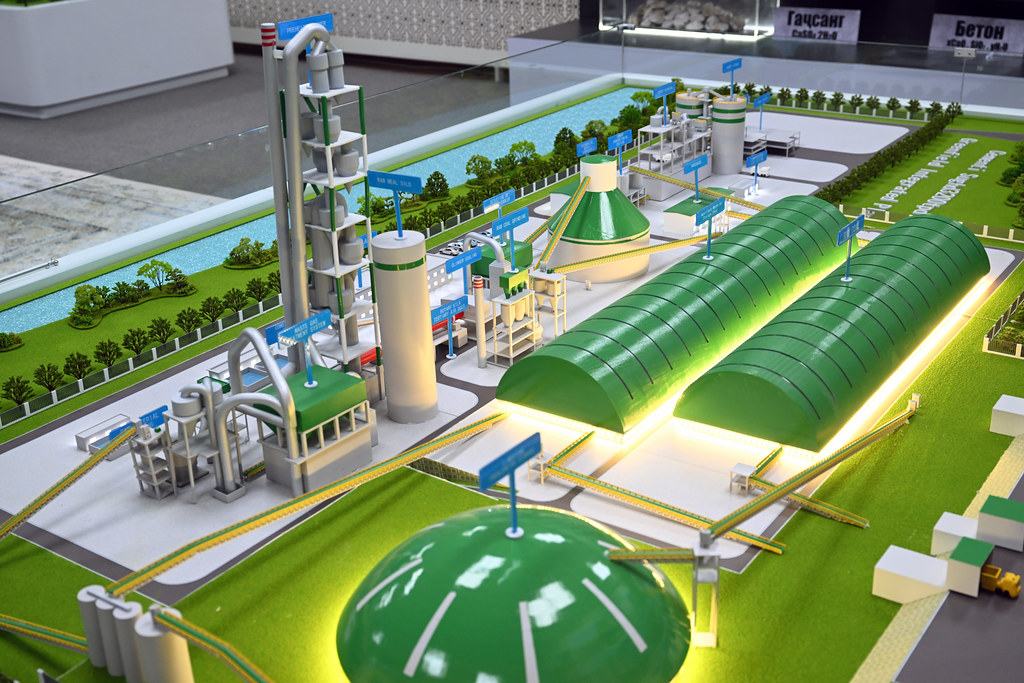

BAKU, Azerbaijan, July 11. Tajikistan has begun construction of a cement plant with an annual production capacity of 1.2 million tons.
This was reflected in a statement published by the press service of the Tajik president following Emomali Rahmon's working visit to the Sughd region on July 9.
"The cement plant will have an annual production capacity of 1.2 million tons, with the technological process covering the full production cycle from raw material grinding to finished product packaging," the statement said.
According to the information, engineering, equipment manufacturing, installation and commissioning will be carried out under a contract between Tajik Metallurgical Plant CJSC and China's SINOMA, a subsidiary of China National Building Materials Group.
The project is expected to employ more than 1,200 local workers during construction and create over 850 permanent jobs once the plant becomes operational, the report noted. The facility is expected to produce cement that meets international standards while complying with environmental requirements.
The government said the project is intended to increase domestic cement production, meet growing demand from the construction sector and ensure stable supplies to the local market at affordable prices.
Meanwhile, accelerated industrialization has been Tajikistan's fourth national development goal since 2018, when President Emomali Rahmon identified the expansion of manufacturing as a strategic priority. To support this objective, the country designated 2022-2026 as the "Years of Industrial Development," focusing on import substitution, job creation, and higher value-added production.
The policy has led to a steady increase in industrial output and the number of manufacturing enterprises. According to the Agency on Statistics under the President of Tajikistan, industrial production increased by 20% year-on-year. Over the past five years, total industrial output has nearly doubled, while more than 2,040 industrial enterprises and 74,000 jobs have been created nationwide. In 2024 alone, 740 new industrial enterprises were launched, generating around 20,000 jobs.
The sector is also expected to remain among the priorities for international development institutions. Against this backdrop, in an exclusive interview with Trend the European Bank for Reconstruction and Development (EBRD) approved its new Strategic and Capital Framework (SCF) for 2026-2030, outlining key priorities for the Bank’s activities in Central Asia and other regions.
According to Huseyin Ozhan, EBRD Managing Director for Central Asia and Mongolia, the framework is focused on three main areas: accelerating the green transition, strengthening economic governance, and developing human capital while promoting equal opportunities.
He noted that these priorities serve as the main guidelines for the EBRD’s operations in Central Asia. The Bank also develops individual country strategies for each state in the region in close cooperation with national authorities, with a focus on strengthening private sector competitiveness, creating jobs, improving skills, promoting inclusion, and supporting digital transformation.



